
Description
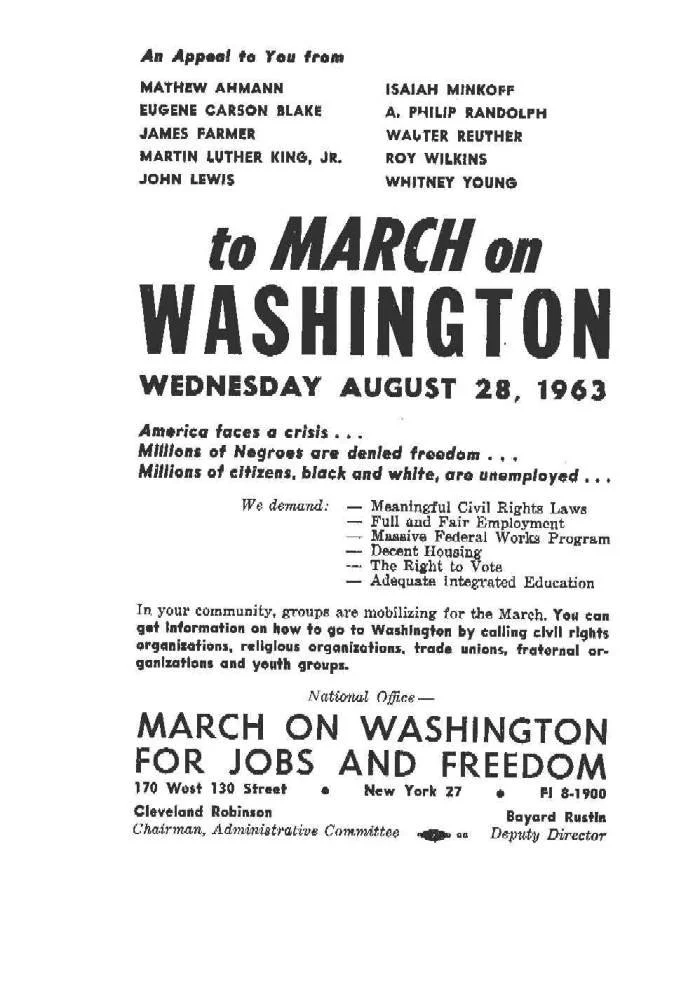
This historical mobilization leaflet, titled "An Appeal to You from... to MARCH on WASHINGTON," outlines the core platform and demands for the massive historic demonstration held on Wednesday, August 28, 1963. The document states that America faces a severe national crisis where millions of Black citizens are denied freedom and millions of workers, both Black and white, remain unemployed. It lists the primary economic and civil rights demands of the march: meaningful civil rights legislation, full and fair employment, a massive federal public works program, decent housing, the right to vote, and adequate integrated education.
The leaflet lists the prominent leaders of the "Big Six" civil rights organizations and major religious and labor figures who signed the appeal, including A. Philip Randolph, Dr. Martin Luther King Jr., John Lewis, James Farmer, Roy Wilkins, Whitney Young, Walter Reuther, Eugene Carson Blake, Mathew Ahmann, and Isaiah Minkoff. At the bottom, it designates the National Office located at 170 West 130th Street in Harlem, New York, listing Cleveland Robinson as the Chairman of the Administrative Committee and explicitly naming Bayard Rustin as the Deputy Director. It concludes with grassroots instructions directing local citizens to connect with civil rights groups, religious bodies, and trade unions to organize transportation to the capital.
Historical Context
The summer of 1963 was a turning point in the American civil rights movement, marked by intense national friction as grassroots activists faced violent resistance across the South and immense federal reluctance to enact sweeping change. Conceived primarily by labor leader A. Philip Randolph and executed through the organizational genius of Bayard Rustin, the March on Washington for Jobs and Freedom was designed to pressure the Kennedy administration and Congress into passing meaningful civil rights and economic legislation.
Despite his indispensable role as the chief organizer coordinating logistics for over 250,000 demonstrators, Rustin faced severe marginalization within the movement’s leadership. Due to pervasive mid-century homophobia and past political associations that opponents sought to weaponize as red-baiting scandals, figures like Roy Wilkins initially attempted to block Rustin from taking a public title, leading to Randolph appointing him officially as "Deputy Director" while running operations out of the Harlem headquarters. This leaflet stands as a vital artifact of that struggle, documenting the collaborative mobilization efforts required to execute a disciplined mass protest while capturing the hidden yet foundational leadership of Bayard Rustin.
The March on Washington was conceived during a pivotal moment when civil rights activism was gaining national attention but facing fierce Southern resistance and federal reluctance to act. Internal civil rights leadership struggled with questions or respectability politics, leading to Rustin's marginalization despite his unparalleled organizing skills. His sexuality and former communist associations made him vulnerable to attacks that could undermine the March's legitimacy in the eyes of mainstream America and political allies, forcing movement leaders to balance moral principles with strategic practicality in their fight for racial justice.
John F. Kennedy Presidential Library and Museum. Leaflet mobilizing activists for the March on Washington, 1963. https://www.jfklibrary.org/asset-viewer/leaflet.
