Barred from marriage in 1982, Bayard Rustin adopted his partner Walter Naegle so their relationship could be legally recognized. The document symbolizes both the injustice they faced and the lengths they had to go to protect their love.
In 1982, same-sex marriage was illegal everywhere in the United States. Homosexuality itself remained a crime in half the country. The federal government was actively hostile to LGBTQ+ people and would remain so for decades. In 1996, the Defense of Marriage Act would codify discrimination at the federal level, denying same-sex couples’ recognition even in states that began permitting civil unions. The Supreme Court would not overturn sodomy laws until 2003. Massachusetts would not legalize same-sex marriage until 2004. America in 1982 was simply not a place where two men could legally commit to each other.
Some same-sex couples responded to this exclusion by exploiting the adoption process. It was the only workaround available. Adult adoption granted hospital visitation rights that were otherwise denied, as hospitals routinely barred same-sex partners from dying loved ones' bedsides. It provided inheritance protections. It created legal kinship where the state refused to recognize romantic partnership. But it came at a cost. Couples had to sever ties with biological families. They had to explain awkward legal relationships to employers, attorneys, and insurance companies, or hide them entirely. Some faced the risk of criminal incest liability depending on their jurisdiction. Most kept the adoptions secret out of fear of losing their jobs, their housing, their place in their communities.
The Rustin-Naegle adoption became known within LGBTQ+ circles as a kind of precedent, a proof that creative legal maneuvering could provide some protection against total legal erasure. When marriage equality finally arrived in 2015, many couples who had adopted one another faced an absurd situation: they had to go back to court and reverse their adoptions to marry. The state that had forced them into this legal fiction now required them to undo it. Many fought these requirements in court, humiliated at having to explain and then dissolve the protections they had been forced to create.
This adoption certificate is a document of desperation. In 1982, Bayard Rustin and Walter Naegle could not marry because the law forbade it. They could not claim each other as spouses. They could not access hospital visitation rights, make medical decisions for one another, or ensure inheritance. The law simply did not recognize them. So, Rustin did what many same-sex couples were forced to do in the early 1980s: he adopted his partner as if Naegle were his child.
Finalized on April 7, 1982, by Family Court Judge Mortimer Getzels, this adoption transformed Rustin and Naegle's ten-year intimate partnership from legally invisible into something the state could recognize: a parent-child relationship. Rustin had to engineer a legal workaround because his government had criminalized his love.
The adoption required Naegle to legally disown his own mother. A social worker visited their home to verify that Rustin was not exploiting the younger man, that this was a "legitimate" adoption. The social worker, working in New York, one of the more progressive jurisdictions in America, understood exactly what was happening and recommended it anyway. The document exists because the system refused to let them marry and offered adoption as the only alternative.
When Walter Naegle later described this to Eric Marcus for the Making Gay History podcast, he was unflinching about it: the adoption was "the only legal thing available to us" to protect their relationship. Not the best thing. Not the dignified thing. The only thing.
The adoption granted them the basics: hospital visitation, medical decision-making, inheritance rights, the ability for Naegle to bury his partner and settle his affairs. These are rights that heterosexual couples never had to negotiate for. Rustin and Naegle had to adopt each other to get them. It would not be until 2015, thirty-three years later, when the Supreme Court finally ruled that same-sex couples had a fundamental right to marry.
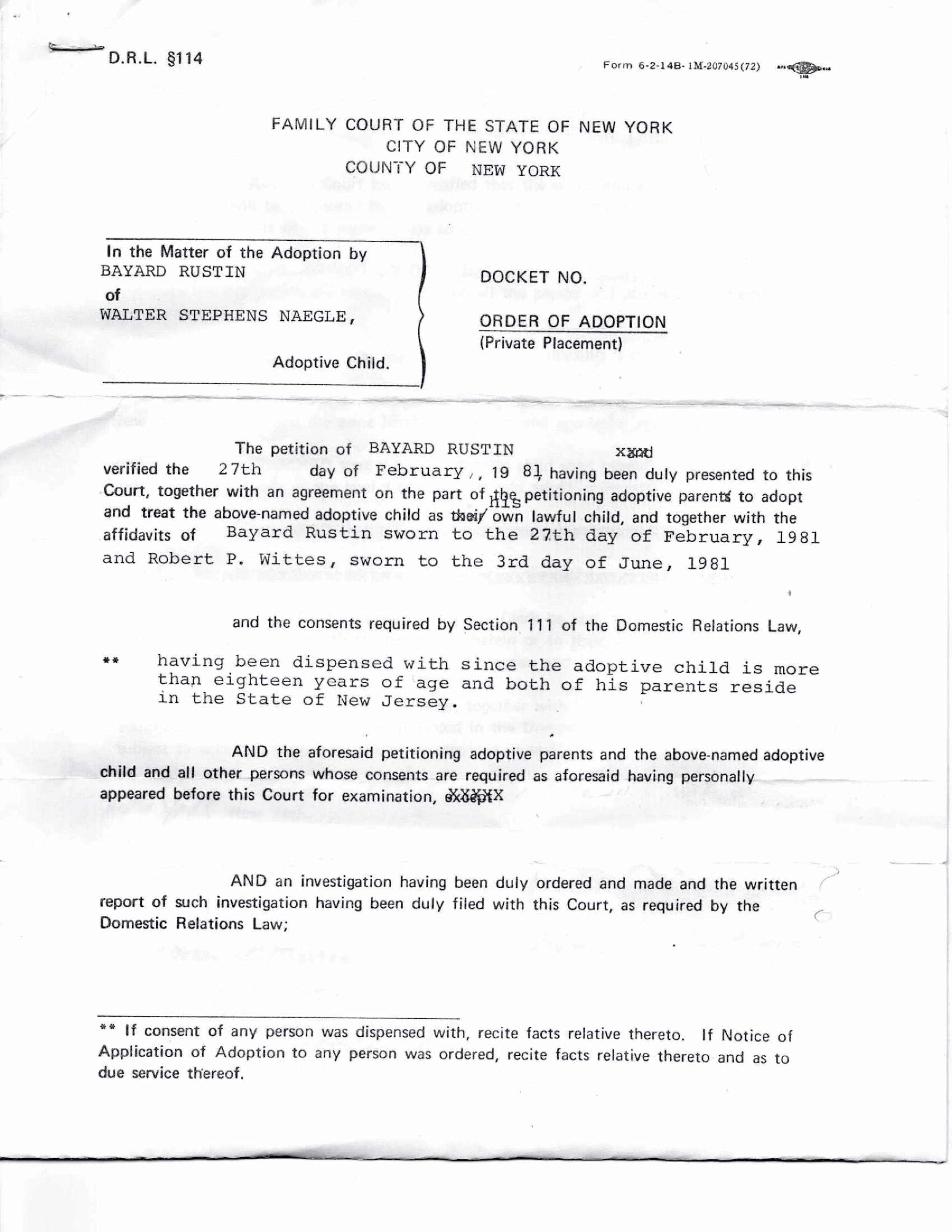
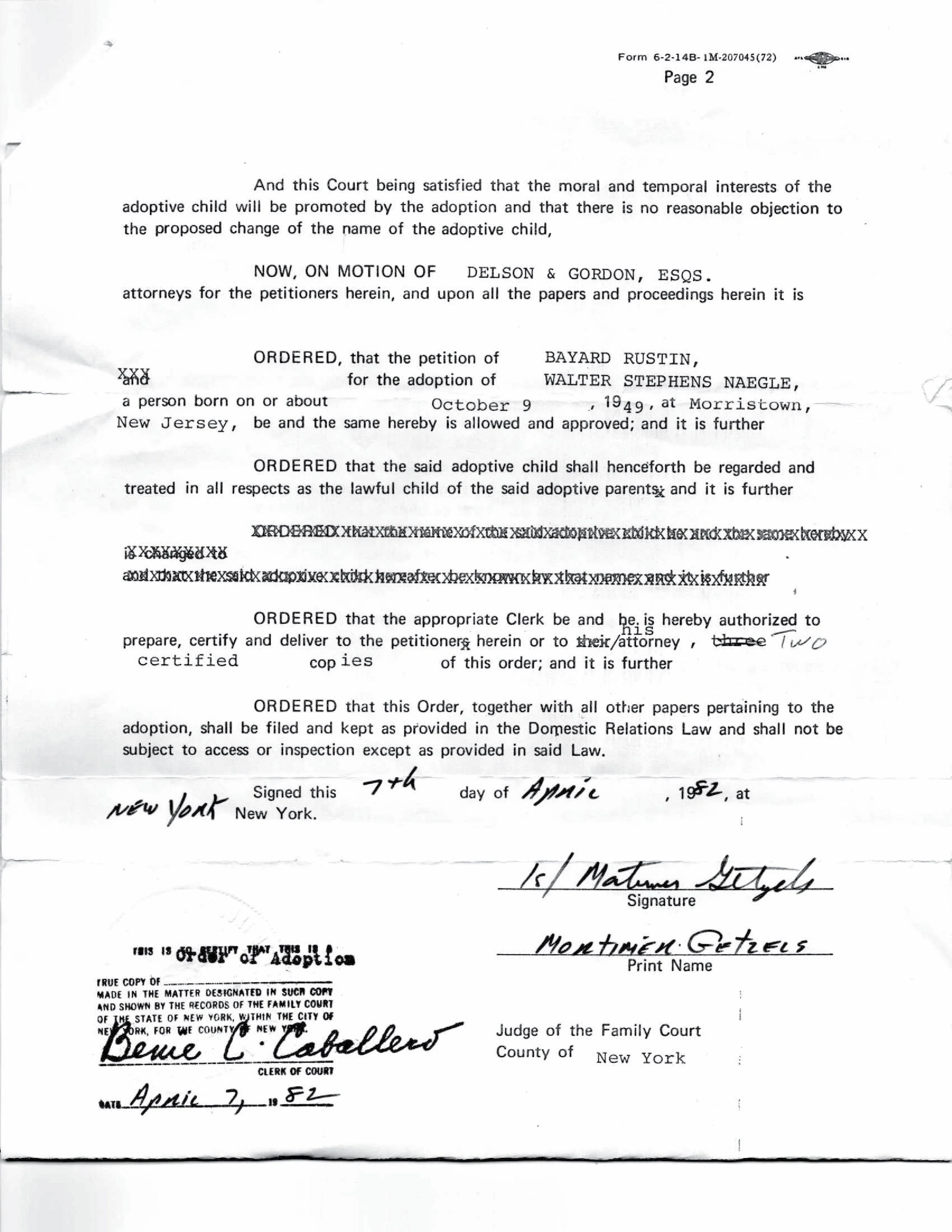
Family Court of the State of New York, County of New York. "Order of Adoption: In the Matter of the Adoption by Bayard Rustin of Walter Stephens Naegle." Signed April 7, 1982, by Judge Mortimer Getzels.
