Please note the exact date of this article’s publishing is unknown.
In this election-year essay, Bayard Rustin calls for a powerful coalition between labor, liberals, and the civil rights movement to defeat a reactionary alliance blocking racial and economic justice. He warns that without a serious, unified political strategy—anchored in programs like A. Philip Randolph’s Freedom Budget—the nation risks repeating the betrayal of Reconstruction and abandoning the promise of democracy.
Description
Writing on the eve of a pivotal election year, Bayard Rustin argues that the future of American democracy depends on a "triple alliance" between the labor, liberal, and civil rights movements. He posits that the "southern Negro," newly empowered by the Voting Rights Act, is in a position to play a major role in determining the country's future by counterbalancing the "Dixiecrat-Republican" alliance. Rustin defines this alliance as a powerful "reactionary" bloc where conservative Republicans joined forces with "Dixiecrats"—segregationist Southern Democrats who defended "states' rights" to oppose federal social programs and civil rights progress. He explains that this alliance thrived by setting the white poor against the Black poor, allowing "exploitative interests" to prosper while blocking essential legislation for housing, education, and medical care.
Rustin warns that without a unified strategy to break this coalition, the nation risks a "repetition of the fateful election of 1876," referring to the post-Civil War "Compromise" that ended Reconstruction and saw the federal government abandon Black Americans to Southern white supremacy. The article is a plea for "serious, practical political strategy" over "rhetorical prospects". Rustin insists that the movement must move beyond winning lunch counter seats to demanding massive federal action for housing and public works. He specifically champions A. Philip Randolph's "Freedom Budget" as a program designed to "apply to every citizen and not just to Negroes," arguing that the only way to "reconstruct the face of the nation" is through a coalition that addresses "black rage and white fear simultaneously" through shared economic goals.
Historical Context
By late 1967, the civil rights movement was fracturing under the weight of the Vietnam War and the rise of "Black Power" militancy. Rustin, ever the institutionalist, saw these divisions as "irreconcilable" and dangerous to the progress already made. He feared that white liberal "disillusionment" and the "white backlash" following urban riots would lead to a conservative resurgence.
The "Big Six" leadership had maintained a facade of unity in 1963, but by 1967, that unity had dissolved. This document highlights Rustin's transition from the street protests of 1963 to the high-stakes "electoral political action" of the late 1960s. He was fighting a two-front war: against the "reactionaries on the far right" and against "adventurist demagogues" within the movement who advocated for separatism or violence. Rustin understood that the "second America" referred to the public facilities and infrastructure needed by the year 2000. To build it in an image of justice, Black Americans had to find "allies" in the white working class. This article captures the exact moment Rustin began to prioritize class-based economic coalitions as the only way to sustain the moral victories of the early 1960s.
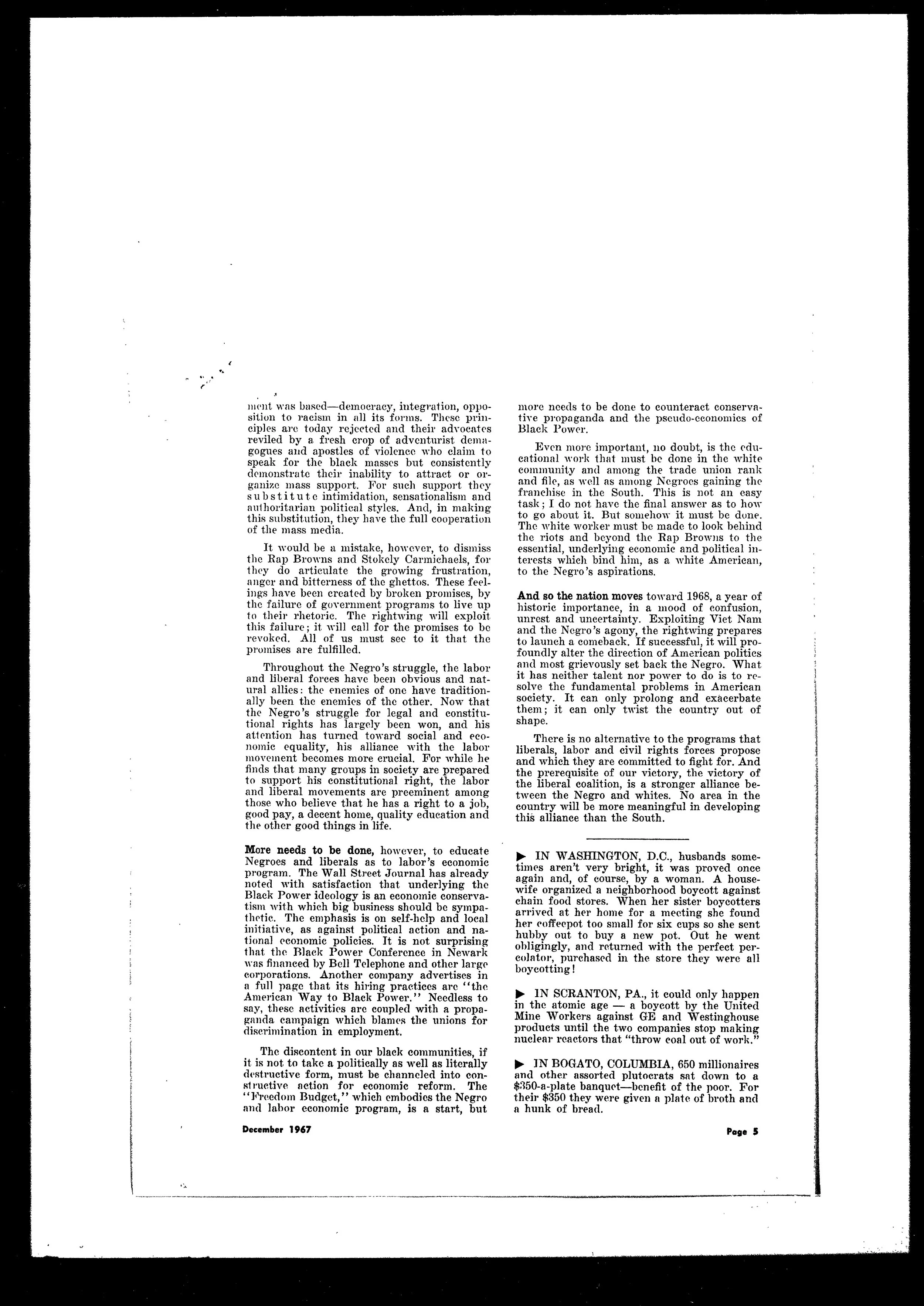
Rustin, Bayard. "The Liberal Coalition and the 1968 Elections." The American Flint, December 1967.
