Description
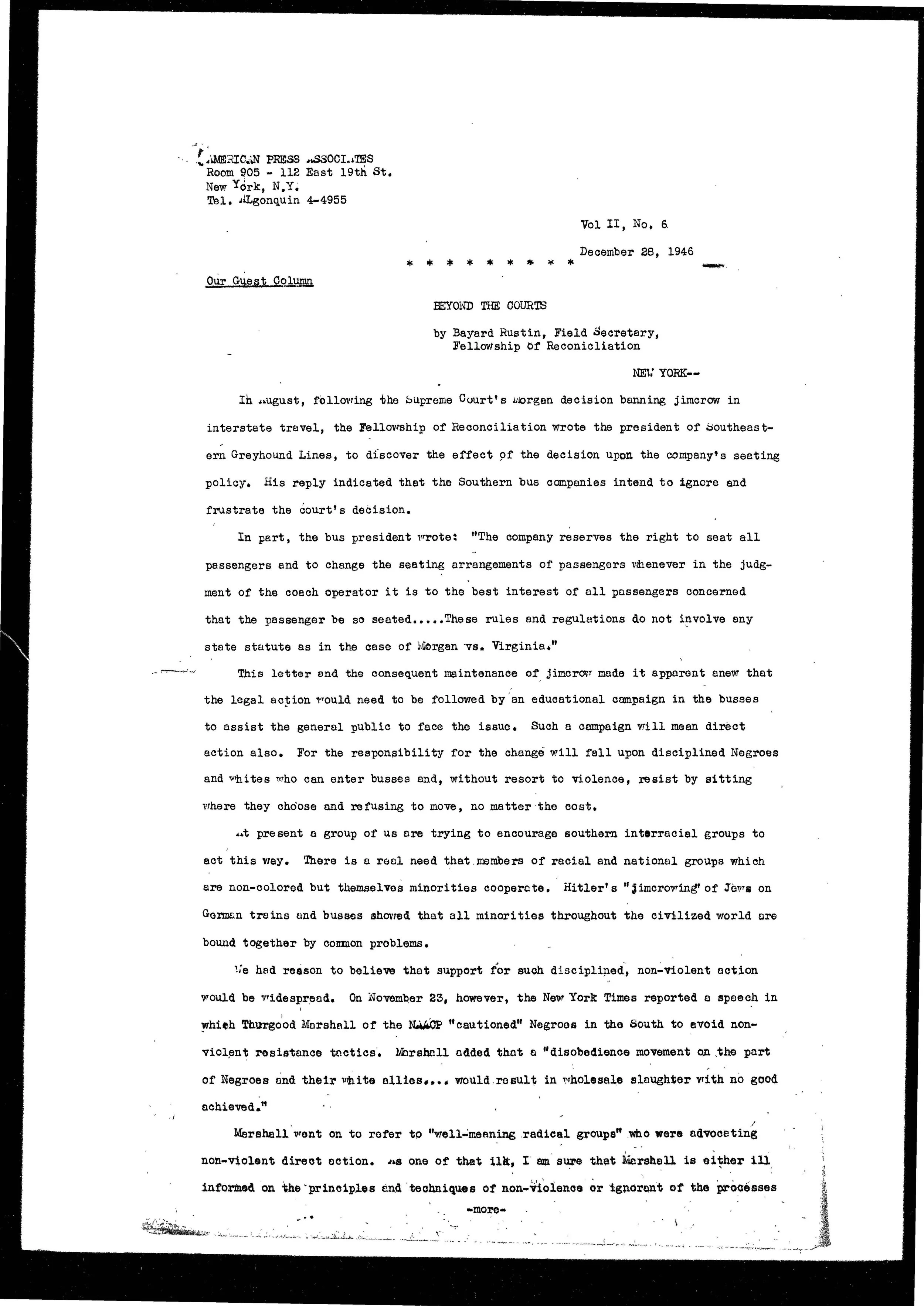
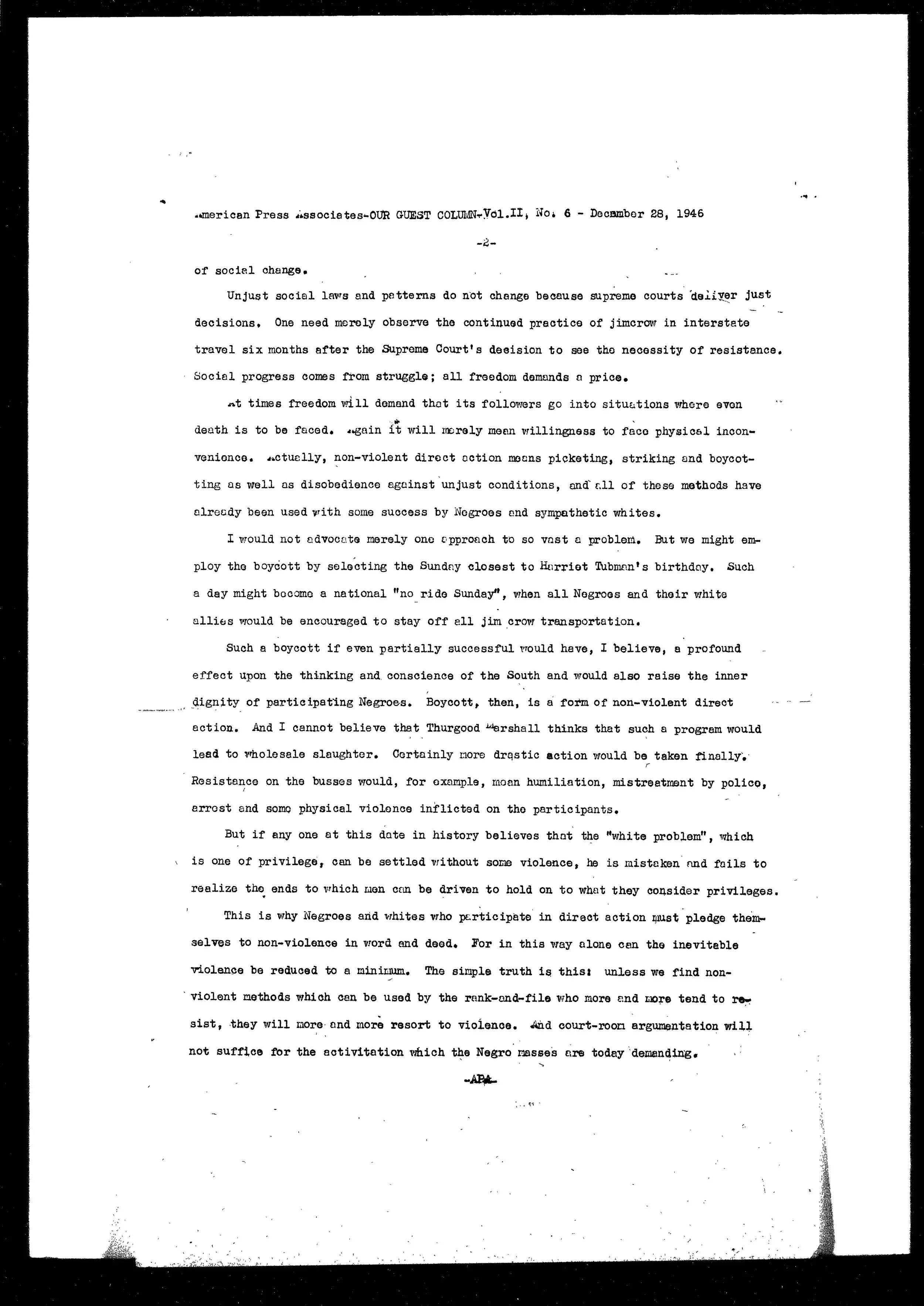
In this guest column for the American Press Associates, Bayard Rustin argues that legal victories in the courtroom mean nothing unless ordinary people enforce them through direct action on the ground. He reveals that after the Supreme Court outlawed segregation in interstate travel in Morgan v. Virginia, the Fellowship of Reconciliation wrote to the head of Southeastern Greyhound Lines to ask how the company would follow the ruling. The bus company president bluntly replied that Southern carriers intended to ignore the court, claiming private company rules allowed drivers to enforce Jim Crow seating regardless of federal law. Rustin points out that this defiance proves a hard truth: unjust social customs do not disappear just because judges hand down righteous decisions. To turn paper rights into reality, integrated groups of Black and white citizens have to step onto buses, sit where they choose, and refuse to move, taking whatever abuse, arrest, or physical violence comes their way.
Rustin then delivers an straightforward rebuke to Thurgood Marshall, the chief legal counsel of the NAACP. Marshall had recently warned Southern Black people against direct-action tactics, claiming that civil disobedience by "well-meaning radical groups" would only lead to "wholesale slaughter". Rustin calls Marshall out directly, asserting that he is either completely uninformed about nonviolence or fundamentally ignorant of how social change actually works. Freedom always requires a price, and waiting for courts alone will never satisfy the growing demand of the Black masses for immediate dignity. To channel this rising anger peacefully, Rustin proposes concrete nonviolent tactics—including a nationwide "No Ride Sunday" bus boycott on the Sunday nearest Harriet Tubman's birthday—warning that if civil rights leaders do not provide nonviolent fighting tools, frustrated people will inevitably turn to open violence to break white privilege.
Historical Context
In June 1946, the United States Supreme Court issued its landmark ruling in Morgan v. Virginia, declaring state Jim Crow transit laws unconstitutional because they placed an undue burden on interstate commerce. While legal reformers celebrated the decision as a breakthrough, Southern state governments, police departments, and private bus carriers like Greyhound and Trailways openly refused to comply. Instead of integrating coaches, companies instructed drivers to enforce segregation as private company policy, leaving Black interstate passengers just as vulnerable to arrest and beatings as they had been before the ruling. This immediate corporate resistance exposed the severe limitations of courtroom decrees in the absence of federal enforcement or grassroots resistance.
This stalemate ignited a fierce debate over strategy within the civil rights movement. The established leadership of the NAACP, led by attorneys like Thurgood Marshall, favored cautious, case-by-case legal challenges and feared that public disobedience in the Deep South would provoke white lynch mobs and derail federal litigation. Conversely, radical pacifists within the Fellowship of Reconciliation and the Congress of Racial Equality (CORE) maintained that legalism without mass participation bred passivity. Written only four months before Rustin helped launch the historic April 1947 Journey of Reconciliation—the original Freedom Ride designed to test the Morgan ruling—this column captures the decisive ideological break between courtroom litigation and the emerging era of direct, nonviolent mass protest.
Rustin, Bayard. "Beyond the Courts." American Press Associates 2, no. 6 (December 28, 1946).
