
Description
In this September 1975 column from The St. Louis American, Bayard Rustin provides an objective review of the massive controversy surrounding social scientist James Coleman’s updated report on school integration. Rustin outlines how Coleman's new findings, which claimed that massive busing programs accelerated "white flight" and reinforced minority isolation in inner cities, triggered an intense emotional response from both sides of the debate. While integrationists questioned Coleman’s intellectual integrity, conservative opponents confidently used the report to launch a renewed offensive against school desegregation. Rustin defends Coleman against accusations of racism, emphasizing that Coleman explicitly stated that American society was less segregated than ever and that the integration of all social institutions remained a deeply healthy development.
The column details Rustin’s agreement with Coleman's main premise: that the federal government made a mistake by focusing exclusively on school desegregation while ignoring the integration of economic and housing institutions. Rustin explains that under ideal conditions, a supportive administration in the White House would apply pressure to integrate housing patterns and job markets alongside the classroom. He shares Coleman’s doubts about the court system, noting that uncoordinated and erratic judicial edicts often resulted in chaotic integration formulas that triggered disruption and polarization rather than helping students. Rustin blames the entire crisis on a political vacuum left by Presidents Nixon and Ford, who deliberately exploited the busing controversy to secure their Southern white voting base rather than providing strong, humane political leadership to fully integrate American society.
Historical Context
In the autumn of 1975, the United States was gripped by intense social conflict over court-ordered desegregation busing, most notably during the violent anti-busing riots in Boston, Massachusetts. White working-class neighborhoods fiercely resisted judicial orders to bus children across city zones, leading to mass protests, school boycotts, and a rapid acceleration of white families moving to independent suburbs. This domestic crisis created an acute dilemma for civil rights organizations, as the practical execution of school desegregation faced severe political gridlock and standard legal strategies struggled to overcome changing urban demographics.
This environment forced a deep reassessment of civil rights tactics as leaders realized that relying solely on federal lawsuits was no longer enough to achieve actual integration. Rustin utilized his late-career platform to steer the conversation away from emotional arguments over busing and back toward a comprehensive, class-based economic realignment. He recognized that the Supreme Court was undergoing a conservative transformation, pointing to recent rulings that allowed municipalities to dilute minority political power through suburban annexation and restrictive zoning codes. By preserving this real-time commentary, this entry demonstrates how Rustin sought to prove that true school integration was completely dependent on breaking down residential segregation and achieving full employment for all working-class citizens.
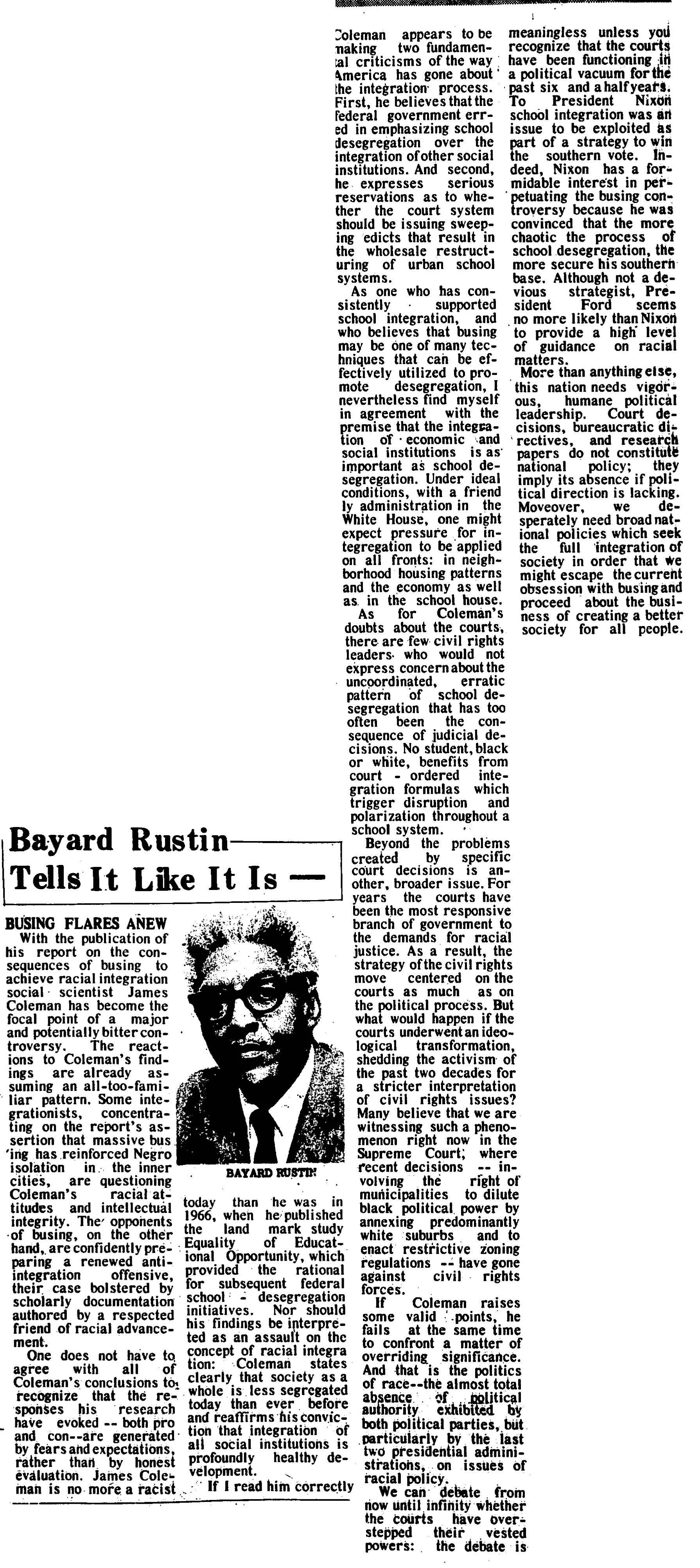
"Bayard Rustin Tells It Like It Is: Busing Flares Anew." The St. Louis American, September 4, 1975, p. 6.
