Description
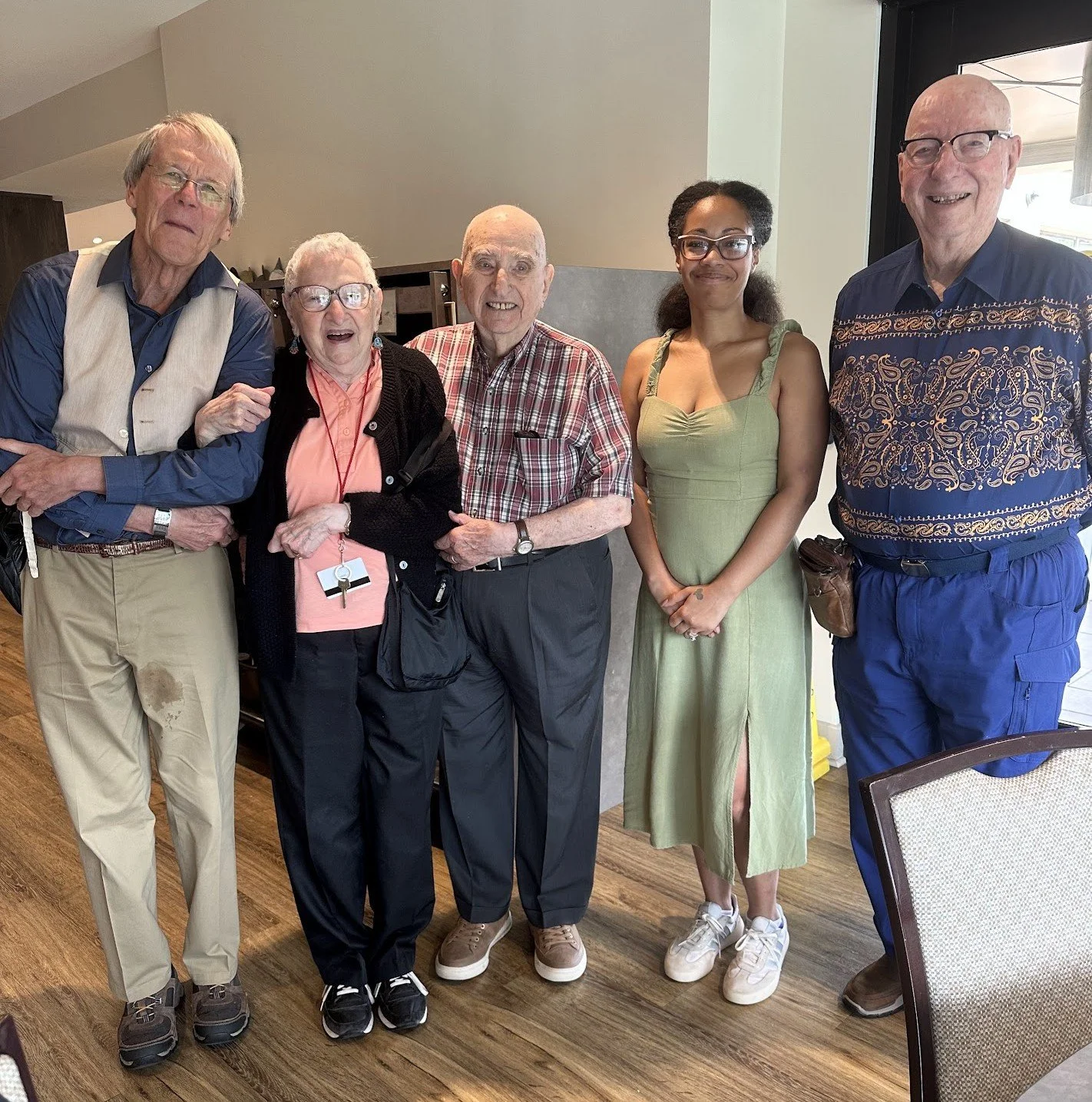
During a trip to the Quaker-affiliated retirement community of Medford Leas in New Jersey, Shaquana Darden, chief archivist and curator of the Bayard Rustin Digital Archive, engaged in an extensive conversation with a close-knit circle of peace and civil rights advocates. The gathering provided a rich, deeply personal window into the life, character, and legacy of Bayard Rustin through the eyes of those who knew him personally. The participants included Marge Rubin, a lifelong photographer who documented movement moments and Rustin's speaking engagements on Long Island; George Rubin, a writer and war veteran; and their friend Daniel A. Seeger, accompanied by their companion Tom Goodrich. Daniel Seeger reflected on his own landmark Supreme Court case, recounting the gravity of his conscientious objection and noting, "the Supreme Court came out on my side, nine to nothing."
The dialogue quickly flowed into warm reminiscences about the vibrant social world that surrounded Rustin during the final ten years of his life, a world largely anchored by Robert and Joyce Gilmore. George Rubin described how their professional affiliations blended effortlessly into deep personal bonds, explaining, "Formally, we were all members of the board of directors of New York Friends Incorporated, but, really, informally, we were all buddies of Robert and Joyce Gilmore... and they used to have soirees of eight or ten people, in their lovely home, and that's where, that's my most vivid recollection of Bayard, at those soirées." It was within these elegant gatherings at the Gilmores' East 11th Street brownstone that Rustin enjoyed his favorite social setting. George fondly remembered Rustin's beverage of choice during these visits, sharing, "I love Mouton Cadet wine... he loved it. It was a wonderful, my favorite wine." The group also noted their connections to broader institutional networks, mentioning that Swarthmore College maintains a robust collection documenting the historical records of the New York Friends Group.
Rustin’s distinctive sense of personal style also left a lasting mark on his friends, playfully defying the traditional Quaker emphasis on plainness and simplicity. While the Quaker tradition favored modesty, Marge and George remembered Rustin as someone who "dressed very dapper." This refined and worldly aesthetic extended directly into his Brooklyn home, which he shared with his partner, Walter Naegle. George recalled that Rustin and Walter maintained an extraordinary collection of global artifacts: "He had a huge collection of African masks... and Walter Naegle is a part of all of that. And they had a bed... unbelievable... I'm amazed the building didn't collapse." Because Rustin traveled the globe for human rights and political advocacy, every country he visited yielded cultural items and statues that he meticulously incorporated into his living space.
Reflecting on Rustin's core personality, George Rubin emphasized his remarkable kindness and steady disposition despite navigating immense political turbulence. George noted, "He was very kind to me. In all the turbulence and all the conflict... even within the peace movement, he was always kind to everybody. He didn't have any enemies... he was patient, cheerful and uppy. He wasn't a sourpuss, and he wasn't a griper." Daniel Seeger expanded on this observation, remarking that Rustin "was a great listener, and then when you respond, you felt a note... you didn't feel that you were in some kind of antagonism."
This exceptional grace and commitment to nonviolence were frequently tested during moments of high-stakes social friction. The group recounted the profound complexities Rustin faced when he attempted to peacefully quell the Harlem riots, only to be met by angry crowds shouting at him to get out of the way. Beyond local activism, Rustin also navigated intense policy debates among his own allies, such as the major controversy and "hullabaloo" that erupted among pacifists when he signed a New York Times advertisement advocating for the sale of jets to Israel.
Furthermore, the conversation explored historical media broadcasts and Rustin's deep appreciation for Negro spirituals, noting programs hosted by figures like Robert Sherman on WQXR where Rustin discussed his background, his views on slavery, and his musical performances. Daniel Seeger explained how Rustin viewed these traditional songs not merely as folk music, but as hidden, revolutionary texts rooted deeply in the Book of Revelation, utilizing scriptural imagery of a world turned upside down to secretly harbor the hope of liberation and structural change. Together, their recollections form an essential record of Rustin’s humanity, his intellectual depth, and the enduring community of friends whose memories continue to illuminate the full scope of his life and legacy.
Historical Context
The historical context of this interview is deeply rooted in the social networks, pacifist movements, and Quaker-affiliated advocacy groups that supported Bayard Rustin throughout his life and career. Figures like Daniel A. Seeger represented a vital link to these mid-century movements, notably through his historic 1965 Supreme Court case, United States v. Seeger. In that landmark unanimous ruling, the Supreme Court broadened the legal definition of conscientious objection, allowing individuals like Seeger to claim draft exemptions based on deeply held moral and ethical beliefs even if they did not adhere to a traditional belief in a Supreme Being. This milestone significantly shaped the landscape of American pacifism and anti-war advocacy during the turbulent decades of the civil rights and Vietnam War eras.
Additionally, the intimate community surrounding Rustin—such as the board members of the New York Friends Group Incorporated and generous patrons like Robert and Joyce Gilmore—highlighted the crucial intersection of wealth, progressive philanthropy, and Quaker social action in New York City. The Gilmores' historic East 11th Street brownstone served as a vital salon where leading peace activists, writers, and artists could gather away from public scrutiny. These networks, preserved through institutional repositories like Swarthmore College, demonstrate how private friendships and organizational frameworks sustained figures like Rustin, providing both personal sanctuary and a collaborative foundation for international human rights work.
Darden, Shaquana. Interview with Marge Rubin, George Rubin, and Daniel A. Seeger. Medford Leas, NJ, August 14, 2026. Bayard Rustin Digital Archive, Bayard Rustin Center for Social Justice.
