Please note: The exact date of this article’s publishing is unknown.
In this article, Bayard Rustin argued that the McCone Commission misrepresented the Watts uprising by ignoring its political intent and the systemic racism that caused it. He warned that by refusing real reforms, the nation was teaching Black Americans that only violent rebellion could make their voices heard.
Historical Context:
The Watts riots erupted on August 11, 1965, in the Watts neighborhood of Los Angeles. The immediate trigger was a traffic stop by highway patrolman Lee Minikus, who pulled over 21-year-old Marquette Frye for drunk driving. During the stop, Frye's mother Margaret arrived at the scene. A verbal altercation escalated when a highway patrolman struck Margaret Frye. The incident sparked outrage in the community. News spread quickly through the neighborhood. Within hours, hundreds of people gathered. By that evening, the riots had begun.
For six consecutive days, the riots spread through South Los Angeles. Police responded with aggression. The National Guard was mobilized. By the time the riots ended on August 16, the scale of devastation was unprecedented. Thirty-four people were dead, over 1,000 were injured, and approximately 3,500 were arrested. Most of the dead were Black. Most of the injured were Black. Over 600 buildings were damaged or destroyed. The material loss exceeded 40 million dollars.
What made the Watts riots historically significant was not merely their scale but what they revealed. The Civil Rights Act of 1964 and the Voting Rights Act of 1965 had just been passed. The government had declared war on poverty. Yet in Watts, despite these legislative victories, Black people lived in conditions of systematic deprivation. The neighborhood was segregated. Jobs were scarce. Schools were inadequate. Housing was deteriorating. Police brutality was routine. For young Black people in particular, the promise of the civil rights movement had proven hollow.
The riots were understood by participants as a political act. This was not simply rage. The uprising was selective. Rioters targeted merchants they saw as exploitative and spared those identified as part of the community. The destruction moved toward City Hall. The message was clear: we exist, we are suffering, and we demand attention.
Rustin's article was written when the McCone Commission's report appeared. The commission had asked serious questions about Watts. But its conclusions blamed Black people rather than structural racism. It called for improved police relations and better training programs rather than addressing unemployment, segregation, and poverty. It represented the failure of white liberal institutions to do anything meaningful in response to Black rebellion.
What is striking about Rustin's 1966 analysis is his clarity that the Watts riots were not an aberration but a warning. They announced the end of an era. The nonviolent civil rights movement had won legal victories. But legal victories did not feed hungry people or provide jobs or end segregation. Young Black people in Watts and across the country were concluding that nonviolence had exhausted its possibilities. Without material change, rebellions would continue.
Rustin's article was preserved in FBI files because it represented exactly this kind of political analysis. He was not calling for riots. He was calling for transformation. He was saying that preventing further riots required massive government investment in Black communities. He was proposing concrete solutions: public works programs, housing construction, job creation. He was insisting that America had the resources to do this but lacked the political will.
The FBI's surveillance and archiving of this article reveals what they feared most. Not violence, but vision. Not disorder, but demands backed by analysis. Rustin had read government documents, found them dishonest, and said so publicly. He had provided Black people with intellectual tools to understand their situation. He had connected rebellion in Watts to broader patterns of racism and inequality. This was dangerous. This was why he was watched.
Description:
Bayard Rustin published this article in Commentary magazine and it became one of his most scathing critiques of how white institutions responded to Black rebellion. The Watts riots in August 1965 had lasted six days, killing 34 people, injuring 1,032, and arresting 3,952. The rioters themselves viewed their actions as a manifesto. Governor Edmund Brown appointed a commission headed by John A. McCone to investigate. Rustin read the McCone Report and found it fundamentally dishonest.
Rustin began by accepting what the rioters had declared: this was not senseless destruction. When he walked the streets of Watts after the riots ended, an unemployed young man told him simply, "We won." How did they win? "We made the whole world pay attention to us," the man said. "The police chief never came here before; the mayor always stayed uptown. We made them come." Rustin understood. The riot had moved in an almost direct path toward City Hall. It was not random violence.
But the McCone Commission had declared the riots to be "insensate rage of destruction." This was a lie told from fear. Rustin then laid out the actual facts about what the rioters had done. Wherever a store owner identified himself as a "poor working Negro trying to make a business" or as a "Blood Brother," the mob passed the store by. The rioters deliberately targeted high-priced merchants with hostile manners. They destroyed food markets, liquor stores, clothing stores, and pawn shops. They did not deliberately burn residences. They did not destroy schools, libraries, or public buildings. They left service stations and automobile dealers mostly untouched. The rioters destroyed liquor stock rather than steal it. They did not attempt to steal narcotics from pharmacies. Most arrests were for looting, not arson or shooting. This was not the behavior of a community "run amok."
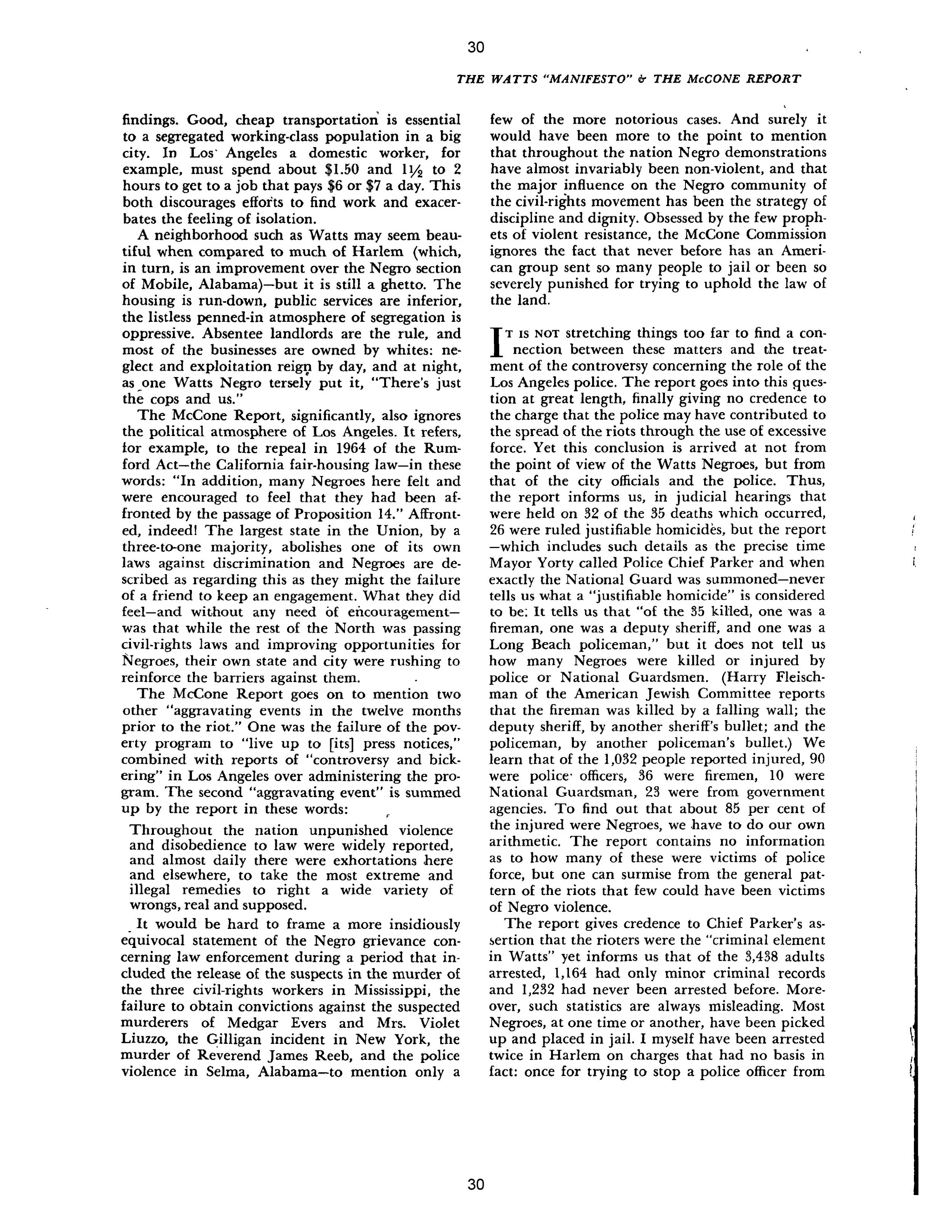
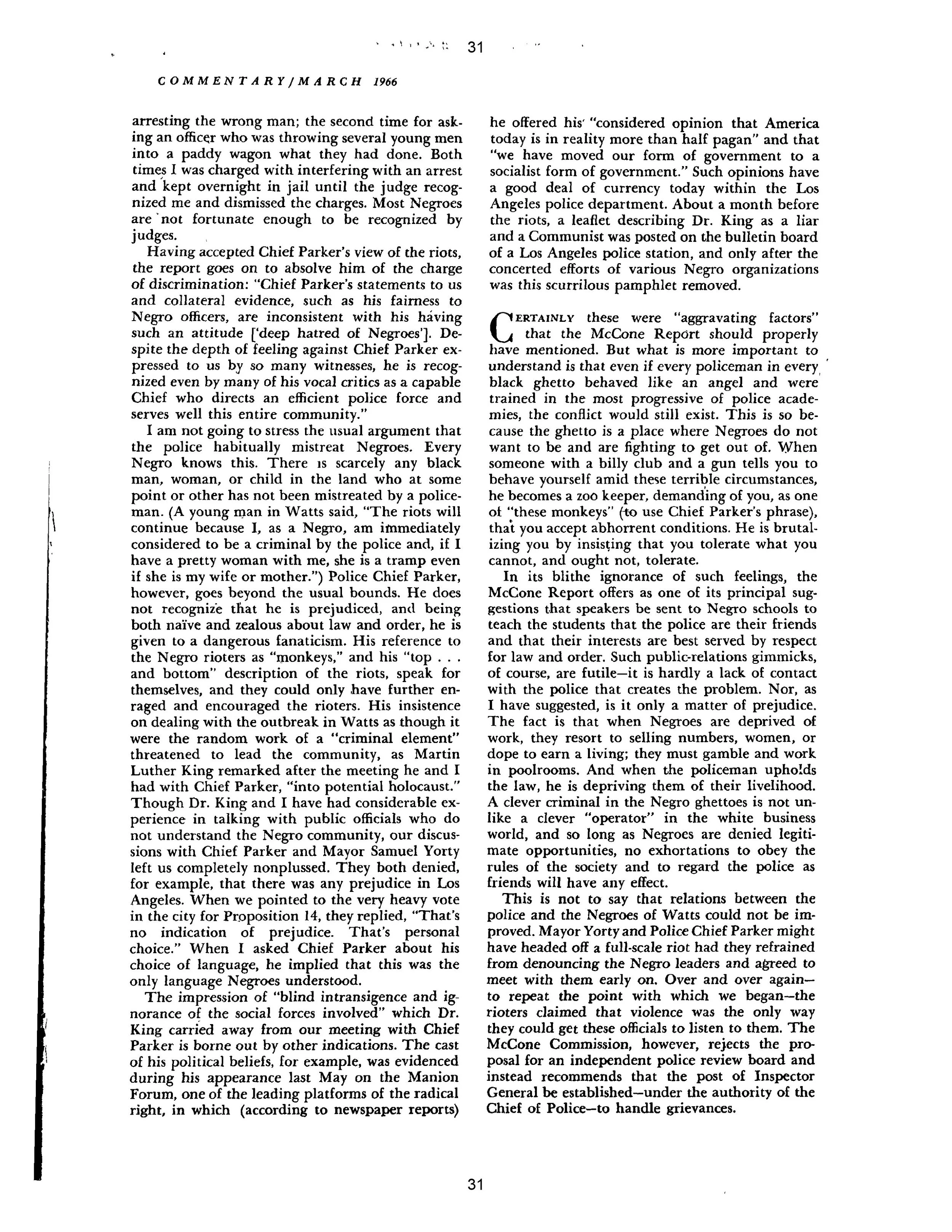
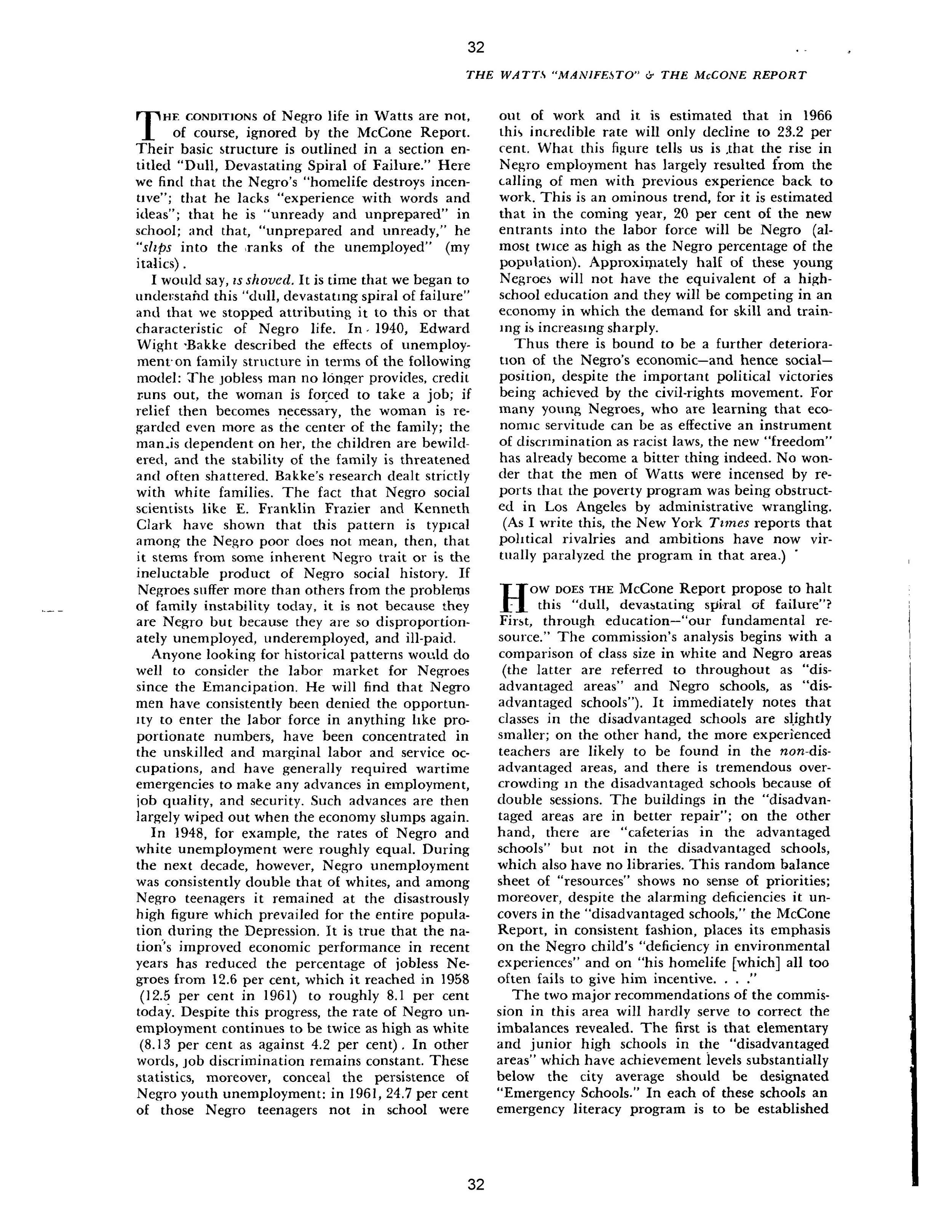
Rustin then dissected the McCone Report's analysis of the causes. The commission blamed Black people for not being "prepared" to meet city life. They had migrated from rural areas unprepared. But Rustin turned this around: the cities were unprepared to meet Black people's needs for jobs, housing, and schools. The report ignored segregation entirely. It talked about unemployment among Blacks but never named the system that kept Blacks underemployed. It blamed police violence on abstract "rioter behavior" instead of on police actions. It defended Police Chief William Parker, who called the rioters "monkeys" and had declared, "We're on top and they're on the bottom."
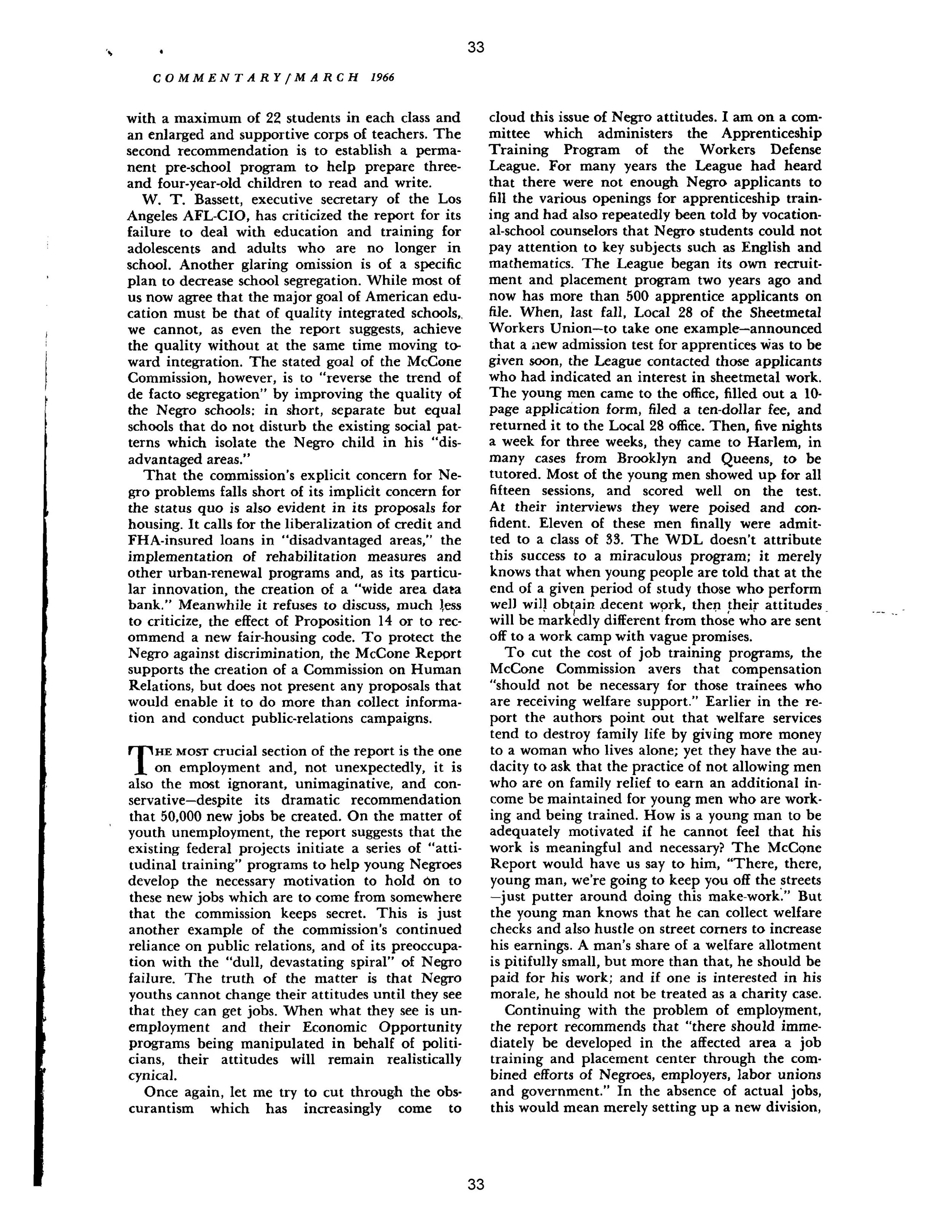
The most brutal part of Rustin's analysis concerned the report's recommendations. The McCone Commission called for 50,000 new jobs but never said where these jobs would come from. It recommended "attitudinal training" for Black youth, as if the problem was Black attitudes rather than the actual absence of work. It suggested that men on welfare relief not be compensated while being trained for jobs, a suggestion that treated poor Black people as charity cases unworthy of wages for their work. The report called for voluntary actions by business and labor, new public relations campaigns, and information-gathering. In other words, it called for nothing.
Rustin concluded with a warning that should have stopped the nation: "What is most impractical and incredible of all is that we may very well continue to teach impoverished, segregated, and ignored Negroes that the only way they can get the ear of America is to rise up in violence."
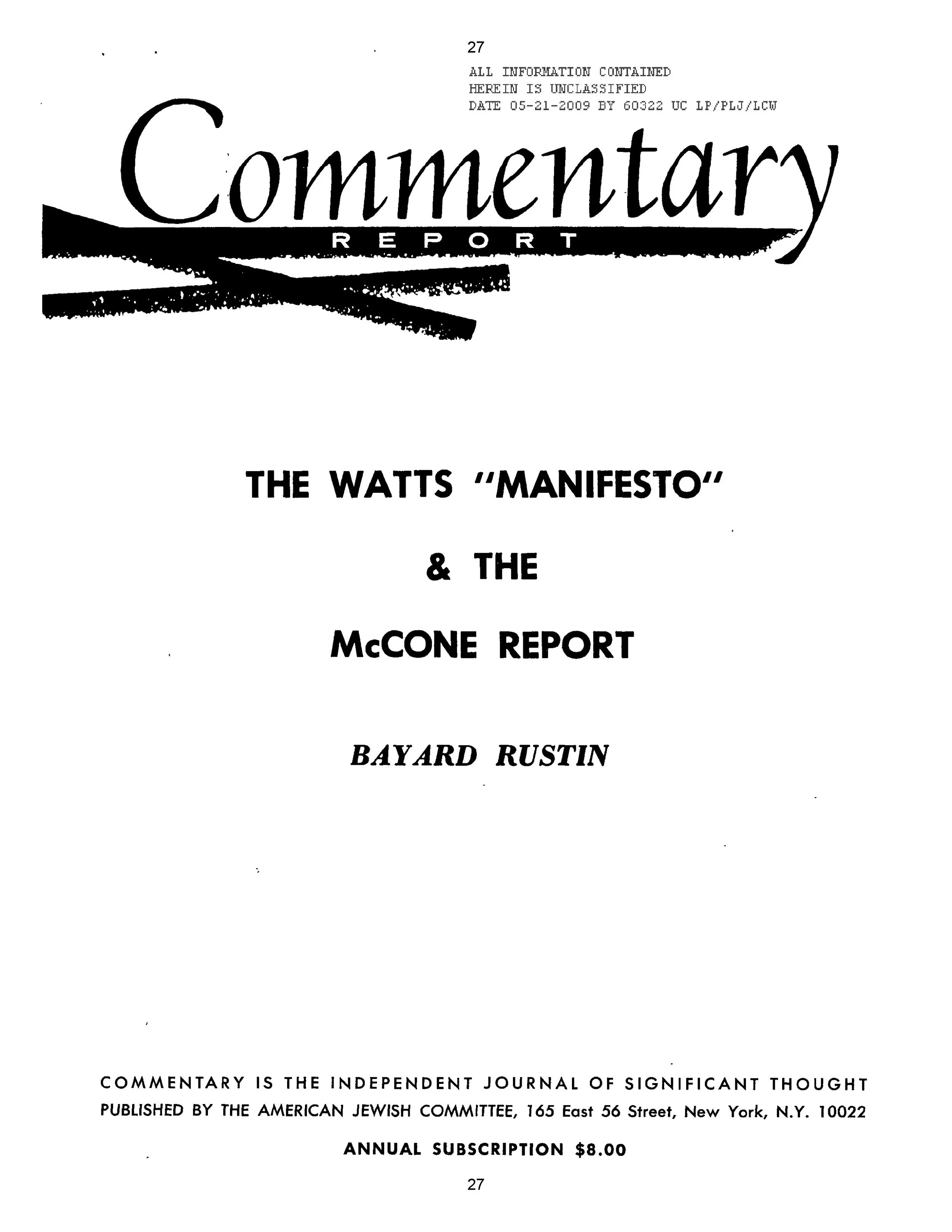
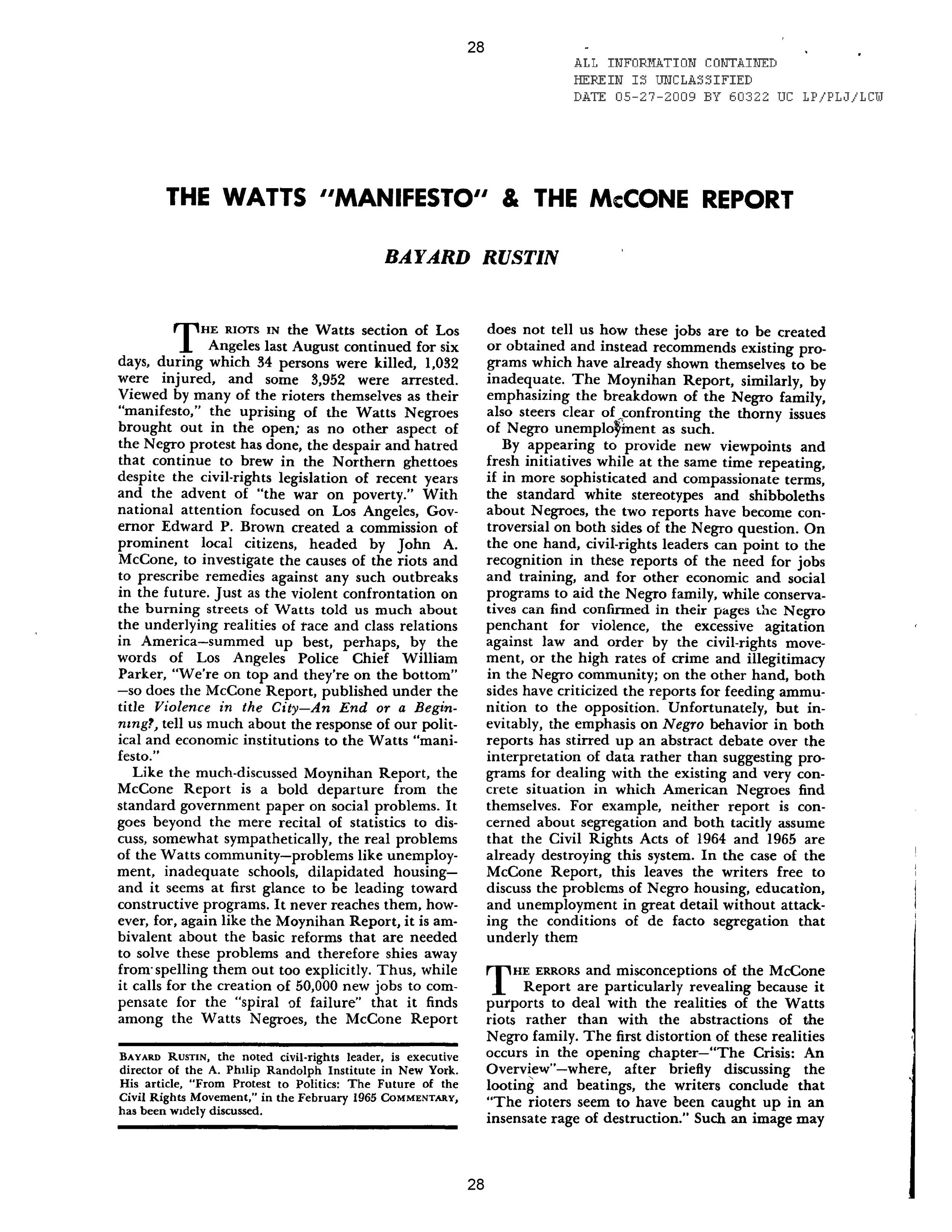
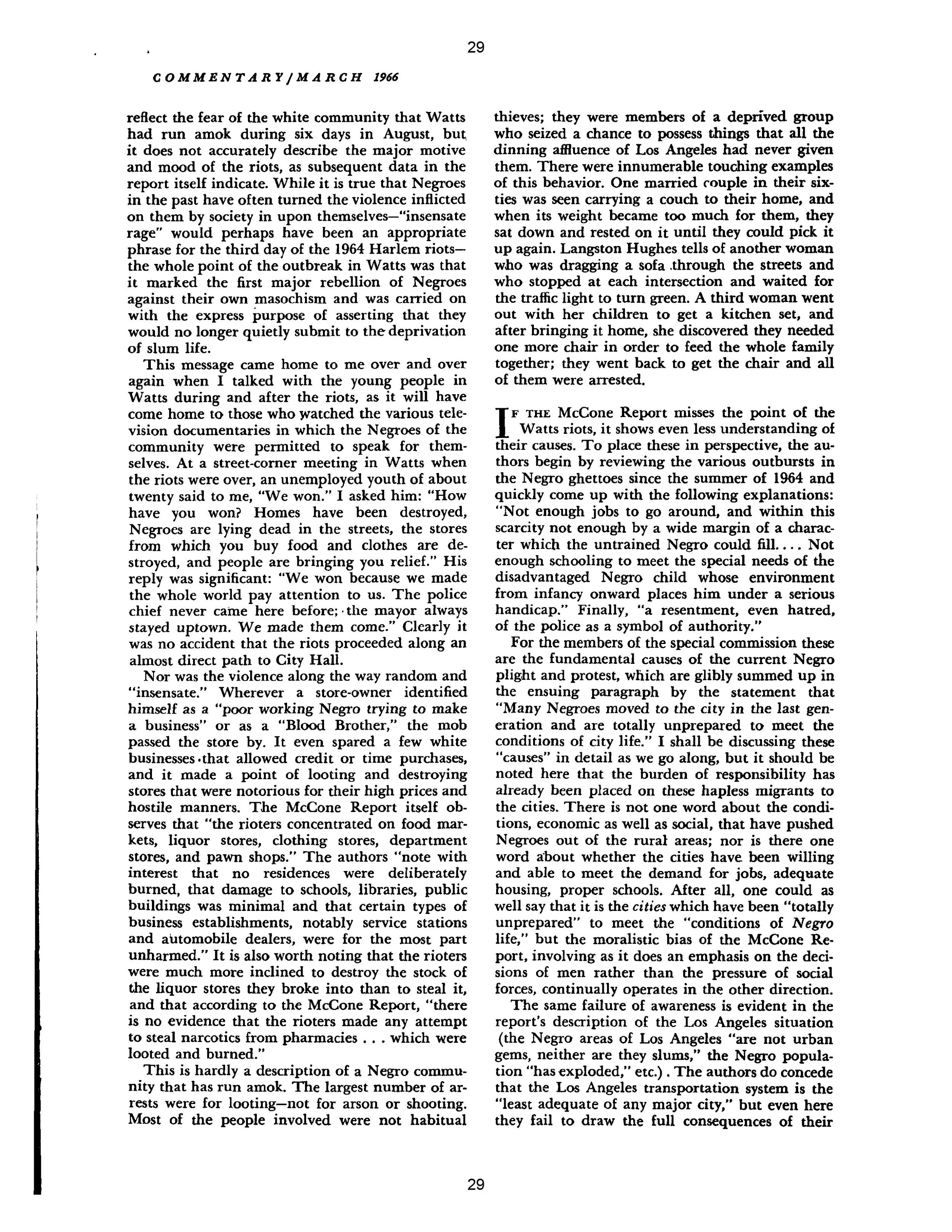
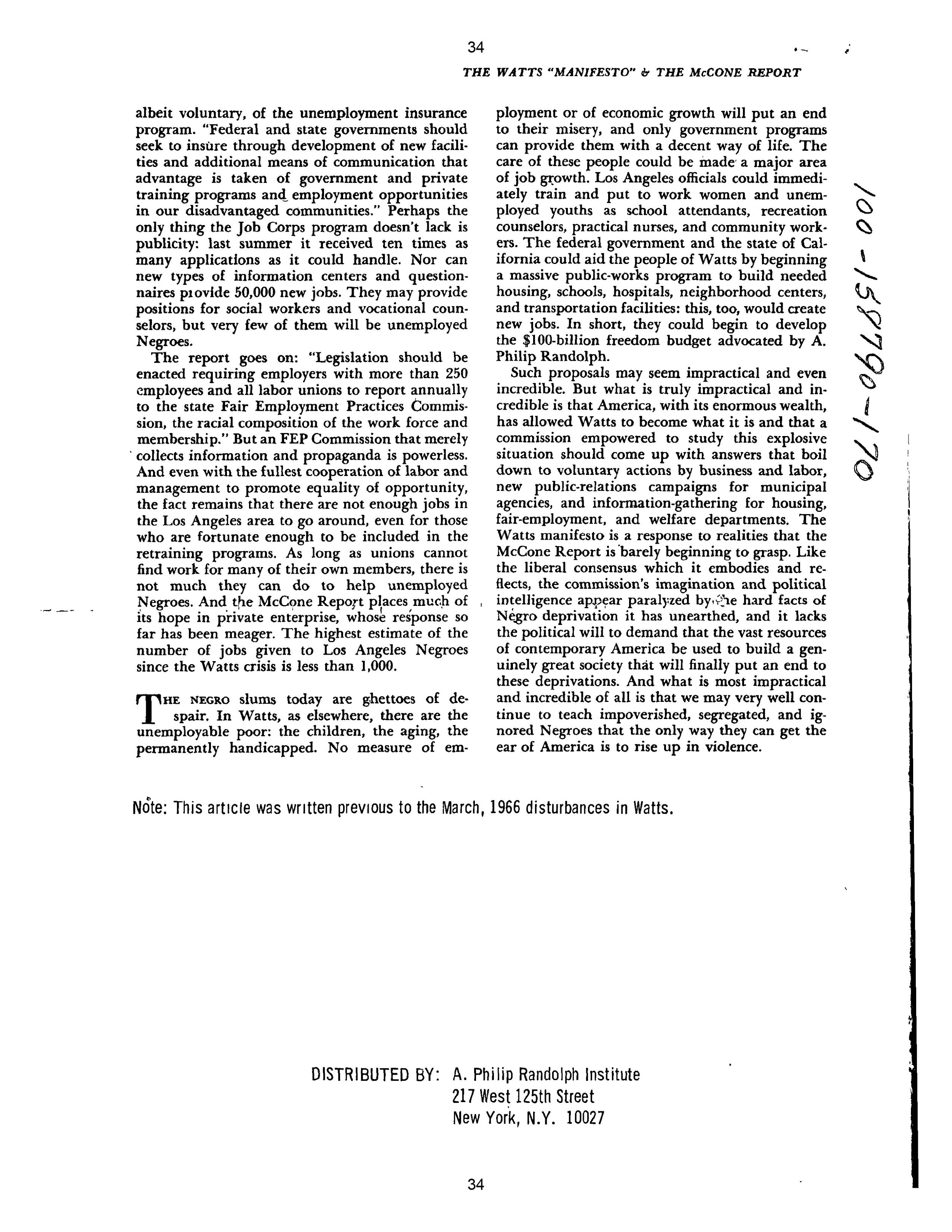
Rustin, Bayard. "The Watts 'Manifesto' and the McCone Report." Commentary 41, no. 3 (March 1966): 27-34. Federal Bureau of Investigation File, declassified May 21, 2009.
