
*Please note: The exact date of this document’s publication is unknown.
Description
In this sharp critique, Bayard Rustin analyzes the "Black Power" slogan as a psychological reaction to the slow pace of racial progress rather than a viable political program. He argues that while the term successfully captures the anger and frustration of the Black community, it lacks a clear definition and risks "ravaging" the entire civil rights movement by causing a bitter internal split. Rustin warns that the "nature of politics" in America makes a purely nationalist approach impossible because Black Americans are a minority of the population and cannot achieve fundamental social change without a majority consensus.
Rustin explains that the "utility of politics" is lost when activists retreat into a "no-win" strategy of racial isolation. He contends that advocating for "Black Power" as a separate force is a contradiction in terms, since real power in a democracy requires allies who share common economic interests. He points out that the movement’s most significant legal victories were won through coalition politics, and moving away from this strategy would only lead to "sterile" confrontations that leave the root causes of poverty, such as unemployment and urban decay, completely untouched.
To move beyond the "enduring disappointment" of the 1960s, Rustin insists that the movement must rededicate itself to integration and the building of a broad "liberal-labor-civil rights" alliance. He argues that instead of a slogan that primarily "galvanizes emotions," the movement needs a "Freedom Budget" that demands the redistribution of wealth through a $2.00 minimum wage and a guaranteed annual income. For Rustin, the only way to prove that "coalition and integration are better alternatives" is for the movement to demonstrate its ability to win material gains for the poor through disciplined, interracial political action.
Historical Context
Published in Commentary magazine in September 1966 and distributed by the A. Philip Randolph Institute, this pamphlet reflects the peak of the ideological war between nonviolent integrationists and the rising "New Guard" of militants. Rustin specifically targets the shifts within groups like SNCC and CORE, led by figures like Stokely Carmichael and Floyd McKissick, who were moving away from the "interracial" strategies of the early 1960s. Rustin felt that this shift represented a move away from the "professionalism" he had spent his life cultivating.
The document highlights the deep divide between coalition and nationalism that characterized the late 1960s. Rustin argued that the Black Power movement was born out of a "failure of nerve" on the part of white liberals and the government to fully implement the civil rights bills already won. He believed that the rise of separatism was a predictable result of the "barbarism" and violence Black activists faced in the South, combined with the lack of economic improvement in Northern urban centers.
Ultimately, Rustin’s argument was that the civil rights movement was being sidetracked by a "romantic" and "emotional" retreat from the hard work of building a political majority. He warned that by attacking white liberals—who were once their closest friends—Black Power advocates were destroying the very coalition needed to win the next stage of the battle for economic rights. This pamphlet stands as a defense of the "long game," asserting that racial justice and American democracy can only survive if the movement remains committed to the difficult, often unglamorous work of interracial partnership.
Downloadable PDF.


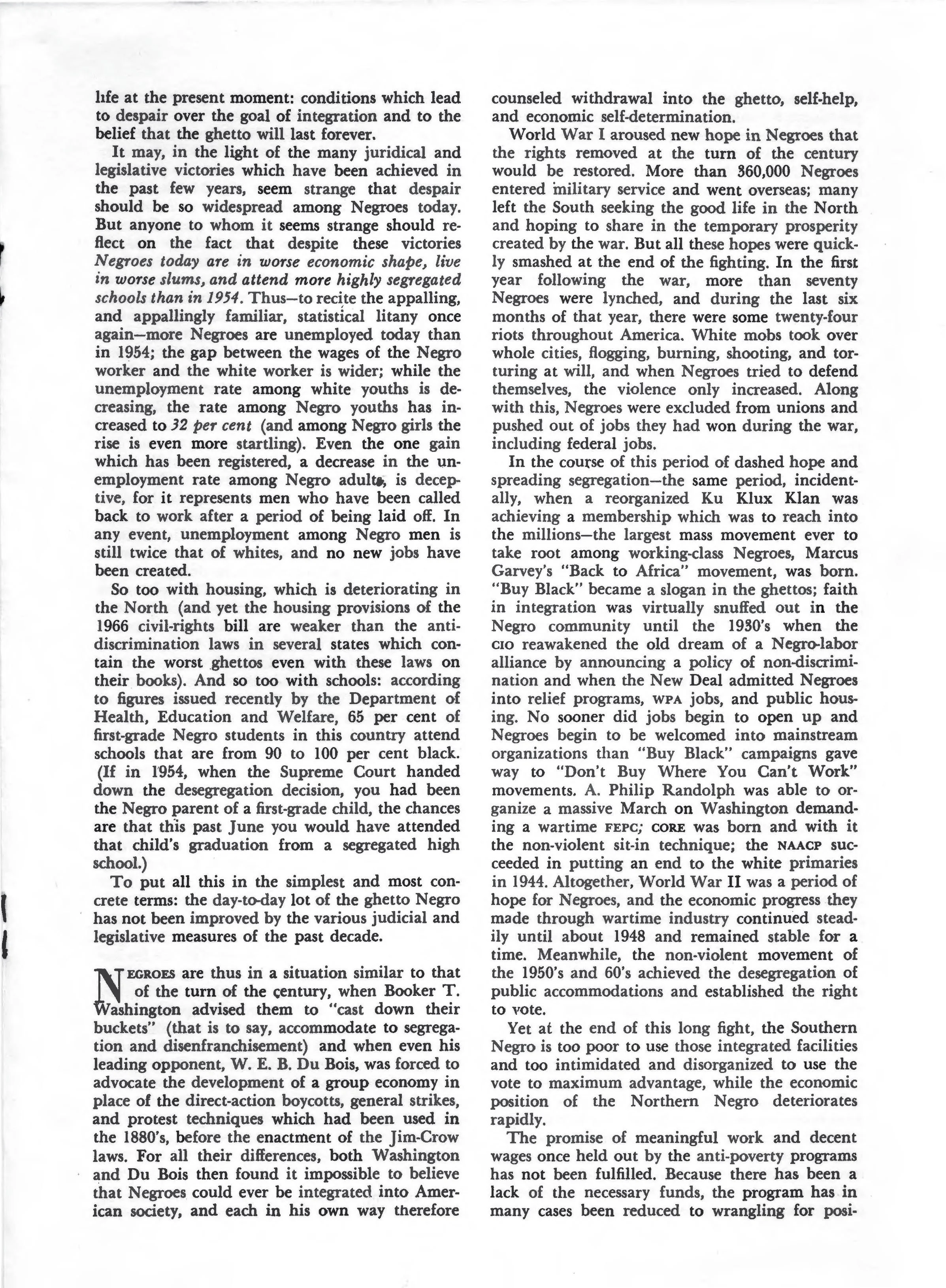


Rustin, Bayard. “ ‘Black Power’ and Coalition Politics.” Pamphlet. Distributed by A. Philip Randolph Institute. New York, 1967.
