
In this 1983 column, Bayard Rustin warns that a Black-led symbolic presidential run risks political isolation by framing national crises like poverty and unemployment as race-specific issues rather than grounds for broad coalition-building. He argues that real power lies not in symbolic candidacies but in multiracial alliances that preserve leverage within the Democratic Party and prevent the splintering of the Black vote.
Historical Context
By 1983, the United States was witnessing a surge in Black political mobilization, catalyzed by the devastating economic policies of the Reagan administration. This period saw the rise of Jesse Jackson’s "Rainbow Coalition" and his eventual 1984 presidential bid. While many activists viewed Jackson’s run as a necessary step to force the Democratic Party to address systemic racism and urban decay, Rustin remained a vocal skeptic. He feared that Jackson's candidacy would act as a "spoiler," draining resources and votes from more moderate, viable candidates who had a broader chance of defeating the incumbent Republican administration.
This tension highlighted a deepening ideological rift within the civil rights movement. Older leaders like Rustin and A. Philip Randolph had spent decades building bridges with the labor movement and the Democratic establishment, believing that Black progress was inextricably linked to the progress of the American working class. Conversely, the "New Guard" of the 1980s felt that the traditional coalition had failed to deliver on its promises, leading them to seek a more independent and racially assertive political path through candidates like Jesse Jackson.
Furthermore, this document reflects the early 1980s transition from the protest-driven activism of the 1960s to the electoral-focused strategies of the 1980s. As Black mayors were being elected in major cities like Chicago and Philadelphia, the debate over how to translate local electoral success into national executive power was at its peak. Rustin’s intervention in this article was an attempt to steer the movement away from what he perceived as a "romantic" and "separatist" dead end, advocating instead for the disciplined, interest-based bargaining that he believed was the only way to achieve substantive legislative change.
Description
In this incisive 1983 "Viewpoint" column, Bayard Rustin, acting as Chairman of the A. Philip Randolph Institute, challenges the prevailing excitement surrounding the potential for a Black-led "symbolic" presidential run. Rustin argues that while the optics of such a candidacy might seem empowering, the strategic reality poses a significant threat to the long-term political health of the Black community. He meticulously dissects the risks of a "race-specific" platform, asserting that issues like unemployment, education, and poverty are not "Black issues" but national crises that require a unified, multi-racial coalition to solve.
Rustin’s tone is one of urgent pragmatism. He expresses a deep concern that a campaign centered solely on Black identity would inevitably lead to political isolation and the splintering of the Black vote. By focusing on a "Black agenda" rather than a "national agenda," Rustin warns that the movement risks alienating essential allies in labor and liberal circles. He emphasizes that the path to real power is not through individual symbolic victories, but through the hard work of coalition politics, which allows the movement to keep the leverage needed to influence the broader Democratic Party platform.
The article concludes with a sober warning that an exclusively Black candidacy would result in political failure and do lasting harm to the strategy of integration. Rustin notes that his skepticism was shared by other established civil rights organizations, such as the NAACP, who feared that a fractured electorate would only empower conservative opposition. This document serves as a testament to Rustin’s unwavering commitment to "coalition politics" over "identity politics," even when such a stance placed him at odds with the rising tide of Black political nationalism in the 1980s.
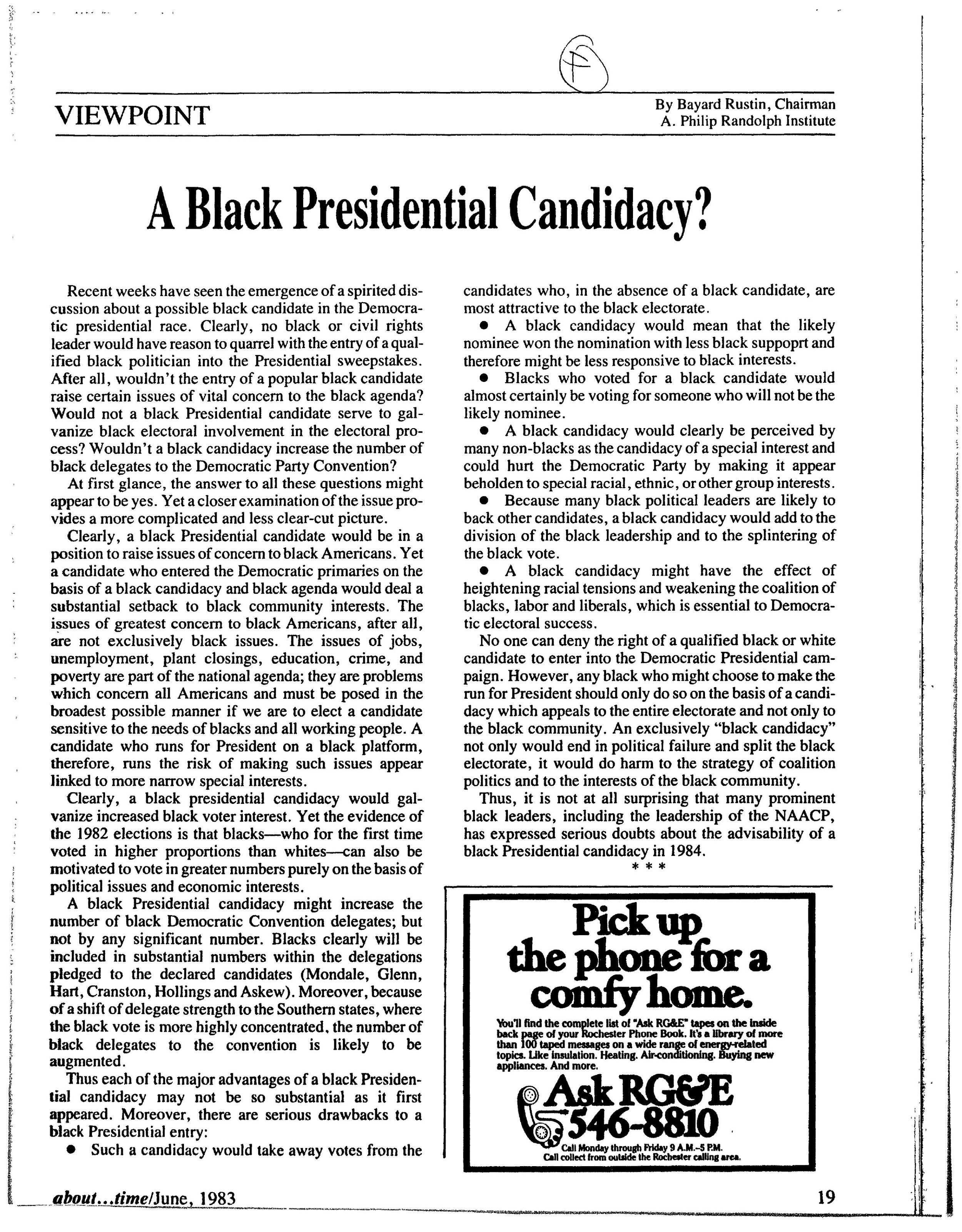
Rustin, Bayard. "A Black Presidential Candidacy?" Viewpoint, June 1983. Bayard Rustin Papers, Articles, Essays, Symposia Remarks, and Speeches, 1942-1987. ProQuest Archival Materials.
