Description
In this 1984 interview, civil rights attorney and activist Morris Abram reflects on the shifting alliances within the struggle for human rights, implicitly centering the coalition-building strategies of Bayard Rustin. Abram recounts his own political education in Georgia, tracing the path from the "Dixiecrat-Republican" alliance of the early 20th century to the sophisticated national lobbying efforts of the 1960s. Throughout his narrative, Abram underscores the necessity of the "triple alliance"—the union of labor, liberals, and Black activists—that Rustin famously championed as the only true "utility of politics" capable of achieving systemic economic change.
The dialogue provides a detailed analysis of how Rustin’s philosophy of universalism influenced the legal and political strategies of the era. Abram highlights that for the movement to succeed, it had to move beyond "moral appeals" to what Rustin called the "mature kind of politics" based on concrete policy results and interracial cooperation. By discussing the friction between race-specific agendas and broad national coalitions, Abram validates Rustin's consistent warning that "racial isolationism" would only empower reactionary forces and dismantle the democratic protections required for marginalized groups to thrive.
Historical Context
Conducted during the Reagan era, this 1984 interview serves as a retrospective on the "enduring disappointment" felt by many civil rights veterans who saw the progress of the 1960s being systematically challenged. This document aligns with Rustin's later framing of himself and the broader queer community as a "barometer and litmus paper" for human rights. Rustin argued that just as Black people had once served as the primary measure of social change, gay men and lesbians had become the central problem through which a society's commitment to fundamental human rights was tested.
Abram’s reflections on the history of Southern disenfranchisement provide the bedrock for understanding why Rustin insisted on the "professionalization" of the movement; without mastering the unglamorous work of precinct organizing, the moral victories of the past were seen as fragile. Ultimately, the interview positions Rustin as the primary intellectual architect of a strategy that recognized racial justice, economic planning, and universal human rights as inseparable components of a healthy American democracy.
See Full Transcript
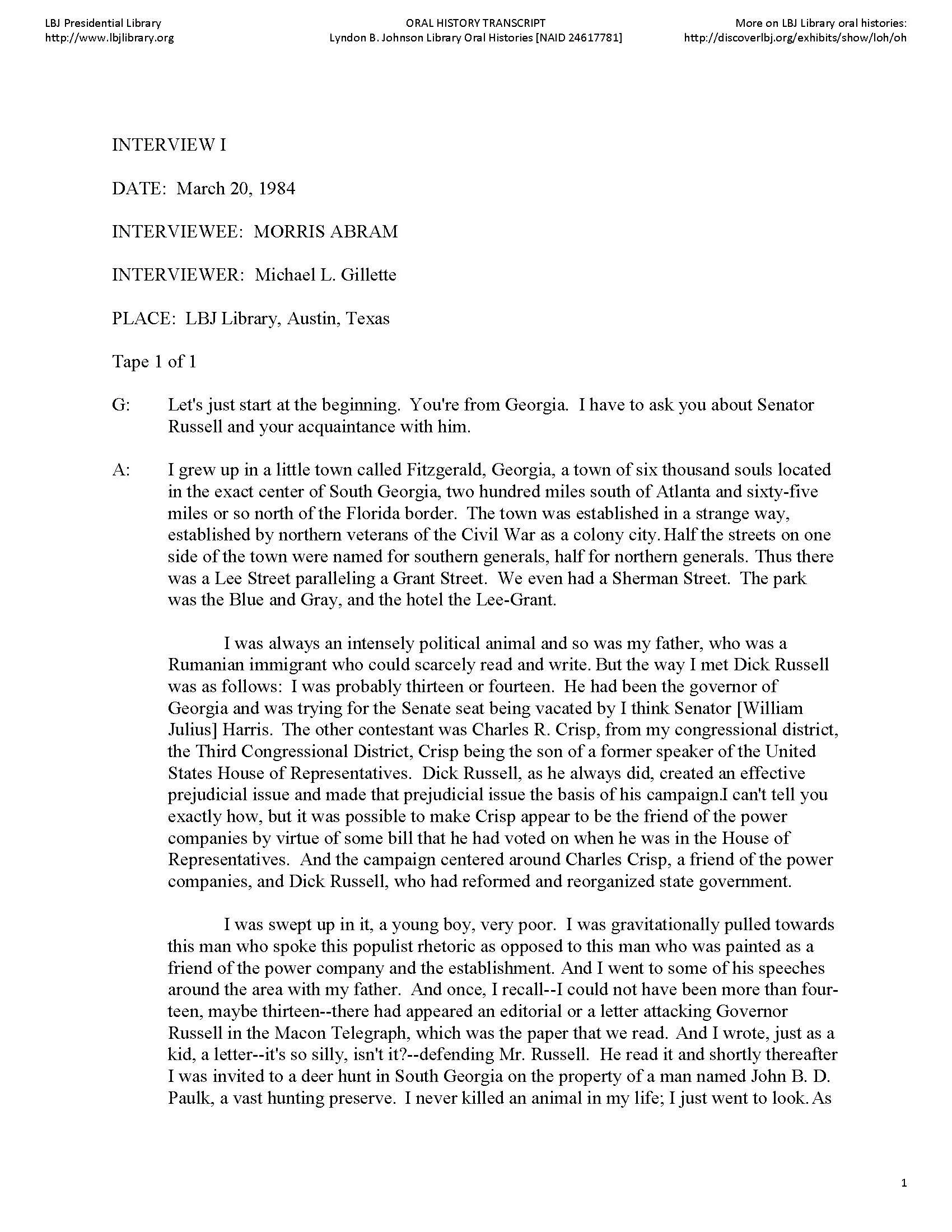
See Full Transcript
Abram, Morris. "Oral History Interview with Morris Abram." Interview by Michael L. Gillette. March 20, 1984. Lyndon B. Johnson Library Oral Histories.
