Description
In this second interview, Morris Abram continues his reflections on the "nature of politics" in the mid-20th century, discussing the evolution of liberal institutions and the role of leadership in a changing society. He uses the example of Bayard Rustin to illustrate the "utility of politics" in moving beyond narrow identity concerns toward a universalist "blueprint" for human rights. Abram emphasizes that Rustin’s "professional" approach to activism allowed him to remain a relevant and influential figure long after the "protest" phase of the movement had ended. He describes Rustin’s ability to build a "triple alliance" of interests as the essential factor in his success as an "architect" of social change.
The interview explores Rustin’s belief that the "long game" of social progress required a commitment to democratic processes and interracial partnership. Abram reflects on how Rustin navigated the "enduring disappointment" of the 1970s and 80s, where the focus shifted from dismantling de jure segregation to the more complex fight against de facto economic inequality. By maintaining his focus on coalition politics, Rustin provided a model for how marginalized groups could achieve real power without retreating into isolation or nationalism. Abram’s account reaffirms that Rustin’s legacy was defined by his insistence that racial justice was inextricably linked to the broad economic health of the entire nation.
Historical Context
This 1984 interview provides a retrospective look at the "revolutionary" 1960s from the vantage point of the early Reagan era, a period marked by a conservative shift in the "flavor" of American politics. Abram and Rustin were part of a generation of "liberal-labor" leaders who sought to preserve the gains of the "Great Society" against a backdrop of increasing political fragmentation. This was an era where the "professionalization" of the movement was complete, and figures like Rustin had transitioned into international human rights advocacy and institutional leadership.
Abram’s narrative underscores the "stamina" required to sustain a career in social justice through decades of shifting political winds. Rustin’s continued commitment to integration and coalition-building served as a constant corrective to those who favored more separatist or "sterile" paths. This document serves as a record of the "long game" of the civil rights movement, proving that the destruction of the "legal foundations of racism" was only the beginning of a larger, ongoing effort to "reconstruct the face of the nation" into a community of mutual respect and economic abundance.
See Full Transcript
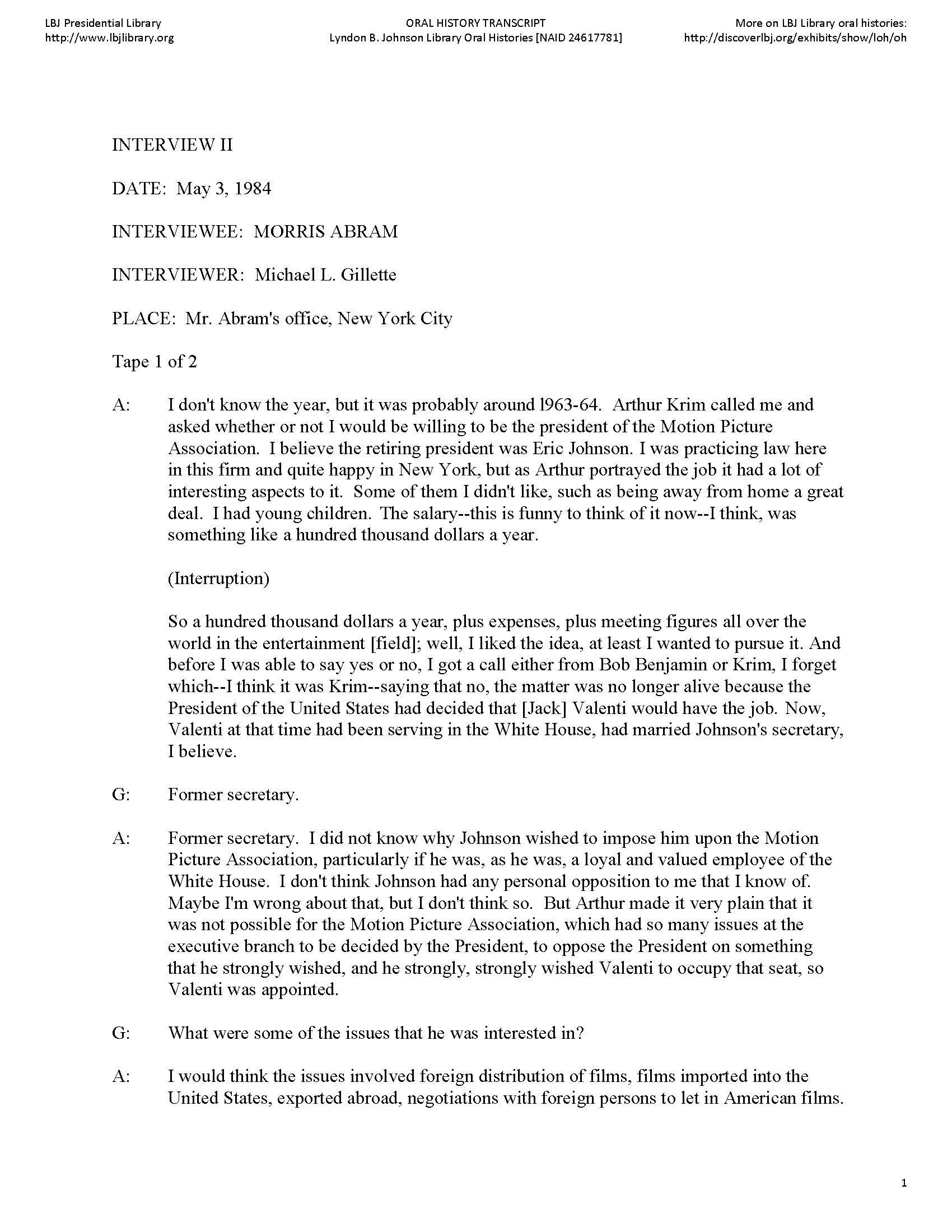
See Full Transcript
Abram, Morris. Interview by Michael L. Gillette, May 3, 1984. Oral History Transcript, Lyndon B. Johnson Library.
