
Please note: The exact date of this article is unknown.
Description
After the dramatic changes of the 1960s, Rustin describes the early 1970s as a time when the civil rights movement had to “grow up.” The fight was no longer about gaining basic rights—it was about using those rights effectively. He calls this new stage one of “political self-expression,” marked less by street protests and more by learning how to work within the democratic system. To show this progress, Rustin points to the huge rise in Southern Black voter registration, which jumped from 28% in 1960 to 66% by 1970, as well as the election of Black mayors in cities like Gary and Newark.
Rustin’s primary objective in this text is to urge a transition toward "professionalism and sophistication" in Black politics. He argues that the movement’s future depends on mastering the less glamorous but essential work of organizing precincts, lobbying lawmakers, and building coalitions. He sees a major opening in the South, where 33 congressional districts with sizable Black populations were still represented by segregationist politicians. With disciplined organizing and partnerships—especially with labor unions—Rustin believes these districts could be won, reshaping Congress in favor of progress.
He also warns against “racial isolationism,” the idea of focusing only on race-based politics. For Rustin, that approach weakens collective power. Instead, he urges building a broad, interracial coalition aimed at real economic change—programs like universal healthcare and stronger social welfare. This reasoning continues the ideas he introduced in The Professionalization of the Movement: Lessons from 1972, where he stressed that the goal wasn’t just electing Black officials, but creating a more just society through shared political power.
Historical Context
By 1972, the civil rights movement was deeply divided. Some leaders, representing the older generation, still pushed for integration and coalition-building, while the younger Black Power movement called for more independence and self-determination. The National Black Political Convention in Gary, Indiana, captured this divide. Rustin passionately defended his “Coalition Politics” approach, warning that forming a separate Black political party would only isolate Black voters from potential allies in labor and liberal circles. He believed lasting equality could only be achieved by working within the Democratic Party and with unions.
This was also the era of President Richard Nixon, whose “Southern Strategy” sought to strengthen white conservative support by stoking racial fears. Rustin saw Nixon’s presidency as an effort to undo the progress of the 1960s, including gains from the “War on Poverty.” His call for political professionalism was an attempt to counter this conservative wave by strengthening the democratic left. He argued that while the civil rights movement had won key legal battles—like ending the poll tax—the real task ahead was learning how to govern and shape policy through elections.
The tension between symbolic victories and practical power was especially visible during Shirley Chisholm’s 1972 presidential campaign. While Rustin admired the historic significance of her run, he worried that her candidacy might split the liberal vote and help Nixon win reelection. His reflections reveal a consistent theme in his thinking: the civil rights movement needed discipline, strategy, and political skill—not just emotion or symbolism—to survive and move forward in an era that was becoming less supportive of social reform.
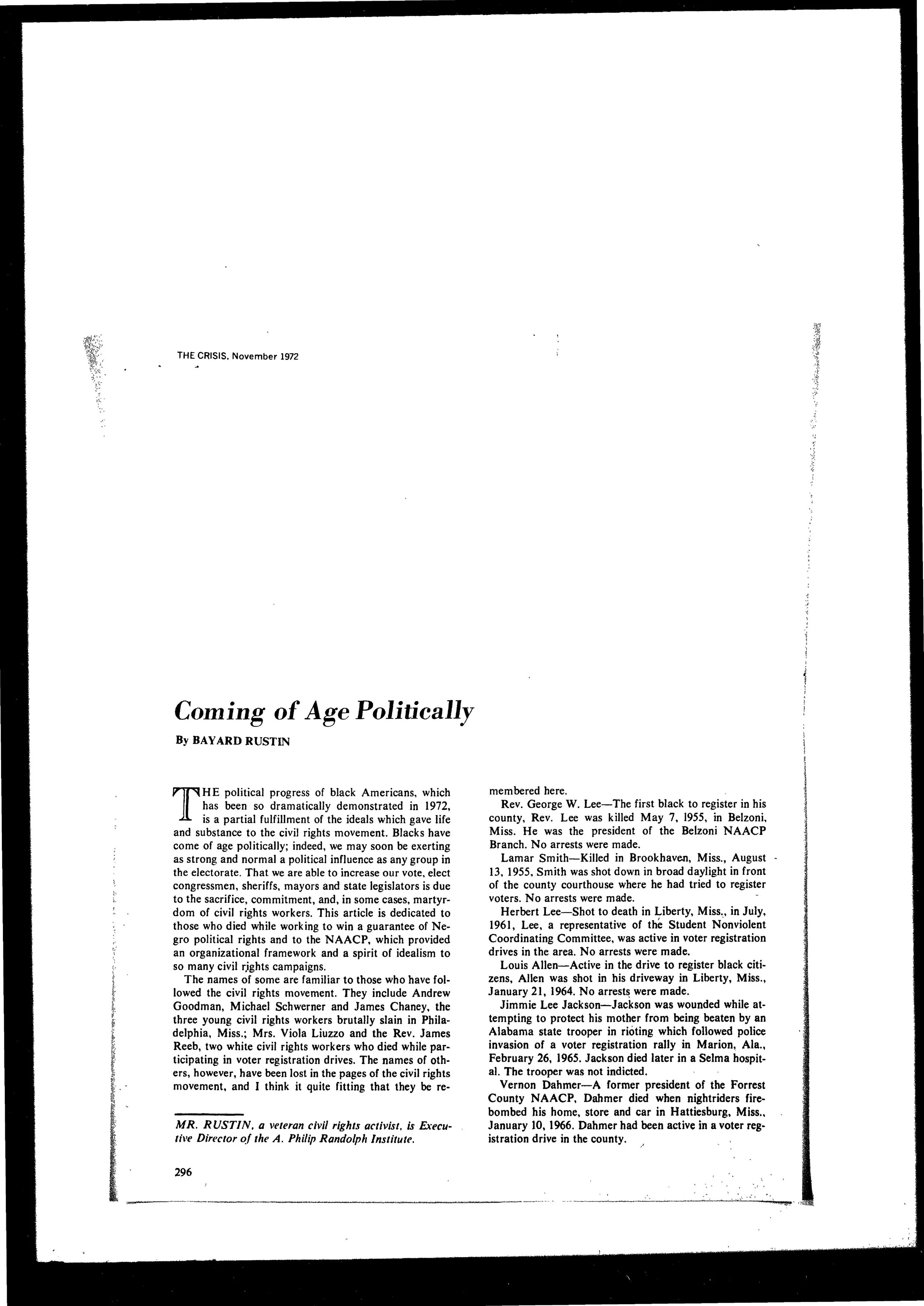
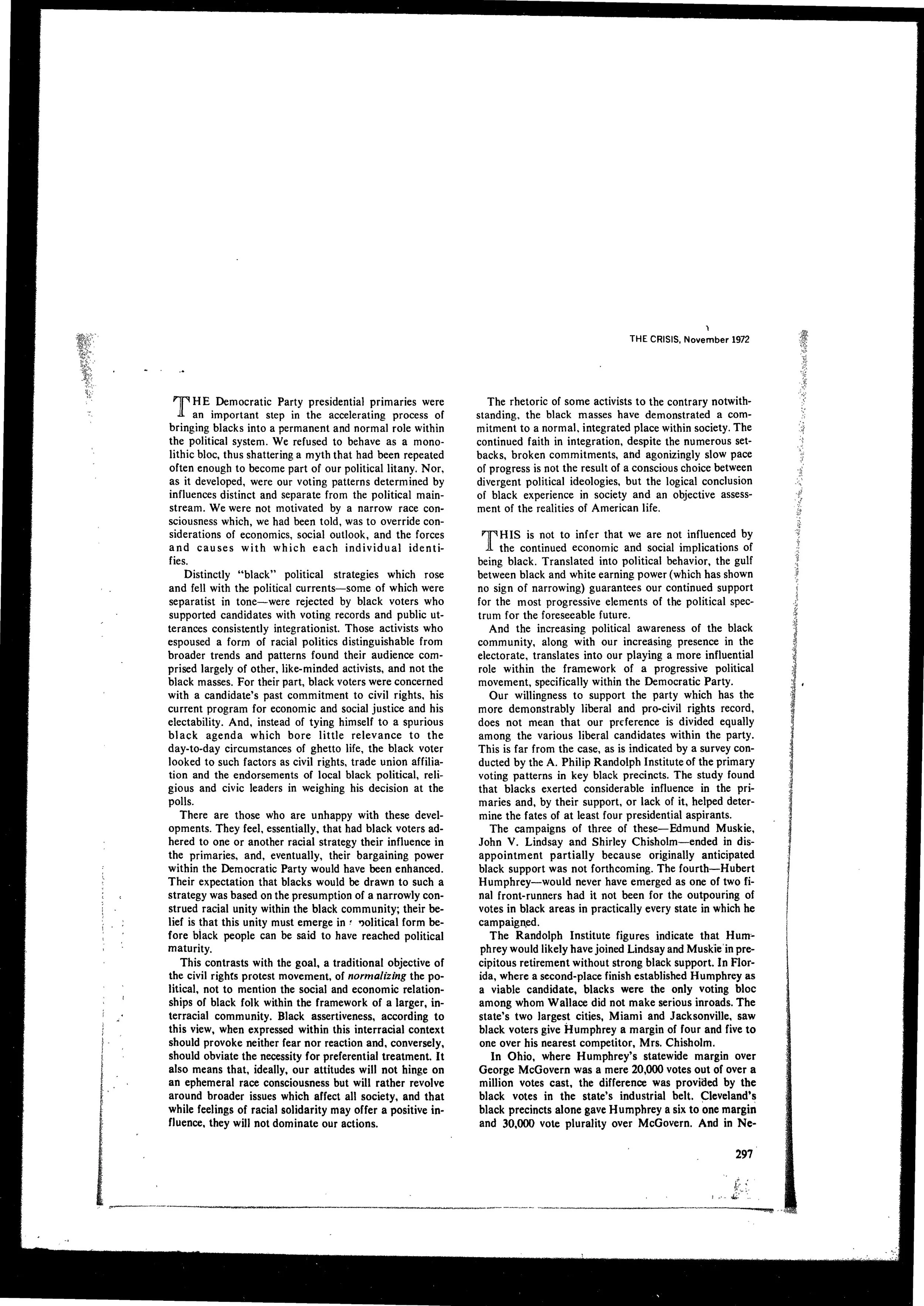
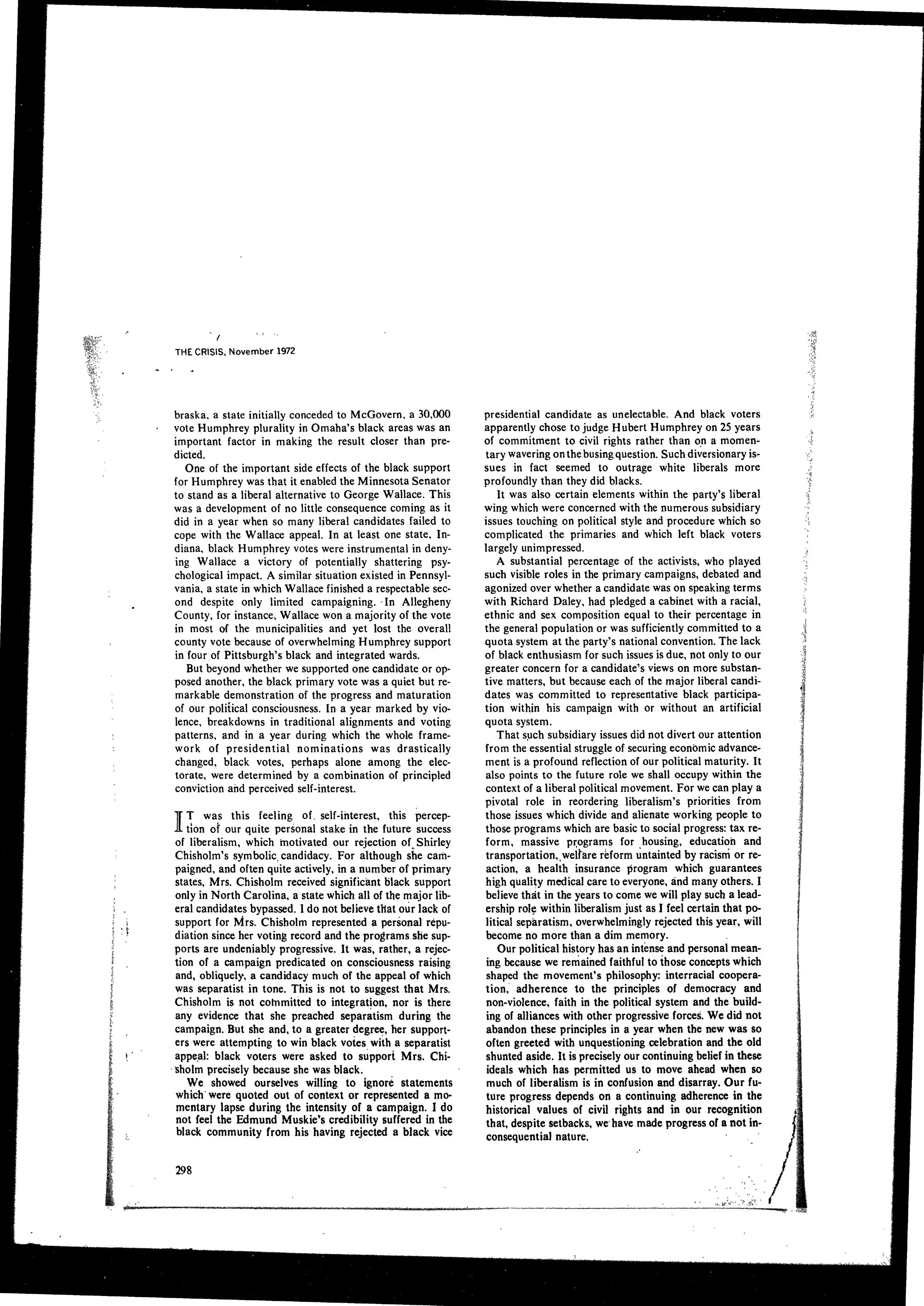
Rustin, Bayard. "Coming of Age Politically." November 1972. Bayard Rustin Papers, Articles, Essays, Symposia Remarks, and Speeches, 1942-1987. ProQuest Archival Materials. Accessed via Princeton University Ezproxy. https://login.ezproxy.princeton.edu/login?url=https://www.proquest.com/archival-materials/bayard-rustin-articles-on-african-americans/docview/2595042694/se-2.
