
Description
In this American Teacher news report covering the American Federation of Teachers (AFT) convention in Honolulu, Bayard Rustin argues that teachers hold a central role in fixing the nation's severe economic crisis and lifting the country out of depression. Rustin tells delegates that this address is the most important one he will give all year, emphasizing that ordinary people cannot rise economically unless teachers first prepare and train them for modern life. He points out that while physical muscle power used to be enough to succeed in America, the modern economic system demands skilled training, placing a heavy responsibility on the public school system to do what families can no longer accomplish alone.
Rustin addresses the changing landscape of social protest, noting that the civil rights movement of the 1960s—focused on school choice, voting rights, and public accommodations—is over, and that demands are now centered on economic survival. He points out a stark economic reality: for every Black person asking for a job or a house, there are multiple white workers who also lack them, proving that the struggle has shifted from race alone to deep economic barriers. Defending the labor movement against its critics, Rustin praises the AFL-CIO and defends union seniority systems as vital protections won by groups like the NAACP and Urban League to keep workers from being fired at a boss's whim. He closes by championing full employment through public works—building much-needed schools, hospitals, and day-care centers—and highlights the groundbreaking success of the United Federation of Teachers (UFT) paraprofessional program in New York City for giving low-income minority workers true career mobility and dignity.
Historical Context
By the summer of 1975, the United States was gripped by severe "stagflation," soaring unemployment exceeding ten percent under the Ford administration, and deep fiscal crises in major cities like New York. The labor movement and public sector unions, including the AFT led by Albert Shanker, faced intense political attacks, budget cuts, and widespread skepticism about the effectiveness of public services and union seniority rules during a contracting economy.
As President of the A. Philip Randolph Institute, Bayard Rustin traveled to the 1975 AFT convention to rally public school teachers behind a broader social and economic agenda. He pushed back against growing racial and economic divisions by insisting that teachers and trade unionists form a united front with minority communities. By tying educational reform directly to labor solidarity and a federal full employment economy, Rustin sought to convince educators that their professional survival was inseparable from the broader working-class fight against economic depression.
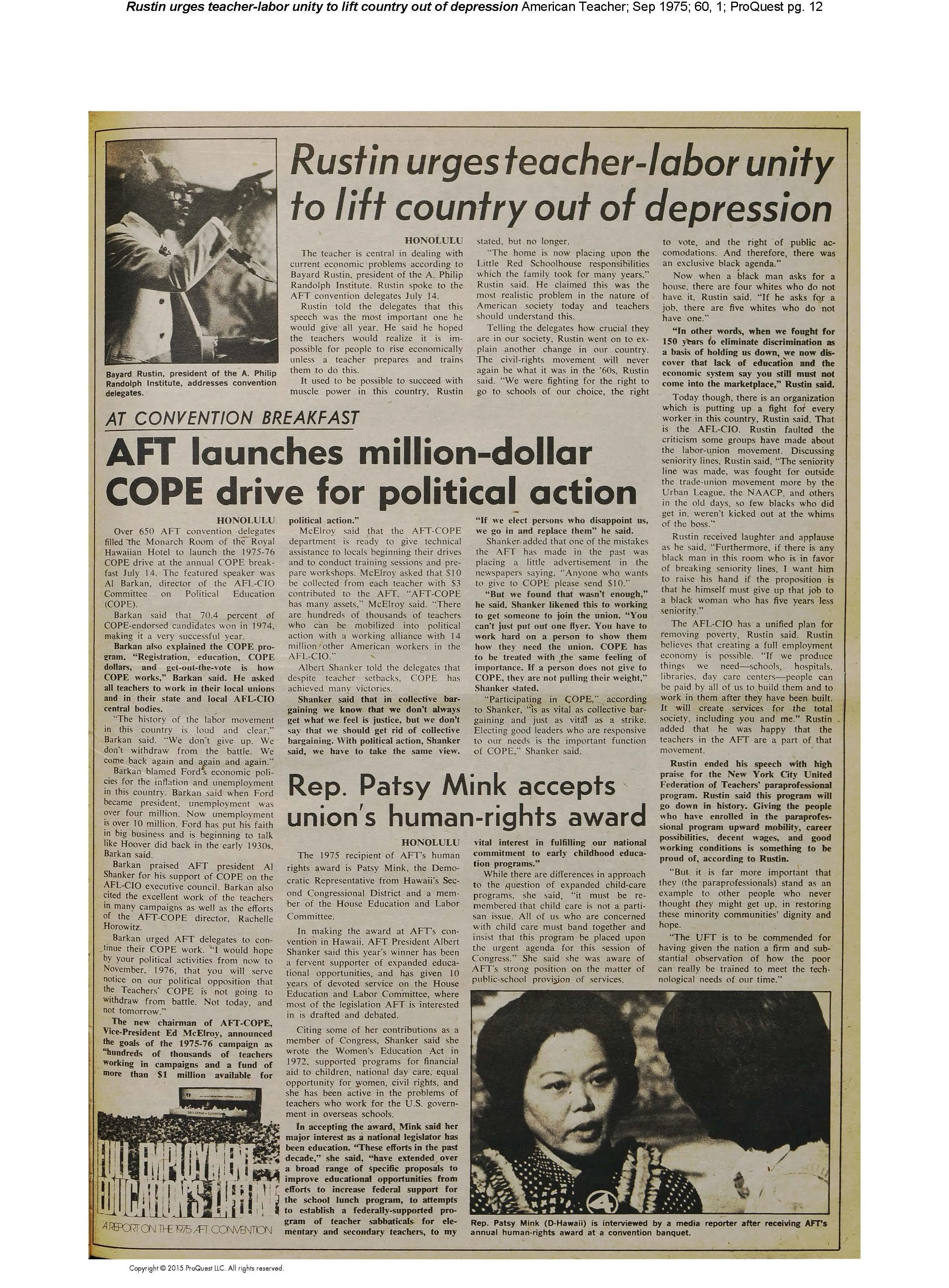
"Rustin urges teacher-labor unity to lift country out of depression." American Teacher 60, no. 1 (September 1975): 12.
