Description
In this published group discussion from Fellowship magazine, Bayard Rustin joins Catholic priest Peter Riga, sociologist Charles R. Lawrence, and rabbi Everett Gendler to debate the moral and political realities of the mid-1960s. Rustin argues that in times of deep revolutionary upheaval, traditional political calculations—or realpolitik—fail completely, and that pursuing what cynics call "utopian" moral truths is actually the only practical way forward. He emphasizes that true peace cannot exist without structural justice, pointing out that freedom must precede peace for oppressed people worldwide, whether in segregated American cities or under colonial apartheid in Africa. Rustin insists that nonviolent activists must be fully prepared to lose minor battles and face state hostility, because building justice into society's institutions is the only way to break endless cycles of revenge.
Later in the discussion, Rustin fields direct questions about the brutal daily conditions in Harlem, noting that ordinary violence within neglected slums vastly outweighs the violence of public riots. He tackles the alienation expressed by militant figures like Malcolm X, arguing that while white society created the sick conditions that bred such bitterness, the true miracle is that thousands of Black children manage to survive slum poverty without becoming embittered. When asked about federal government intervention, Rustin maintains that activists must rely on Washington for massive economic solutions while keeping the pressure on through direct action. He closes by asserting that the civil rights movement must push past legal victories into deeper economic struggles, warning that automation and joblessness require radical government action, such as public works and full employment, to give real meaning to human dignity.
Historical Context
This 1965 panel conversation took place at a major turning point in modern American history, occurring just as the civil rights movement transitioned from securing Southern voting rights to confronting the deep economic and institutional decay of Northern urban ghettos. The escalating conflict in Vietnam was also sharply dividing religious and pacifist groups, forcing anti-war activists and civil rights leaders to grapple with how domestic racial injustice connected to American foreign imperialism in the Third World. Progressive religious thinkers, Catholic priests, and Jewish rabbis were increasingly joining radical pacifists in questioning traditional American institutions and searching for a moral vocabulary robust enough to address both racial segregation and global war.
By the spring of 1965, the Johnson administration had formally initiated Operation Rolling Thunder and escalated U.S. ground troop deployments to Vietnam, triggering fierce protests across college campuses and within pacifist networks like the Fellowship of Reconciliation. Domestically, Congress was debating the mechanics of the landmark Voting Rights Act following the historic Selma marches, while inner-city communities across the North remained heavily segregated and economically deprived. In this precise historical moment, religious and secular leaders were desperately trying to reconcile the moral urgency of domestic civil rights with the mounting moral crisis of foreign military intervention.
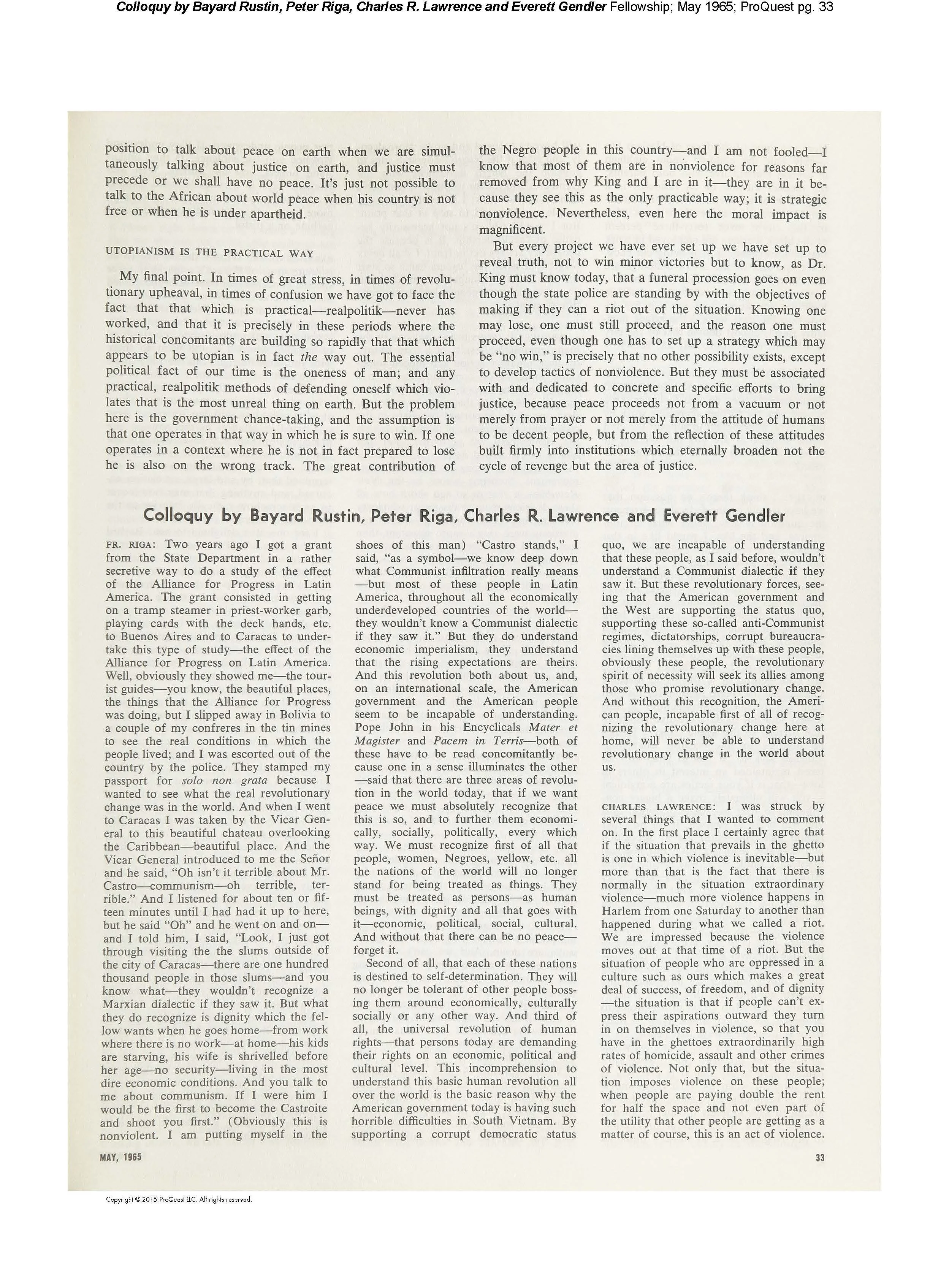
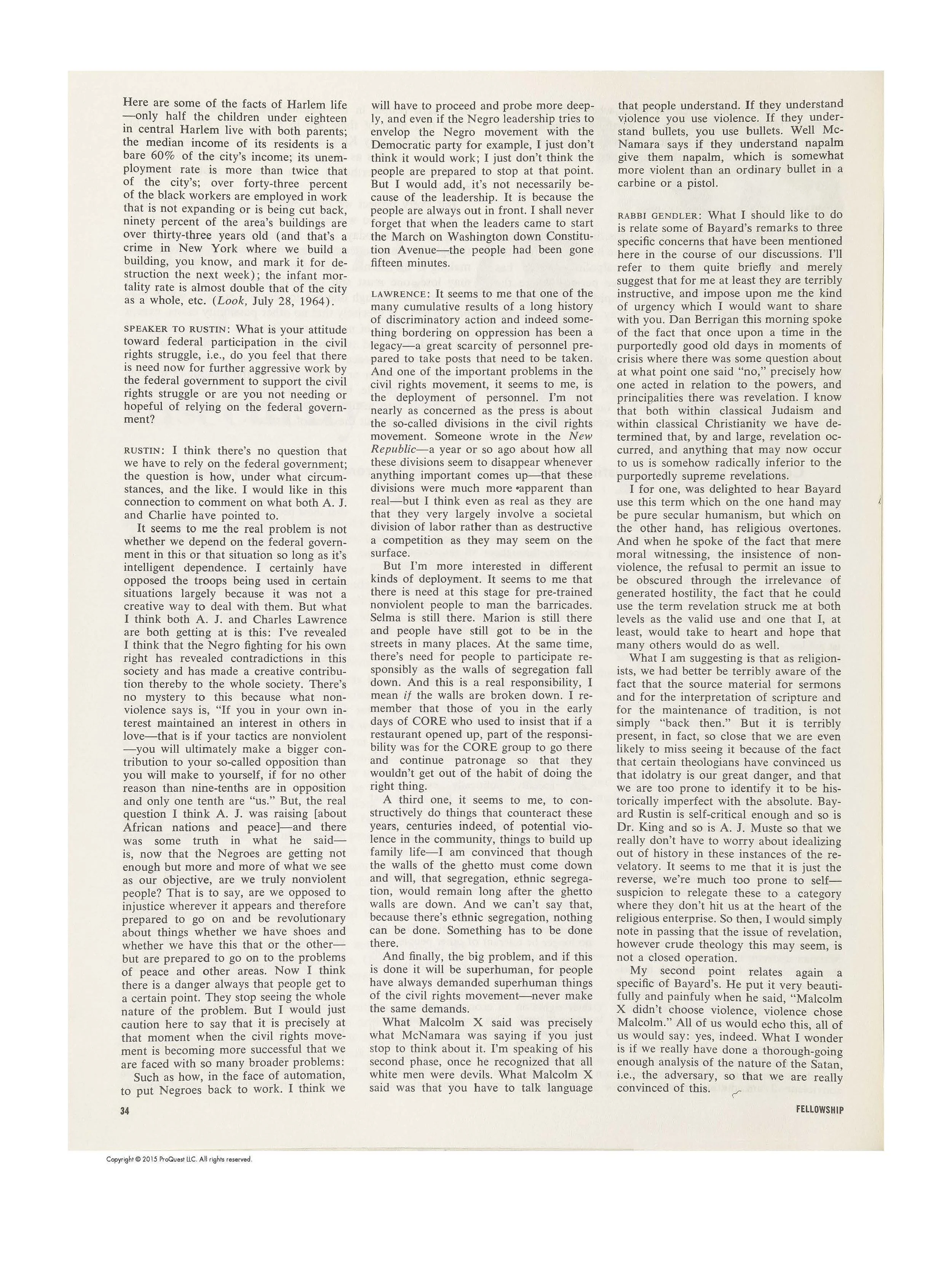
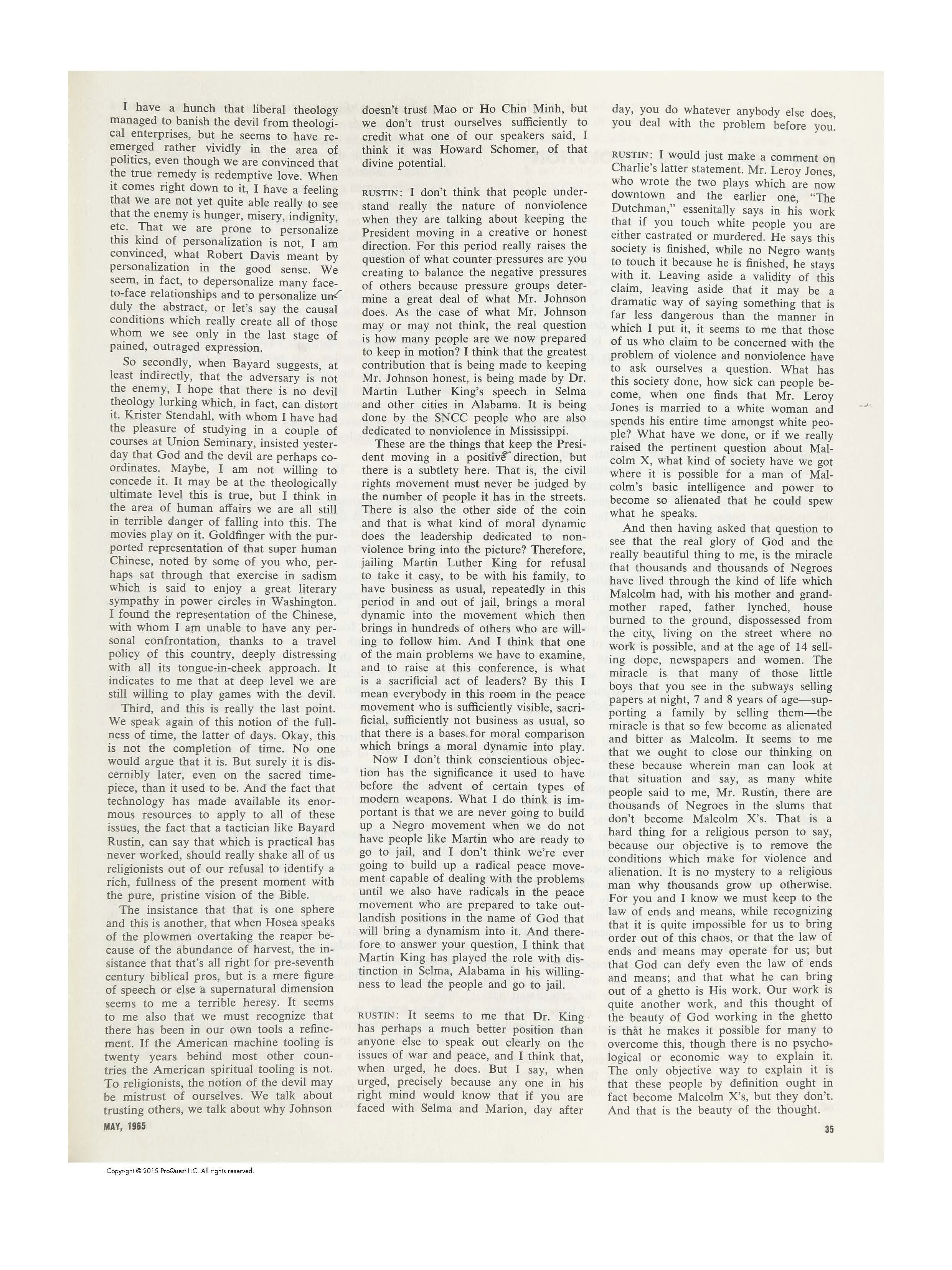
Rustin, Bayard, Peter Riga, Charles R. Lawrence, and Everett Gendler. "Colloquy." Fellowship 31, no. 5 (May 1965): 33–35.
