Description
In these two personal reports published in Fellowship magazine, Bayard Rustin shares his real-life experiences putting his body on the line against racial segregation while traveling as a youth organizer for the Fellowship of Reconciliation. In the July 1942 report, he describes boarding a bus from Louisville to Nashville and calmly refusing the driver's demand to move to the back, stating plainly that obeying an unjust law means cooperating with evil. When four police officers board the bus and brutally beat him about the head and shoulders, Rustin refuses to fight back or raise his hands in self-defense. He knows that any physical defense will be used by the police as an excuse to beat him further, so he stays completely still, stands up with open arms, and tells them he offers no resistance. He gets dragged off the bus, arrested, insulted in a police cruiser while writing down Bible verses from memory, and brought before an official who is ultimately disarmed by his calm truthfulness and releases him without a criminal record.
In the second report from October 1942, Rustin details two more clashes with Jim Crow in Cape May, New Jersey, and Baltimore, Maryland. While attending a Quaker conference at Cape May, he refuses to use a designated "colored beach," believing that accepting segregation is just as morally wrong as white racism. He and several white friends walk onto the main public beach, keep the conversation friendly and humorous while lifeguards and managers try to remove him, and simply stay until the authorities give up, successfully opening the beach to local Black residents. Later that year in Baltimore, after arriving by train on a rainy night, taxicab drivers refuse to pick him up because of his race. Rustin stands his ground in the narrow station driveway, blocking traffic in the pouring rain for ninety minutes until a driver finally gives in and takes him where he needs to go.
Through these stories, Rustin lays out the practical truth of nonviolent direct action against racial caste systems. He shows that sitting back and accepting Jim Crow only helps keep oppression alive, whereas disciplined, fearless non-cooperation exposes the ugliness of segregation and forces authorities to deal with their own wrongdoings. Rather than begging for small favors, Rustin proves that standing firm without hate creates a powerful moral force that breaks down racist traditions and forces real change.
Historical Context
These 1942 reports come from a time when early civil rights workers were first turning the nonviolent philosophy of the Indian independence movement into practical weapons against American apartheid. Long before the famous sit-ins and Freedom Rides of the 1960s, radical pacifists associated with groups like the Fellowship of Reconciliation began testing direct action against segregated public spaces in the North and Upper South. These early efforts faced immense hostility from a society where segregation was heavily backed by local laws, courts, and everyday social pressure, while mainstream civil rights groups still relied mostly on court battles and polite lobbying.
This work happened right in the middle of World War II, a time when America claimed to be fighting foreign tyranny abroad while aggressively practicing racial segregation at home. Pacifists saw this massive hypocrisy as an opening to challenge domestic racism through direct, public resistance. By writing down his arrests and physical beatings on buses, beaches, and city streets, Rustin gave the anti-war and civil rights movements a clear manual for action, proving that ordinary people could break down Jim Crow through planned personal courage.
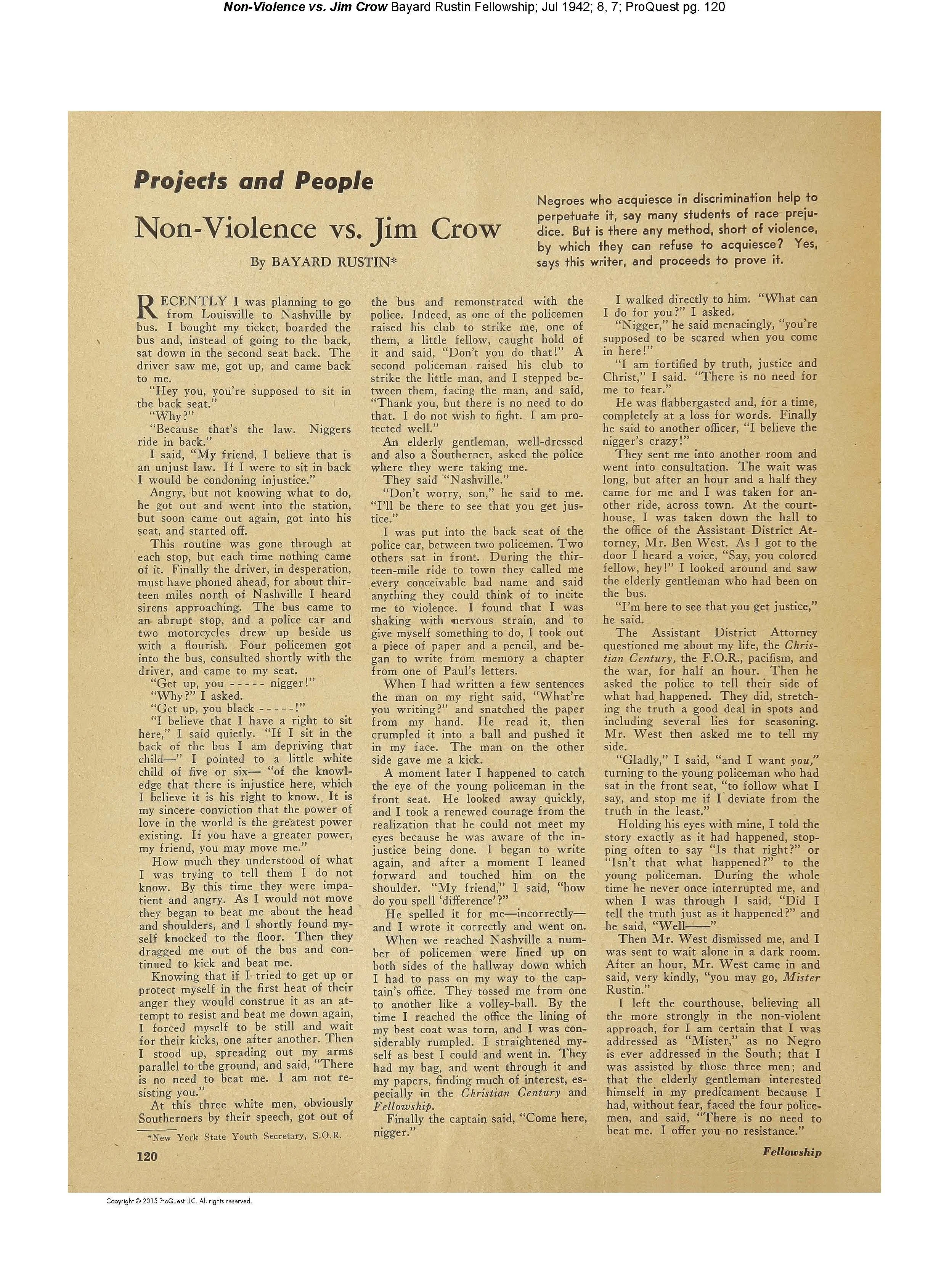
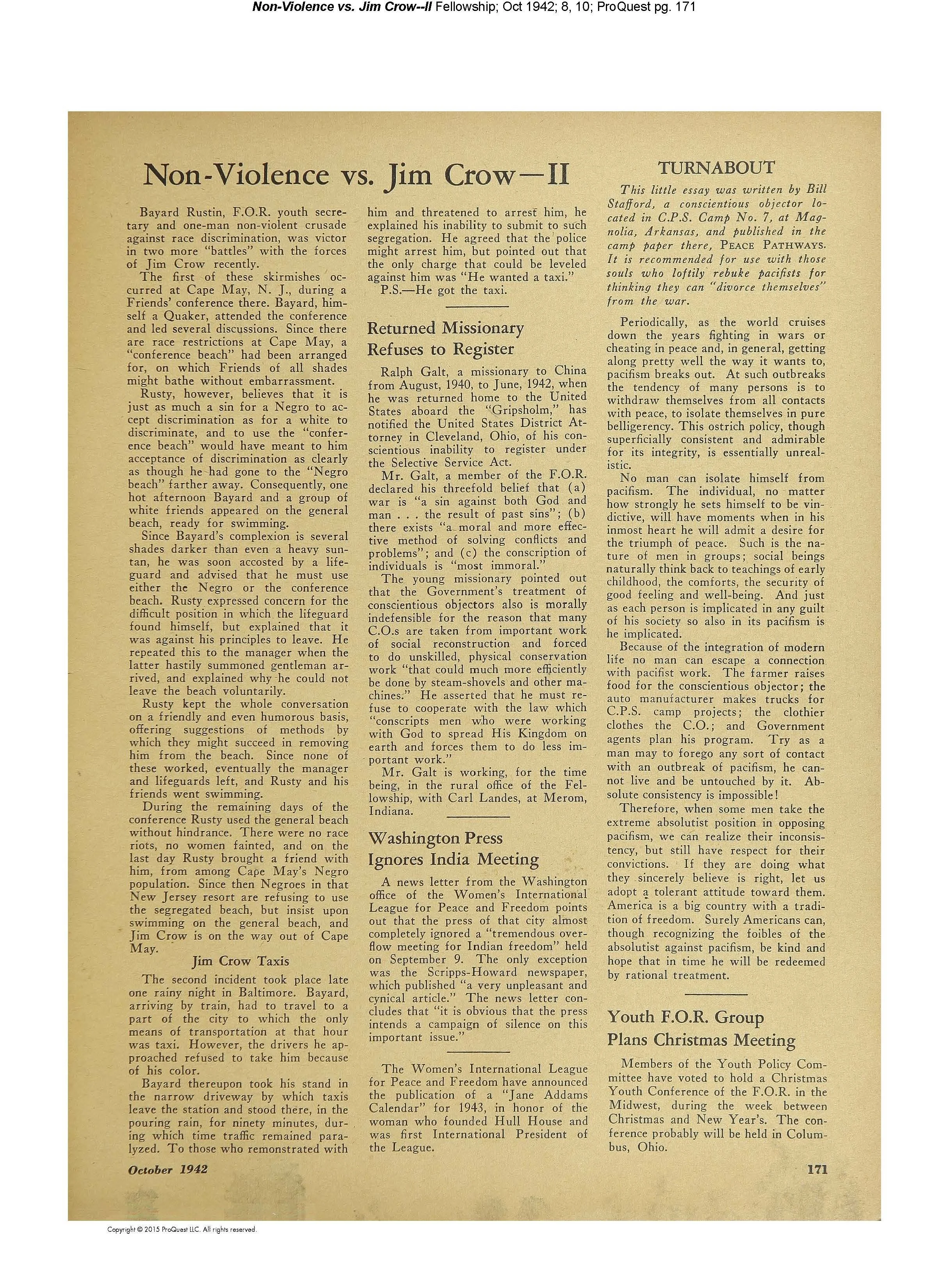
Rustin, Bayard. "Non-Violence vs. Jim Crow." Fellowship 8, no. 7 (July 1942): 120; Rustin, Bayard. "Non-Violence vs. Jim Crow—II." Fellowship 8, no. 10 (October 1942): 171.
