
Description
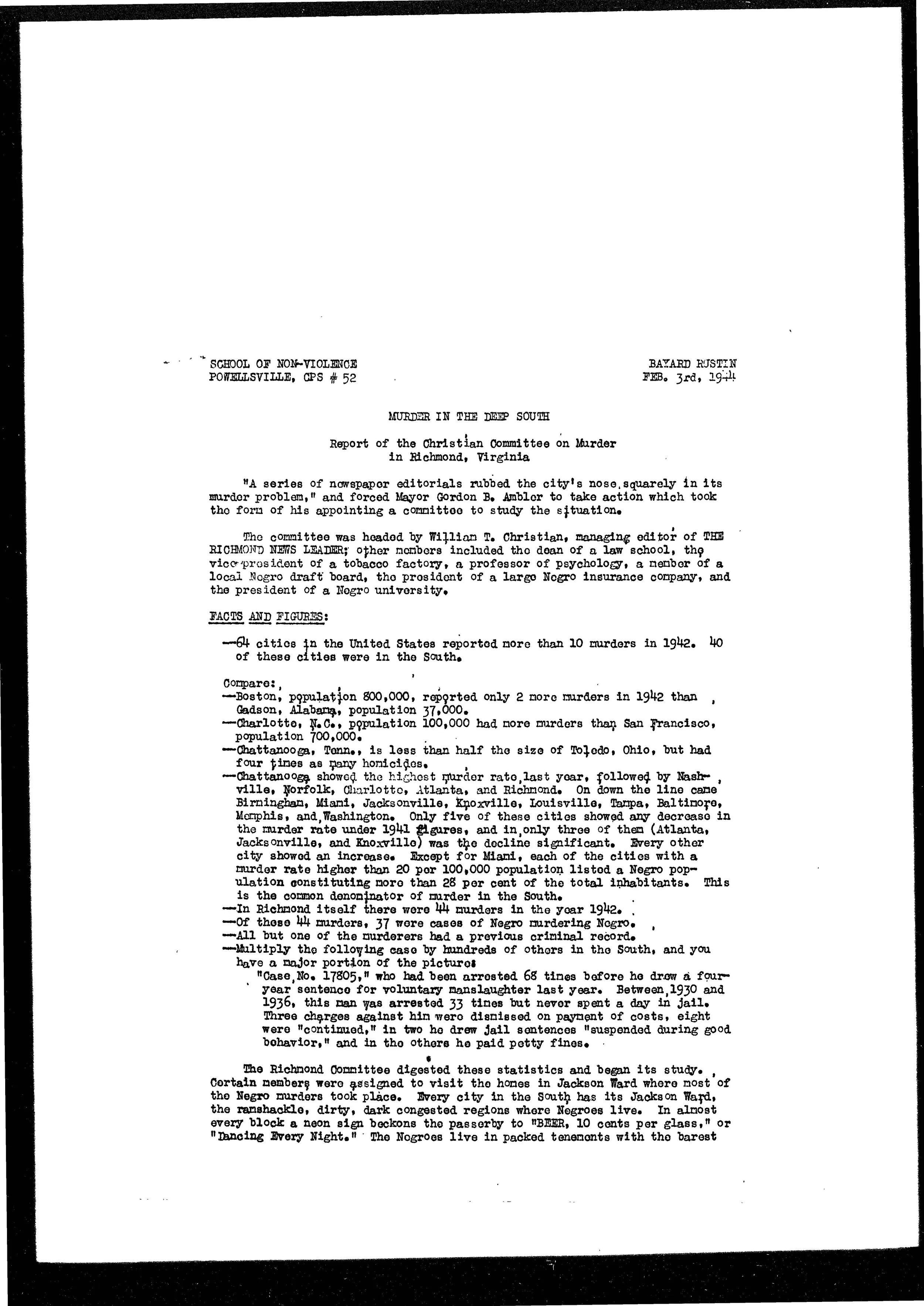
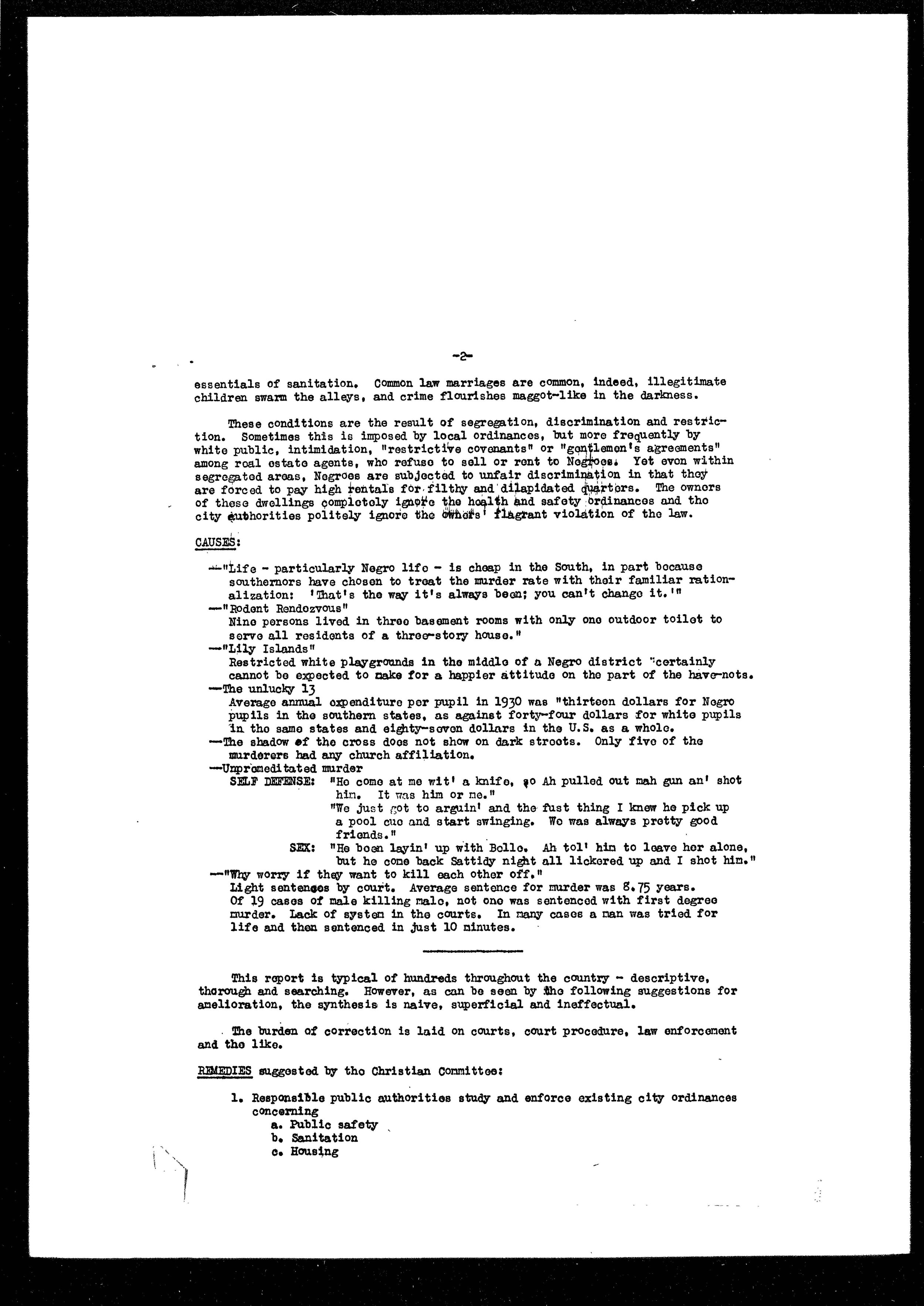
In this paper prepared for the School of Non-Violence at Civilian Public Service (CPS) Camp No. 52 in Powellsville, North Carolina, Bayard Rustin reviews an official investigation into soaring homicide rates in Richmond, Virginia. The original inquiry, ordered by Richmond Mayor Gordon B. Ambler and led by newspaper editor William T. Christian, was triggered by heavy newspaper coverage of local murders. Rustin extracts the report's startling statistics, pointing out that 40 of the 64 American cities with more than ten murders in 1942 were in the South, and that in Richmond, 37 of the city's 44 homicides that year involved Black victims and perpetrators. The official report documented miserable living conditions in segregated districts like Jackson Ward—where families lived crammed into dark, rat-infested tenements with outdoor toilets while white-only playgrounds sat in the center of Black neighborhoods. It also exposed a broken legal system that treated Black lives as cheap, frequently sentencing men convicted of life-and-death offenses in casual, ten-minute trials and giving light prison sentences under the racist assumption that Black-on-Black homicide did not warrant serious concern.
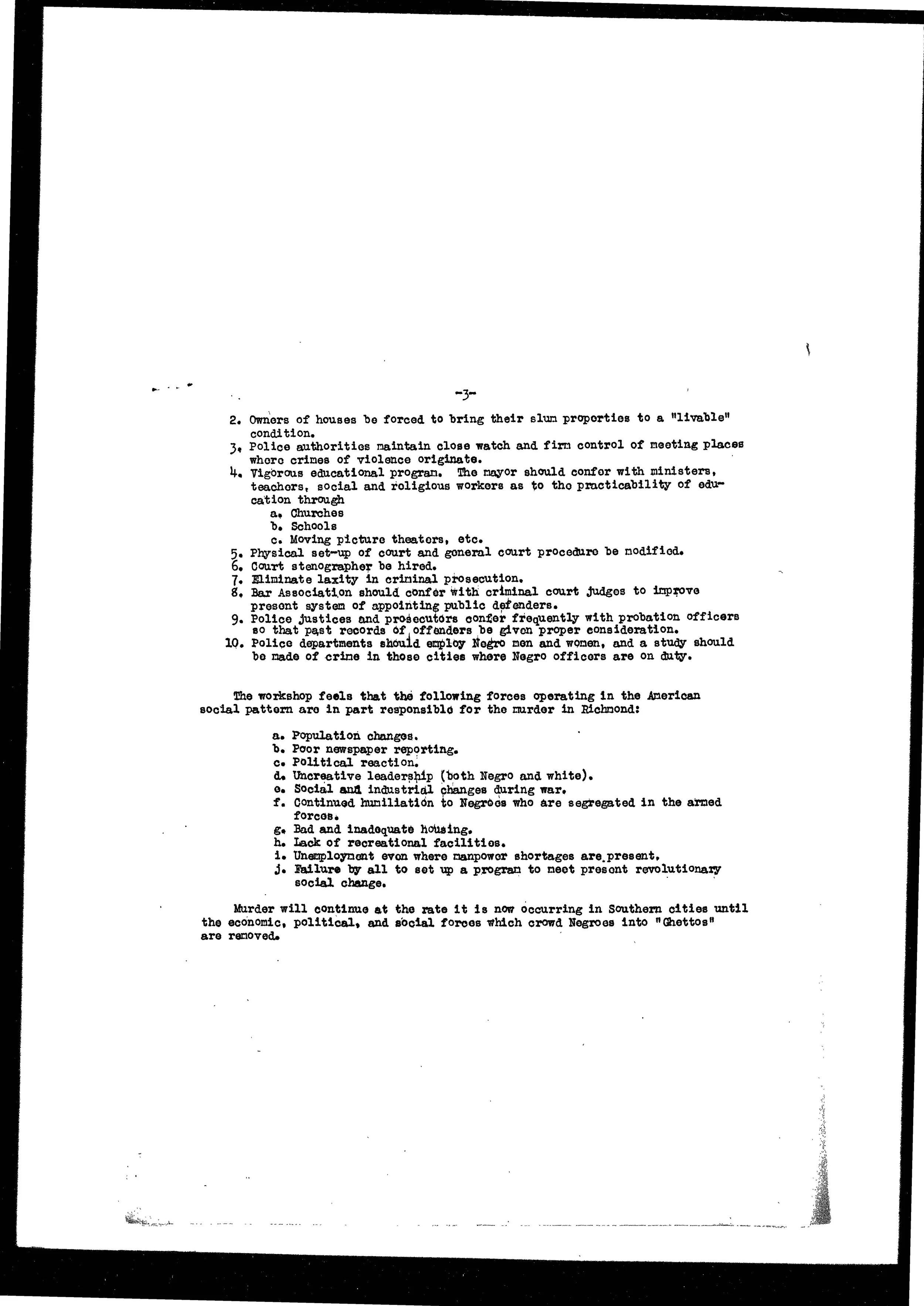
While praising the Christian Committee for documenting these harsh facts, Rustin delivers a direct critique of its proposed remedies. The committee suggested administrative Band-Aids: hiring court stenographers, tightening probation, modifying courtroom procedures, launching moral lectures in churches, and enforcing housing codes. Rustin dismisses these proposals as naive and superficial because they place the blame on court routines and individual behavior rather than systemic oppression. He argues that violent crime in Southern cities is not an accident or a moral failing of Black people, but the direct consequence of restrictive covenants, price-gouging landlords, unequal public schooling, and the daily humiliation of Jim Crow. Rustin insists that until the political, social, and economic structures that force Black citizens into crowded, neglected ghettos are completely destroyed, urban violence will inevitably continue.
Historical Context
This report was written at the midpoint of World War II, a period marked by massive wartime industrial expansion and the rapid, crowded migration of both Black and white laborers into Southern and Northern cities. The wartime emergency placed immense pressure on Southern urban infrastructure, worsening residential segregation and stretching inadequate city services to the breaking point. In segregated Southern cities like Richmond, local governments preserved white political and economic dominance by confining Black residents to neglected municipal wards through informal covenants and landlord collusion. When social strains surfaced as violent street crime and intra-racial homicide, white city leaders and conservative media often treated the problem as an issue of criminal law enforcement rather than addressing the municipal neglect, housing shortages, and poverty that created it.
Rustin produced this curriculum paper while assigned to CPS Camp No. 52 in Powellsville, North Carolina, where conscientious objectors performed public service during the war. Through educational initiatives like the School of Non-Violence, Rustin and other radical pacifists examined the structural roots of domestic racism and violence, using real-world municipal studies to train fellow war resisters. By analyzing the Richmond report, Rustin cut through the liberal assumptions of Southern civic committees, showing that white paternalism could not reform a carceral system built upon segregation. The text documents a key moment in Rustin's early intellectual career, showing how he moved beyond conventional pacifist moralizing toward a materialist critique of urban decay, legal double standards, and institutional racism.
Rustin, Bayard. "Murder in the Deep South: Report of the Christian Committee on Murder in Richmond, Virginia." School of Non-Violence, Powellsville CPS Camp No. 52, February 3, 1944.
