Description
In this column Bayard Rustin argues that organized labor has lifted more Americans, including Black Americans, out of poverty than any other institution. He opens by endorsing this assessment from Harry Van Arsdale, president of the New York City Central Labor Council, while acknowledging that some unions have practiced racial discrimination. Rustin traces Black economic advancement to the union organizing drives of the Depression and argues that greater economic security helped make the civil rights protests of the 1950s and 1960s possible. He identifies the Freedom Budget for All Americans as a program connecting labor’s economic demands with the unfinished Black freedom struggle. As evidence of that connection, he cites the AFL-CIO Executive Council’s September 12 resolution calling for one million public-service jobs, 2.5 million new housing units, expanded mass transit, and faster construction of public facilities.
Rustin then explains how access to skilled employment can change through organized recruitment and training rather than promises alone. He reports that the Joint Apprenticeship Training Program of the Workers Defense League and the A. Philip Randolph Educational Fund has placed more than 300 Black and Puerto Rican young men in building-trades unions in New York City and Westchester County over three years. The program recruits applicants, provides counseling and tutoring, and has opened offices in Cleveland, Buffalo, and Newark. Rustin credits program head Ernest Green, the AFL-CIO Civil Rights Department, and Peter Brennan, president of the New York Building Trades Council, with helping secure cooperation. He also describes temporary employment supplied by garment, teachers’, and automobile workers’ unions, alongside expanded apprenticeship opportunities and summer jobs through Local 3 of the International Brotherhood of Electrical Workers. His argument is practical: removing discrimination requires preparation, placement, union cooperation, and sustained access to paid work.
Historical Context
By the autumn of 1967, the uprisings in Newark and Detroit had made employment discrimination, poor housing, unequal public services, and police mistreatment urgent national issues. These conflicts exposed how little access to economic security many Black urban residents had, despite the civil rights victories of the preceding years. In the construction industry, exclusion from skilled trades and apprenticeship opportunities had become a particular point of confrontation: publicly visible building projects did not necessarily provide jobs for the Black and Puerto Rican communities around them. Rustin’s article belongs to this struggle over whether organized labor would remain a barrier to opportunity or help open a reliable path into better-paid work.
The immediate circumstances included both a new labor policy commitment and efforts to change hiring practices. On September 12, 1967, the AFL-CIO Executive Council adopted an urban-crisis resolution calling for public-service jobs, housing construction, mass transit, and public facilities. Meanwhile, the apprenticeship partnership involving the Workers Defense League and the A. Philip Randolph Educational Fund was expanding beyond New York into Cleveland, Buffalo, and Newark. These developments gave Rustin concrete evidence with which to answer criticism of unions without denying their discriminatory practices. Herbert Mitgang’s November 9 letter confirms that the New York Times was considering the article for publication at this moment, although the surviving correspondence does not establish a specific commission or publication date. The article intervened in an immediate dispute over who could deliver jobs and whether integration could be achieved through cooperation with unions.
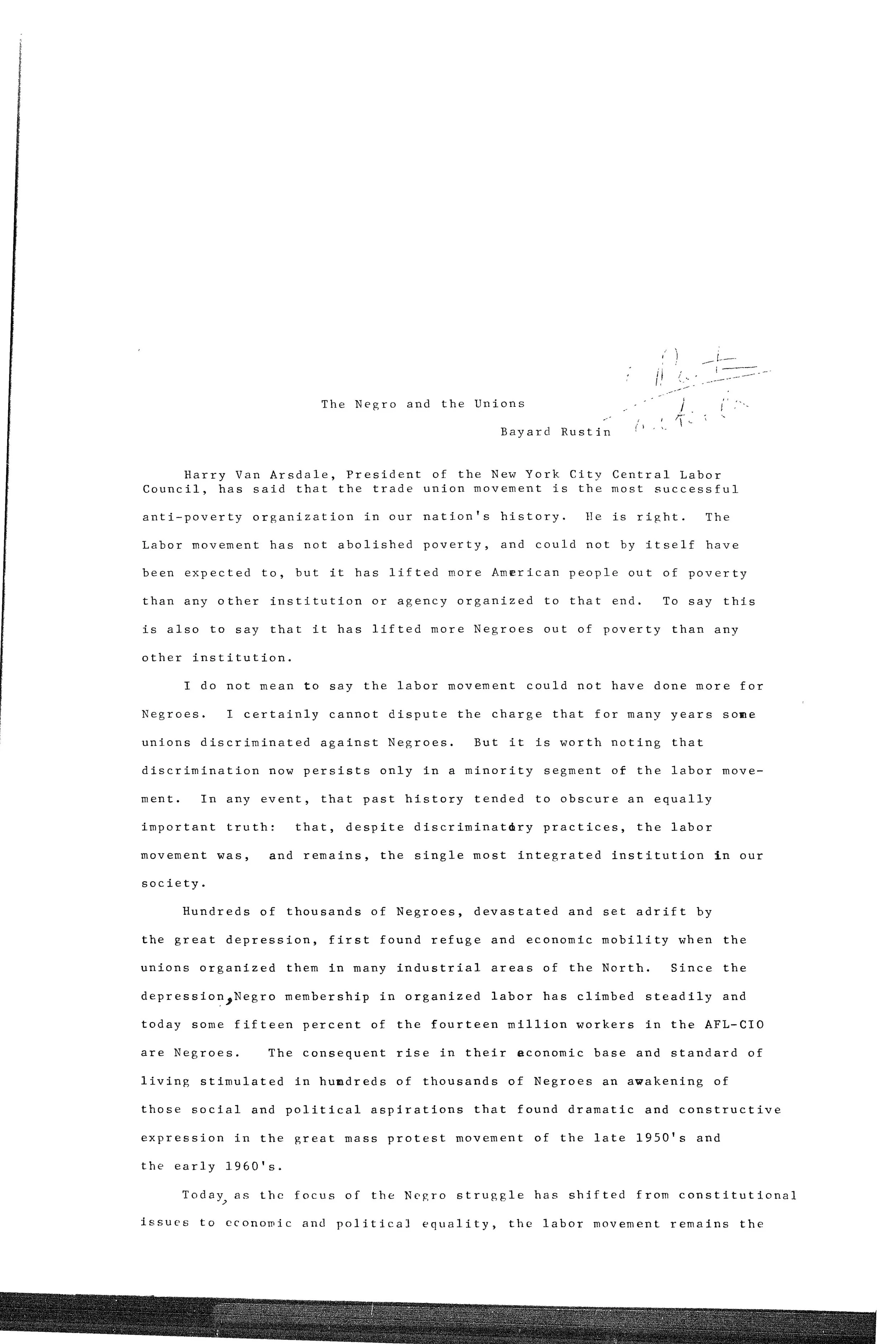
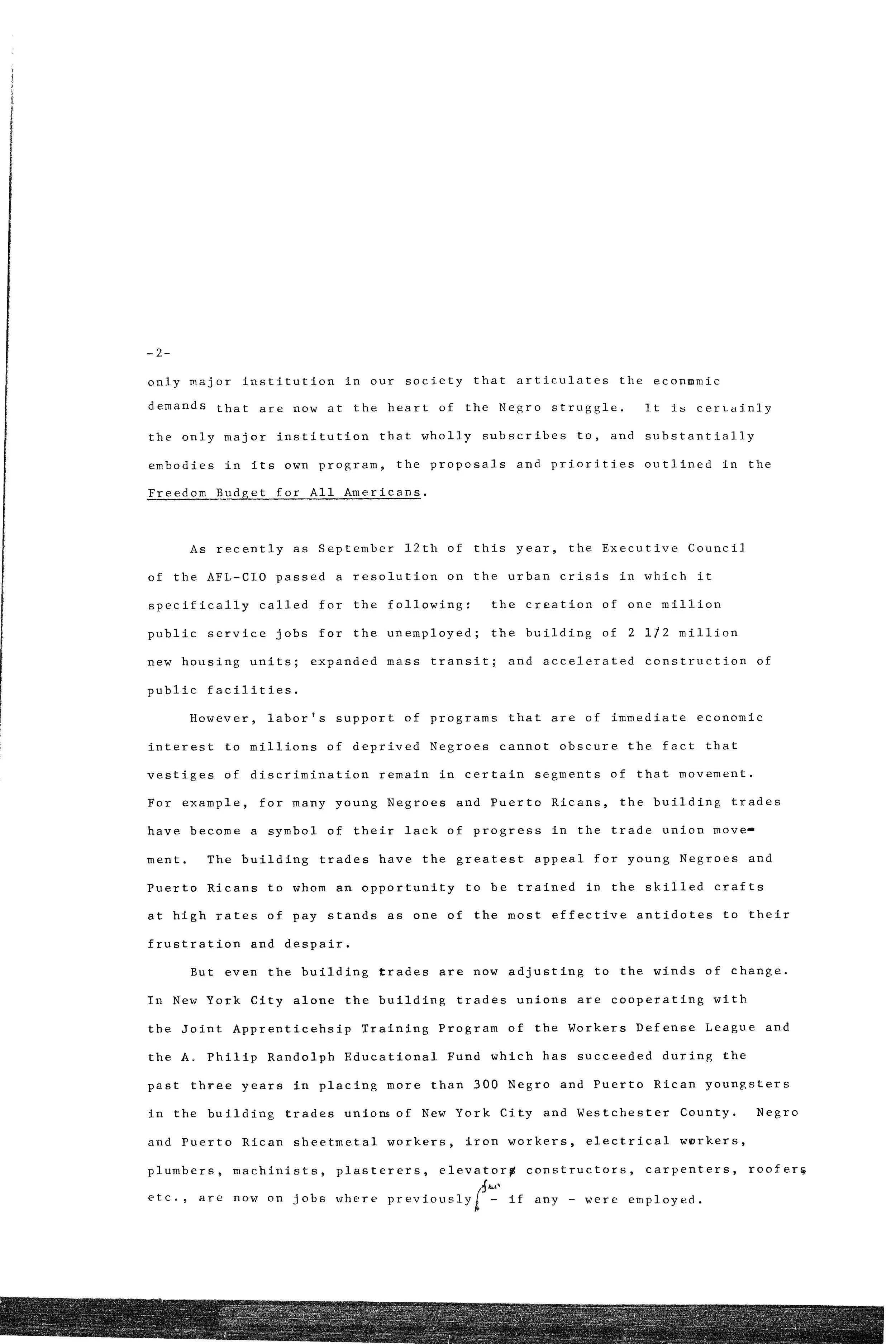
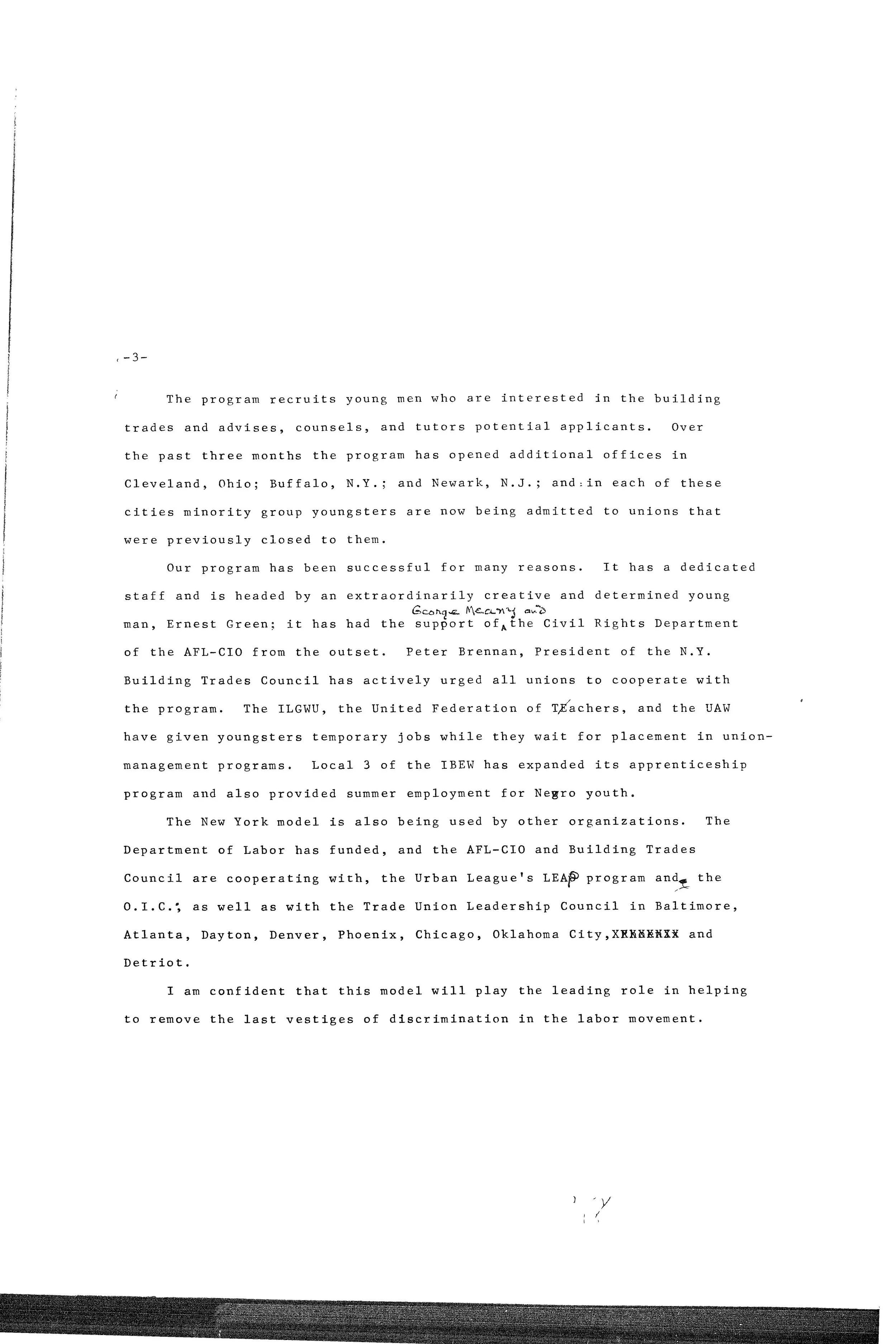
Rustin, Bayard. "The Negro and the Unions." Unpublished manuscript submitted to The New York Times, November 1967
