Description
On February 3, 1964, a massive, peaceful boycott led by Bayard Rustin and a coalition of civil rights groups effectively crippled the New York City school system. Over 464,000 students—nearly 45 percent of the total enrollment—stayed home to protest racial imbalance and subpar conditions in schools serving Negro and Puerto Rican communities. The day was marked by orderly picketing at 300 schools and culminated in a march of 3,500 demonstrators on the Board of Education headquarters in Brooklyn. To maintain the educational momentum, "Freedom Schools" were established at boycott headquarters, where figures like comedian Dick Gregory taught students to be "little soldiers" in the struggle for equality.
The boycott demonstrated the "utility of politics" through a massive display of community discipline and nonviolent direct action. Despite the freezing weather and early skepticism from school authorities, the sheer scale of the absences forced the city to acknowledge the "revolutionary" demand for integrated, quality education. This event highlighted the effectiveness of coalition politics, as Negro and Puerto Rican communities united to demand a fundamental change in the "flavor" of the city’s educational institutions. By emptying hundreds of classrooms, the organizers proved that the collective refusal of the marginalized could effectively grab the "ear of America" and disrupt the status quo.
Historical Context
The 1964 New York City school boycott remains the largest civil rights demonstration of the 1960s, occurring during a critical transition for the movement. While the struggle in the South focused on de jure segregation, this Northern uprising targeted de facto segregation, inequality sustained by housing patterns and systemic disinvestment rather than explicit laws. Bayard Rustin’s leadership in this effort underscored his belief that the movement had to move beyond Southern "barbarism" to confront the institutional racism embedded in major Northern cities.
The event reflected the "professionalization" of the movement, requiring complex logistical coordination across five boroughs and multiple ethnic groups. It served as a precursor to the shift toward electoral power, showing that the community had the organizational "stamina" to mount a sustained challenge against the Board of Education. The boycott also exposed the limits of white liberal support; while the protest was hailed as a success by its leaders, it faced significant "resistance" from city officials who initially tried to downplay the impact of the absences. Ultimately, this day of defiance was a watershed moment that forced a national conversation on the interdependence of racial justice and educational equity in urban America.
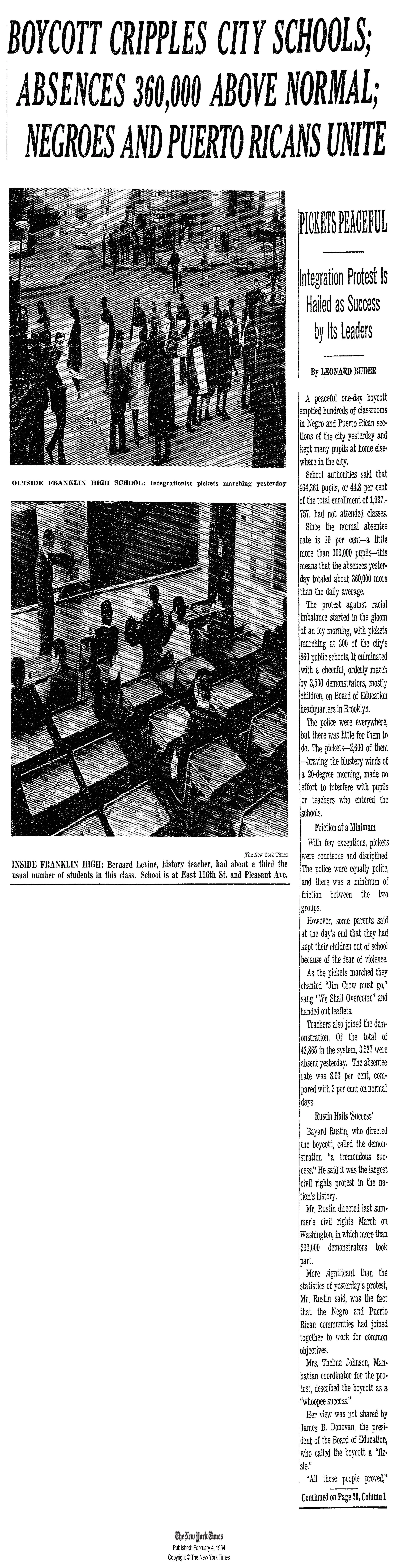
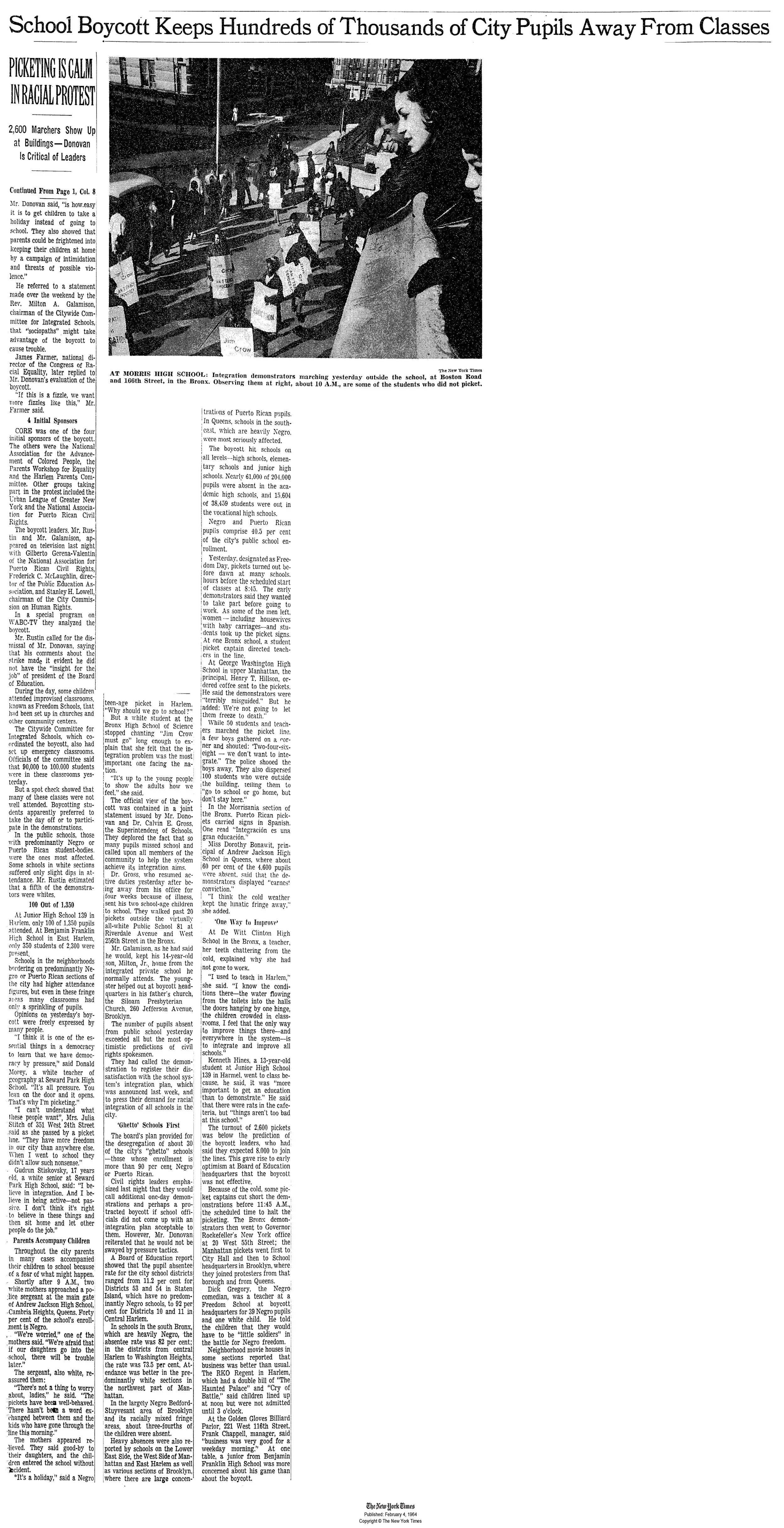
Buder, Leonard. "Boycott Cripples City Schools; Absences 360,000 Above Normal; Negroes and Puerto Ricans Unite." The New York Times, February 4, 1964.
