
Please note: The exact date of this article’s publishing is unknown.
Description
Historian Daniel Perlstein analyzes the "enduring disappointment" of the late 1960s by focusing on Bayard Rustin’s controversial stance during the 1968 New York City school crisis. In this period, Rustin’s commitment to coalition politics was severely tested as he allied with the United Federation of Teachers (UFT) against Black activists demanding "community control" of schools in neighborhoods like Ocean Hill-Brownsville. Rustin argued that the push for local control was a form of "romantic" nationalism that would ultimately lead to racial isolation and the destruction of the interracial labor-liberal alliance he believed was the only true "utility of politics."
Rustin feared that the move toward community control represented a retreat from the goal of integration into a new form of de facto segregation. He cautioned that if Black communities sought to govern their own underfunded institutions in isolation, they would remain trapped in a state of "competitive scarcity" rather than achieving the broad economic redistribution he envisioned. By prioritizing his alliance with organized labor over the immediate demands of local Black militants, Rustin sought to protect the democratic institutions he viewed as essential for long-term progress, even as he faced accusations of abandoning the very movement he helped build.
Ultimately, Perlstein illustrates how Rustin viewed the "nature of politics" as requiring a painful choice between local empowerment and national coalition. Rustin maintained that without the support of the white working class and powerful unions, Black political power would remain a hollow victory, unable to solve the deep-seated problems of unemployment and urban decay. His refusal to support the Ocean Hill-Brownsville experiment was not a rejection of racial justice but a strategic insistence that the struggle for equality must remain integrated and broad-based to avoid the "dead end" of separatist despair.
Historical Context
The 1968 school crisis was a watershed moment that shattered the historic alliance between Black activists and white Jewish liberals in New York City. This conflict arose as the focus of the movement shifted from dismantling de jure segregation in the South to confronting the entrenched institutional racism of the North. Rustin’s receipt of the UFT’s John Dewey Award in 1968 signaled his deep integration into the labor establishment, a position that many younger, more militant activists viewed as a betrayal of the rising "Black Power" sentiment.
The crisis reflected the "professionalization" of the movement that Rustin had championed, where strategic alliances with unions were seen as more vital than street-level protest. However, the intense racial polarization and charges of antisemitism that emerged during the teachers' strikes highlighted the fragility of the "triple alliance" Rustin had spent decades cultivating. This article serves as a sobering look at the limits of coalition politics when local demands for self-determination clash with the centralized power of established institutions, revealing the complex trade-offs Rustin made in his pursuit of a "Great Society."
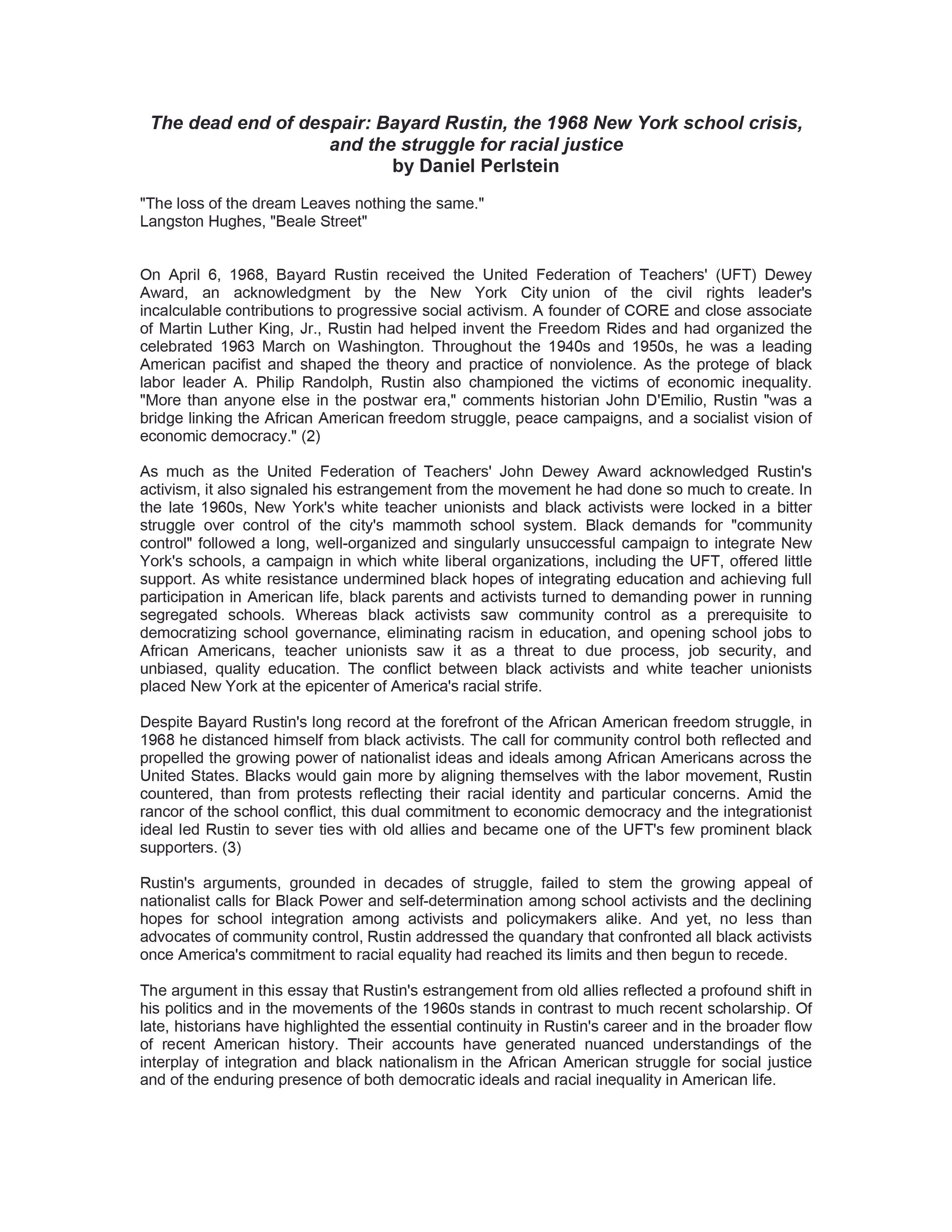
Perlstein, Daniel. "The Dead End of Despair: Bayard Rustin, the 1968 New York School Crisis, and the Struggle for Racial Justice." Journal of American History (2002).
