Description
In this oral history, Mississippi NAACP leader Aaron Henry provides a sweeping overview of the civil rights struggle in the South, focusing on the formation of the Mississippi Freedom Democratic Party (MFDP) and the 1964 Democratic National Convention. Henry discusses Bayard Rustin’s pivotal and controversial role as a strategic advisor who attempted to bridge the gap between the radical demands of the MFDP and the practical constraints of national party politics. He describes Rustin’s "utility of politics" in advocating for a compromise that would ensure the movement remained part of the "labor-liberal-civil rights" alliance, even when that stance put him at odds with more militant activists on the ground.
The interview highlights Rustin’s belief that the "nature of politics" required the movement to transition from "protest to responsibility" to achieve long-term legislative gains. Henry reflects on how Rustin sought to manage the "enduring disappointment" of the convention by framing it as a necessary step toward the 1965 Voting Rights Act. By acting as a "professional" strategist who looked beyond the immediate conflict, Rustin emphasized that the "blueprint" for Black political power depended on maintaining a seat at the table of the national Democratic Party, rather than retreating into the "perils of isolation."
Historical Context
The 1964 Atlantic City convention represented a "revolutionary" crossroads for the movement, exposing the deep friction between grassroots activism and institutional power. As the primary strategist behind the March on Washington, Rustin was tasked with navigating the "legal foundations of racism" within the party structure while facing intense "resistance" from Southern segregationists. His push for a compromise at the convention was a direct application of his theory of coalition politics, where he argued that isolating the movement from the Johnson administration would be a "no-win" strategy.
This document serves as a record of the shifting "flavor" of the movement, as younger activists in SNCC and the MFDP began to question the integrationist and nonviolent strategies that Rustin had long championed. Henry’s perspective offers a window into the "professionalization" of the struggle, where leaders had to weigh the moral purity of their demands against the strategic need for a "triple alliance" that could deliver federal intervention. Ultimately, the events discussed here underscore the "long game" Rustin played to ensure that the movement moved from the streets into the halls of power, laying the groundwork for the "Great Society."
See Full Transcript
See Full Transcript
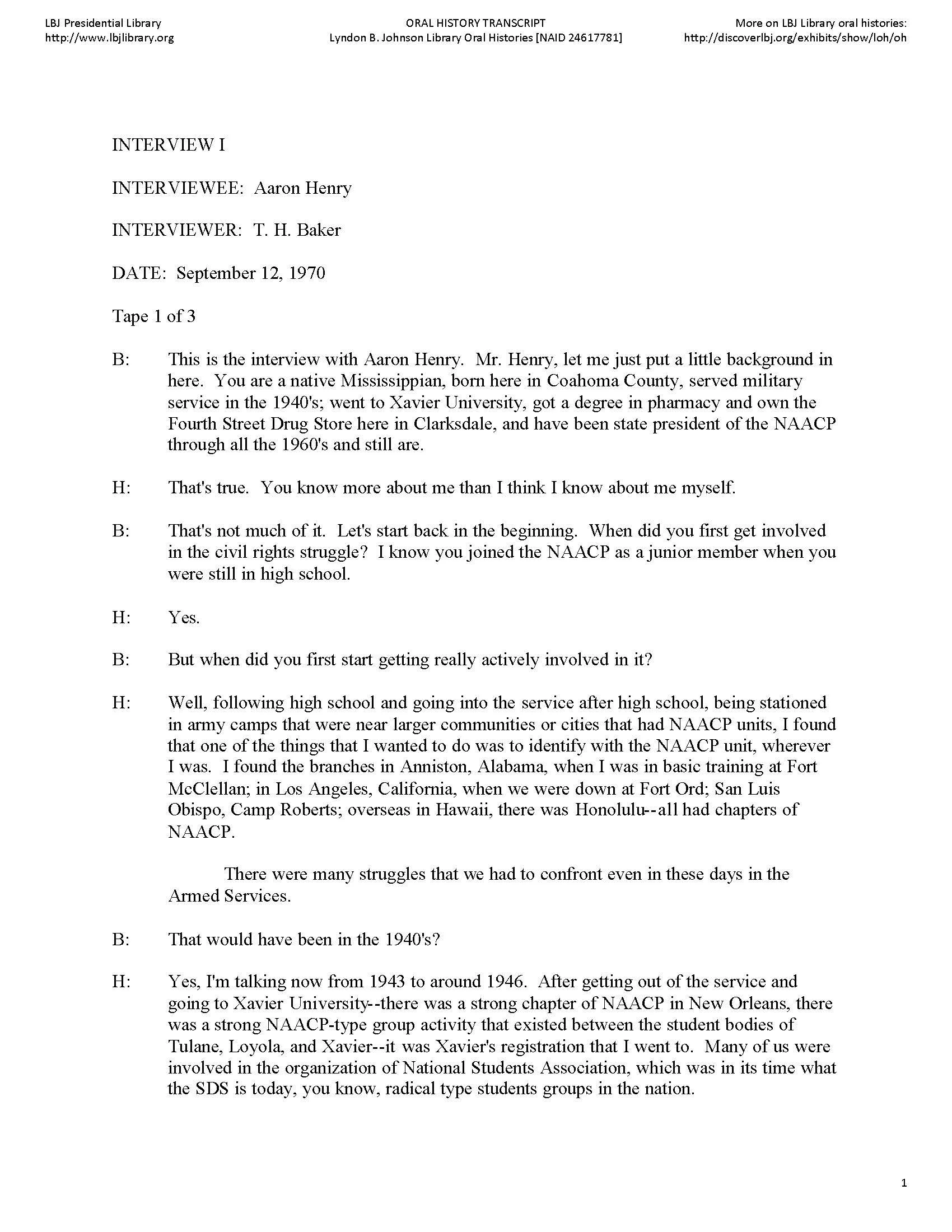
Henry, Aaron. Interview by T. H. Baker, September 12, 1970. Oral History Transcript, Lyndon B. Johnson Library.
