Please note: Though circulated in 1970-71, the exact date of publication for this pamphlet is unknown.
Description
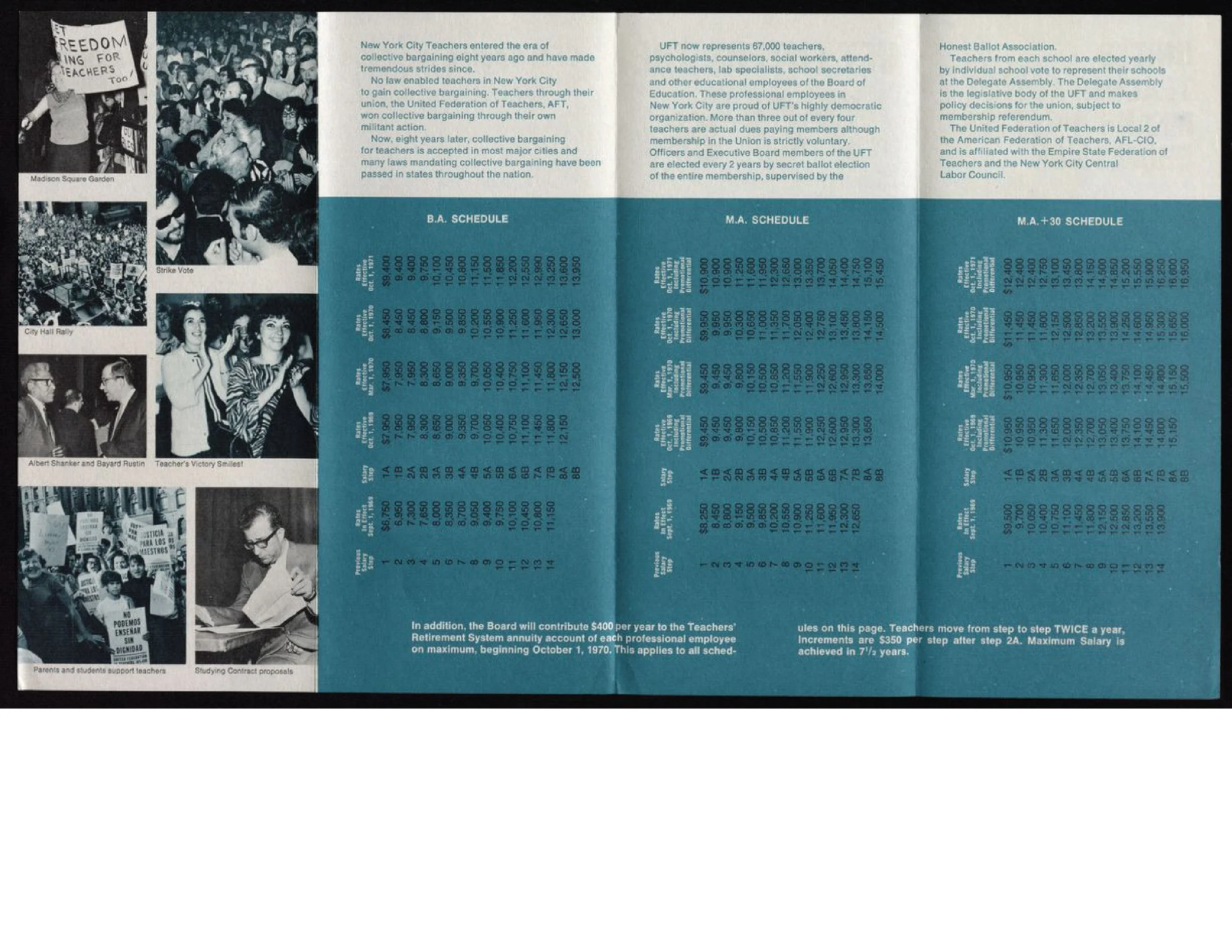
This 1970 pamphlet highlights the major achievements of the United Federation of Teachers (UFT) following its negotiations with the New York City Board of Education. It outlines significant contract victories, such as restructuring salary schedules so that teachers could reach maximum pay in 7 and 1/2 years instead of 14, alongside semi-annual salary increments and yearly contributions to a teacher annuity fund. Furthermore, the document details substantial educational and welfare gains, including funding for the More Effective Schools (MES) program, transitional school services, early childhood centers, and comprehensive family medical, dental, and prescription coverage funded by the Board of Education.
Beyond financial compensation, the pamphlet showcases how the union fought to secure robust teacher rights, democratic governance, and social equity. It explains that the UFT operated democratically, with voluntary membership exceeding 75%, officers elected every two years by secret ballot, and an annual Delegate Assembly serving as the union's legislative policy-making body. The publication also emphasizes coalition-building and civil rights alliances, featuring imagery and messages of solidarity between teachers, parents, and students—such as signs reading "Civil Rights Teachers Support the Strike" and Spanish-language banners supporting educational dignity.
Historical Context
Entering the 1970s, the United Federation of Teachers (Local 2 of the American Federation of Teachers, AFL-CIO) had established itself as a powerful and militant labor force in New York City, representing tens of thousands of teachers, psychologists, counselors, and school secretaries. Having fought for and won collective bargaining rights through direct union action eight years prior, the UFT set a national pace for urban teachers' unions by leveraging collective bargaining to mandate widespread organizational structures across major American cities.
This period was simultaneously marked by intense educational, racial, and community tensions within urban public schools. Against this backdrop of friction, the union sought to project an image of democratic reform, institutional protection, and community alignment. By promoting expanded educational resources for disadvantaged areas, textbook improvements reflecting minority and urban life, and cooperative frameworks with parents, the pamphlet framed the union's contract battles not only as professional labor disputes, but as vital contributions to broader social justice and educational equity.

United Federation of Teachers. Pamphlet, 1971. “Gains in Social Equity and Contracts.” Princeton University Digital Library. https://dpul.princeton.edu/catalog/6fc77dbd-0215-4433-8362-2d56e5843747.
