
Description
In this March 1970 column from The St. Louis American, Bayard Rustin delivers a direct analysis of the Nixon administration's civil rights record. Rustin targets the new phrase "benign neglect," which presidential adviser Daniel P. Moynihan pulled from nineteenth-century British colonial history and applied to American race relations. Rustin argues that this term perfectly describes the White House's strategy of combining appeals to white racial backlash with sophisticated excuses to roll back social and economic gains for Black citizens. He notes that the administration repeatedly cuts funding for programs like Model Cities and education under the guise of "fiscal responsibility," forcing poor and minority communities to bear the full burden of fighting inflation.
The column details how the administration's policy of neglect is most destructive in public education. Rustin explains that instead of supporting integration or increasing compensatory school funding, President Nixon gave in to Southern pressure to halt desegregation and vetoed vital educational spending bills. Rustin dissects and refutes the administration's arguments, noting that officials like domestic assistant John Ehrlichman claimed to oppose school integration for purely social reasons rather than educational ones. Using data from the 1966 Coleman Report, Rustin proves that desegregation is actually the single most effective tool for boosting the academic achievements of lower-class Black children. He concludes that local compensatory programs failed not because spending doesn't matter, but because the federal funds provided were too low and were applied to schools that remained isolated by race and class.
Historical Context
In early 1970, the United States was transitioning into a conservative political era as the Nixon administration successfully implemented its "Southern Strategy." This electoral plan focused on winning over white Southern voters and working-class Northerners by slowing down federal enforcement of civil rights laws and opposing court-ordered school integration. The leak of Moynihan's internal memo advising the President to treat the issue of race with a period of "benign neglect" sparked an immediate crisis of trust among Black leaders, who saw it as proof that the federal government was officially abandoning the struggle for racial equality.
This political shift forced civil rights groups into a highly defensive position as they watched the legal victories of the 1960s being actively dismantled by federal bureaucracy and conservative judicial appointments. Operating as the Chairman of the A. Philip Randolph Institute, Rustin recognized that the administration was using sophisticated sociological arguments to mask a basic retreat from public investment in poor communities. He insisted that the legal foundations of school integration could not be separated from federal spending, warning that cutting school budgets would trap minority children in underfunded, segregated neighborhoods. By analyzing this document, we can see how the battle over educational policy became a central front in the fight to preserve the gains of the Great Society against a growing anti-regulatory political wave.
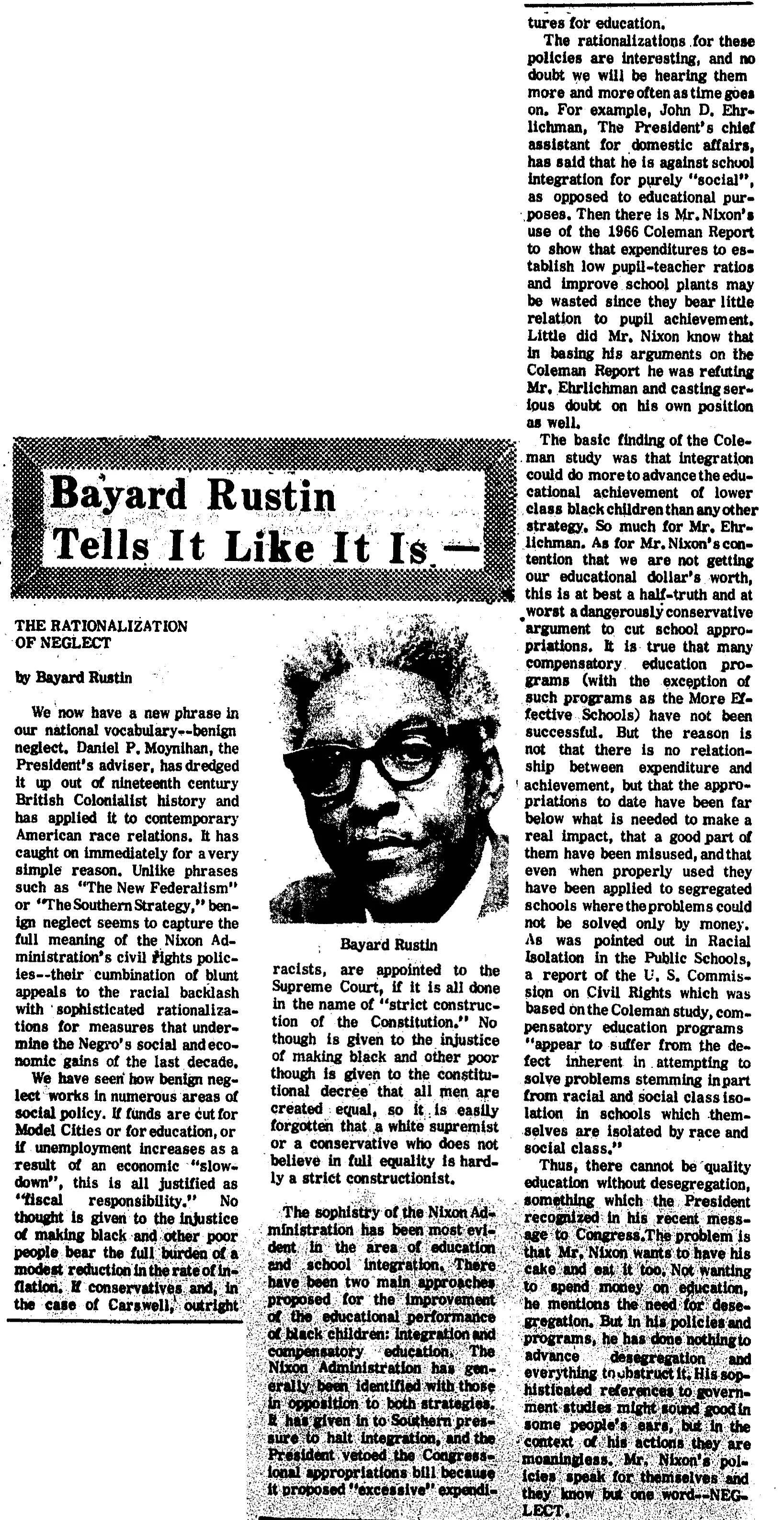
Rustin, Bayard. "Bayard Rustin Tells It Like It Is: The Rationalization of Neglect." The St. Louis American, March 19, 1970, p. 8.
