
Description
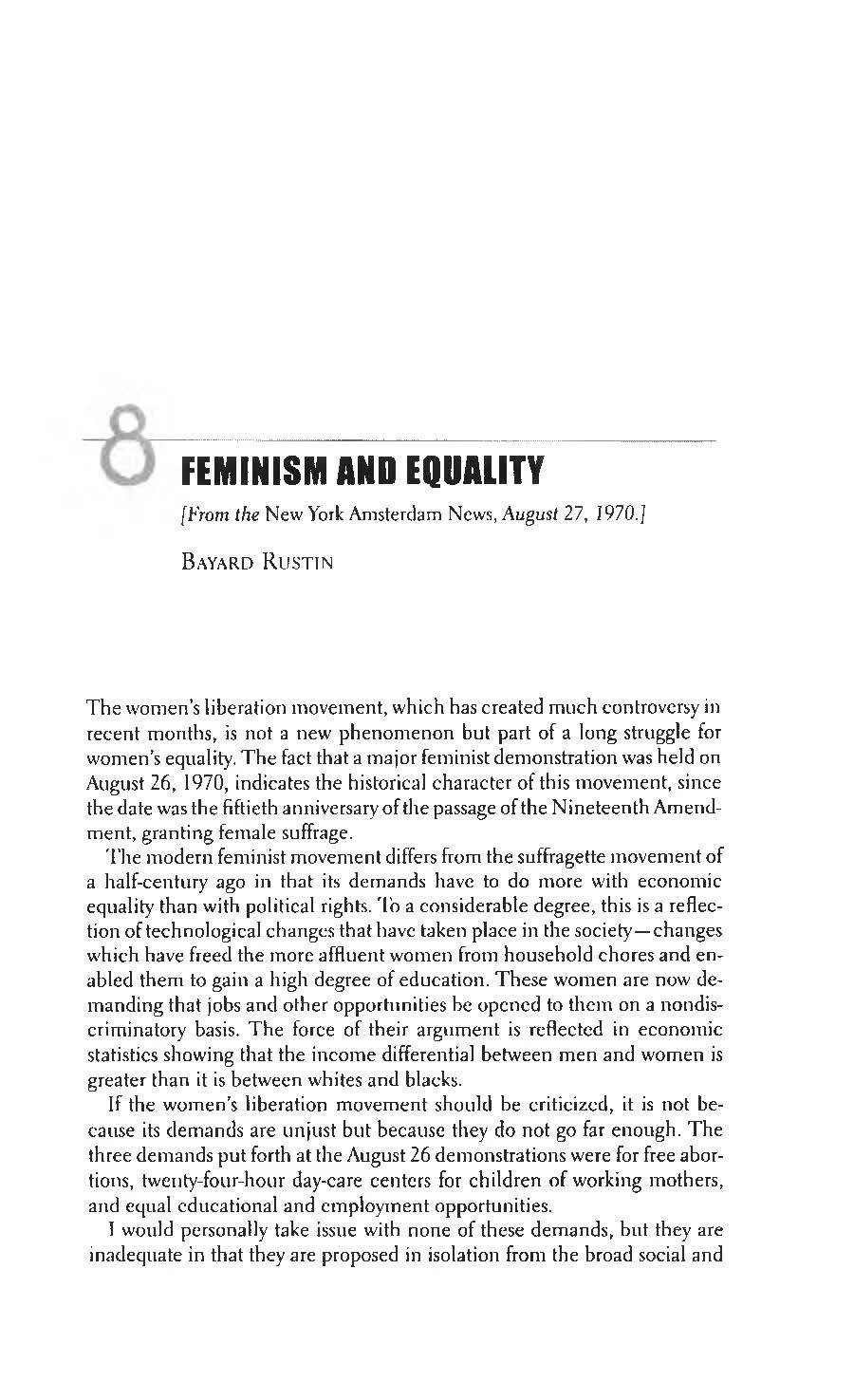
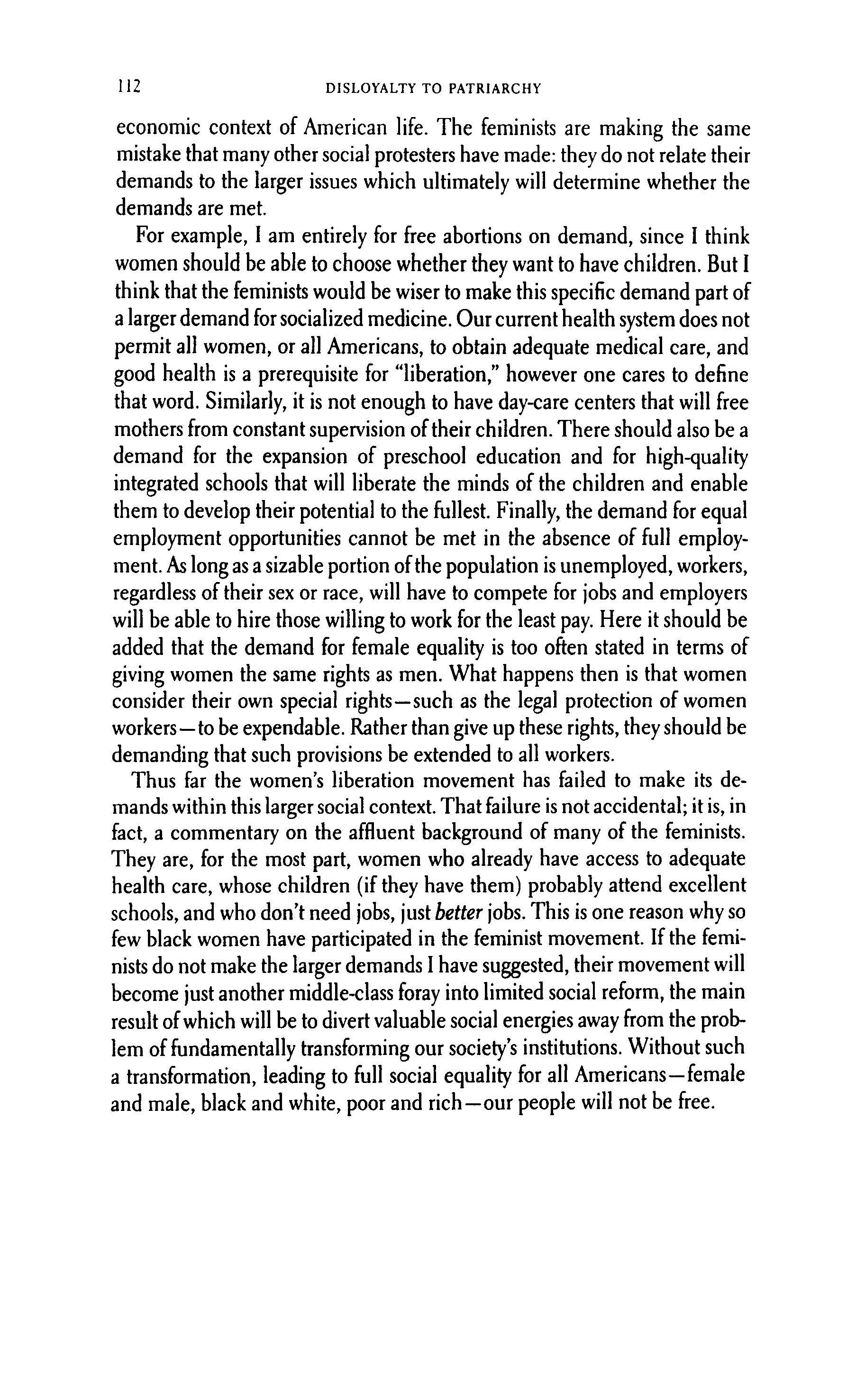
In this 1970 column for the New York Amsterdam News, Bayard Rustin provides a naked assessment of the women’s liberation movement, which he acknowledges as part of a "long struggle for women's equality." While Rustin supports specific demands like free abortions and day-care centers, he maintains that these goals are inadequate because they are proposed in isolation from the "broad social and economic context of American life." He argues that the utility of politics requires relating these issues to a "larger social context," such as the need for socialized medicine and full employment. For Rustin, the "middle-class foray" of modern feminism risks diverting valuable social energies away from a "fundamental transformation" of society’s institutions.
Rustin emphasizes that the movement’s failures are a "commentary on the affluent background" of many of its leaders, who focus on the needs of women who "don't need jobs, just better jobs." He points out that this narrow focus is a primary reason why so few Black women have participated in the movement. Instead of giving up special legal protections for women workers in the name of "equality," Rustin argues that these rights should be extended to the entire workforce. He characterizes the struggle as one that must achieve "full social equality" for all Americans, asserting that true liberation is impossible without a blueprint that addresses the needs of the poor and the working class.
Historical Context
Published in August 1970, this article captures the atmosphere of ideological friction as the "Black Power" era intersected with the second wave of feminism. Rustin’s history of writing during this period often cast him as a strategic irritant to social movements that he felt lacked a rigorous class analysis. He was unique in his insistence that the "nature of politics" in a democratic society must focus on a "revamping of the economy" rather than the pursuit of "symbolic victories." This document serves as a record of his effort to professionalize the intersection of race, gender, and class advocacy.
The year 1970 marked a period of "disarray" for liberal forces and an increase in racial polarization. Rustin’s column reflects his concern that the "revolutionary" rhetoric of the era was being spent on limited reforms that left the basic structures of inequality intact. By highlighting the absence of Black women from feminist leadership, Rustin was not merely critiquing a movement but attempting to redirect it toward the "long game" of institutional reconstruction. This entry preserves Rustin’s role as a strategist who believed that liberation was only possible through a fundamental transformation of the society's economic and political power.
Rustin, Bayard. "Feminism and Equality." New York Amsterdam News, August 27, 1970. https://doi.org/10.1177/00328855470270010
