
Description
Harry McPherson, a top advisor to President Johnson, discusses the internal dynamics of the White House during the height of the civil rights movement and the Vietnam War. McPherson identifies Bayard Rustin as a crucial "outside" voice who possessed a sophisticated understanding of the "utility of politics," often providing the administration with a clear-headed analysis of the "nature of politics" within the Black community. He reflects on Rustin’s role in advising the President on how to address urban unrest and economic inequality without fracturing the "labor-liberal" coalition that supported the administration’s domestic agenda.
The interview highlights Rustin’s strategic "blueprint" for the "Great Society," where he pushed for massive federal investment in jobs and housing as the only way to solve the "enduring disappointment" of de facto segregation. McPherson describes Rustin as a "professional" who understood that the movement had to move from "protest to politics" to secure lasting change. By serving as a bridge between the radical demands of the streets and the legislative machinery of the White House, Rustin utilized his expertise to ensure that the "legal foundations of racism" were not just dismantled, but replaced with a new economic order of "abundance" for all poor Americans.
Historical Context
This interview took place in the immediate aftermath of the LBJ presidency, a period defined by the dual pressures of the Civil Rights Movement and the "barbarism" of the Vietnam War. Rustin’s influence in the White House was a testament to his success in building an "interracial majority" that could exert real political pressure on the federal government. However, this same influence led to friction with younger activists who viewed his closeness to the administration as a betrayal of the movement’s "revolutionary" roots.
McPherson’s account provides a window into the "competitive scarcity" of the late 1960s, where resources were increasingly diverted away from social programs toward the war effort. Rustin’s advocacy represented a final effort to protect the "triple alliance" of labor, liberals, and civil rights leaders from being "ravaged" by the rising tide of nationalism and polarization. This document preserves the "long game" of an organizer who believed that the only way to "reconstruct the face of the nation" was through disciplined, coalition-based engagement with the highest levels of American power.
See Full Transcript
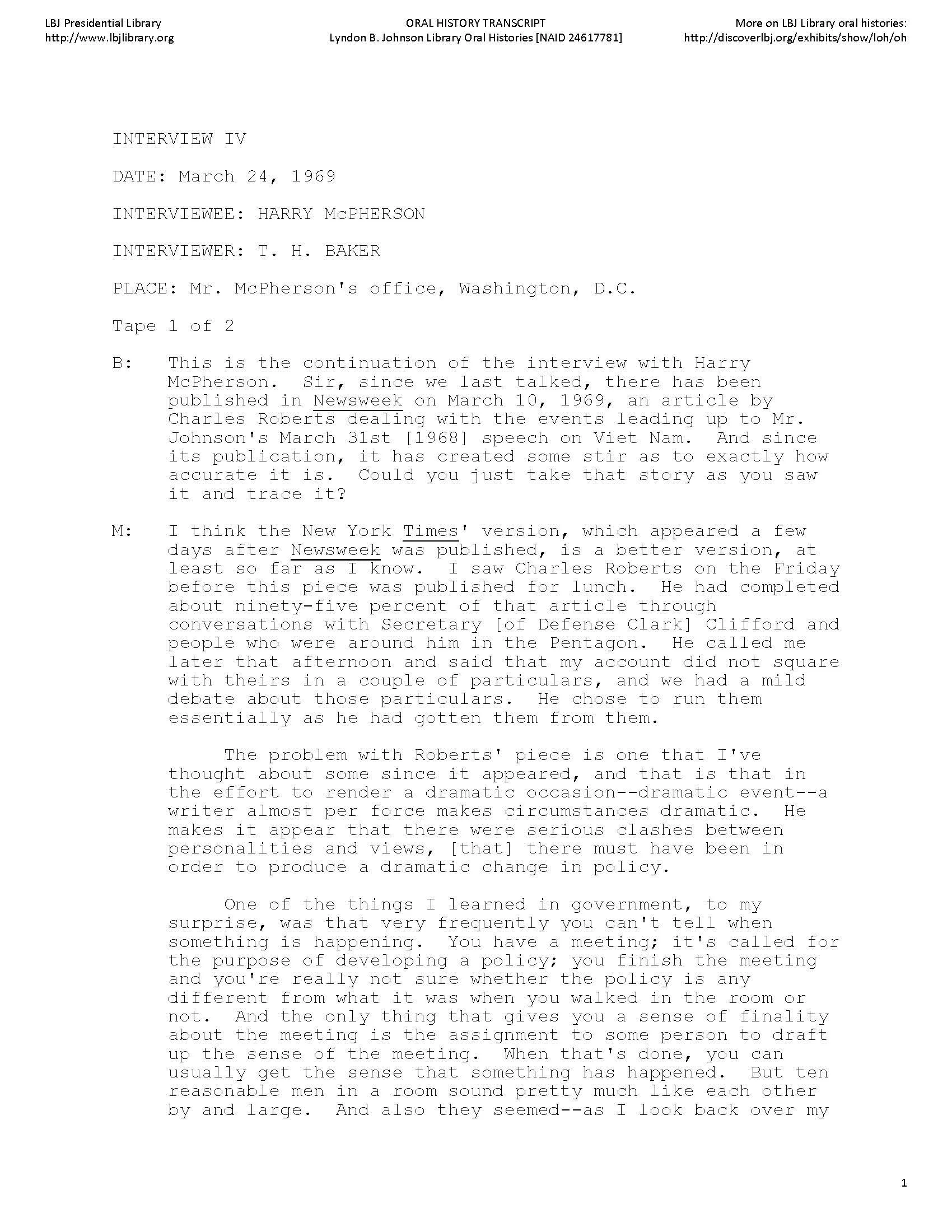
See Full Transcript
McPherson, Harry. Interview by T. H. Baker, March 24, 1969. Oral History Transcript, Lyndon B. Johnson Library.
