Description
In this extensive oral history, Sterling Tucker, a Vice Chairman of the 1963 March on Washington, provides a critical perspective on the internal dynamics of civil rights leadership and the "utility of politics." Tucker explicitly addresses the "falling out" between Bayard Rustin and the Southern Christian Leadership Conference (SCLC) during the planning of the 1968 Solidarity Day March. He describes how Rev. Ralph Abernathy’s lieutenants grew unhappy with Rustin’s aggressive, independent role, accusing him of crystallizing demands without collective discussion and attempting to separate the March from the broader Poor People's Campaign. Tucker eventually replaced Rustin as coordinator, noting the intense pressure of mobilizing a massive national effort in just ten days amid a negative press environment and deep organizational discord.
The transcript also captures the fundamental tactical shift that Rustin championed: the move from "protest to politics." Tucker explains that while the movement was previously fueled by moral problems—such as sitting in at restaurants and going to jail—it eventually reached a stage where progress required legislative maneuvering and the appropriation of funds for housing, education, and jobs. He echoes Rustin’s belief that while protest must never compromise, politics always requires it, citing the 1964 Atlantic City compromise as a pivotal moment where leaders like Rustin and Martin Luther King Jr. urged young activists to transition from the street to the ballot box to capture actual political power.
Historical Context
This interview, conducted only a year after the assassination of Dr. Martin Luther King Jr., is part of the vast collection at DiscoverLBJ, an online repository hosted by the LBJ Presidential Library that contains a multitude of oral history transcripts from the era. It reflects the "enduring disappointment" and fragmentation of the movement as it struggled to adapt to the post-civil rights legislative landscape. Tucker describes the 1968 Solidarity Day March as a moment of profound tension between integrationists and separatists, noting that while Rustin’s call for the march welcomed those who favored integration, other factions within the campaign viewed such distinctions as irrelevant to the immediate needs of hunger and shelter.
The dialogue provides essential context for the "professionalization" of the movement that Rustin pioneered. Tucker discusses how the Kennedy and Johnson administrations navigated their relationships with civil rights leaders, moving from a position of fearing violence to viewing the Justice Department’s Civil Rights Division as a remarkable ally. He frames President Lyndon B. Johnson not as an obstructionist, but as a skilled politician who "caught the spirit of the times" and felt a deep, genuine connection to the plight of the poor, ultimately setting up the War on Poverty as a practical application of the economic justice Rustin and A. Philip Randolph had long advocated.
Read Full Transcript.
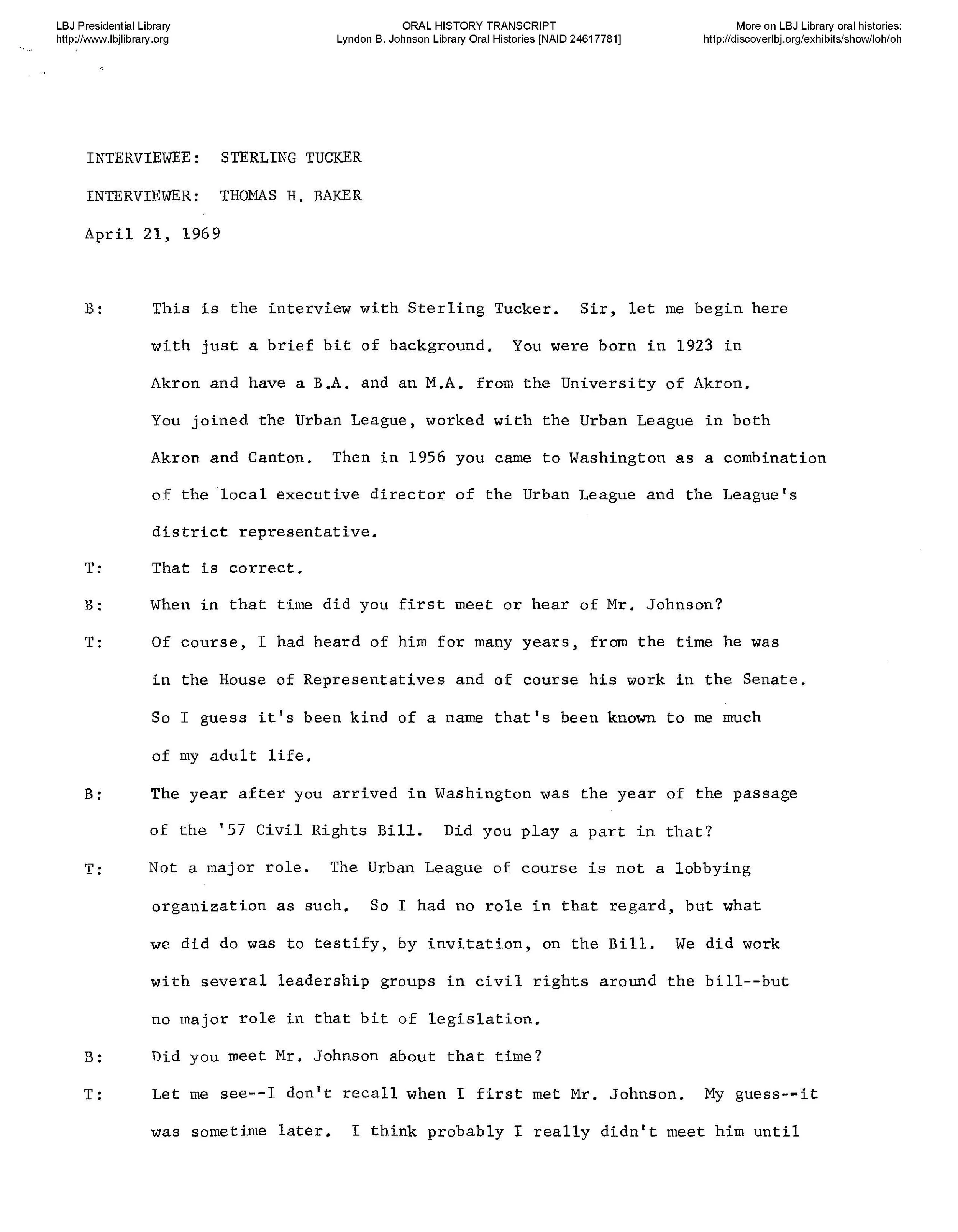
Tucker, Sterling. "Oral History Interview with Sterling Tucker." Interview by Thomas H. Baker. April 21, 1969. Lyndon B. Johnson Library Oral Histories, DiscoverLBJ. https://discoverlbj.org/item/oh-tuckers-19690421-1-74-57
