Description
In this oral history interview, Nash Castro, a key administrator for the National Park Service, reflects on the logistical coordination required for mass demonstrations, highlighting the standard of "meticulous planning" established by Bayard Rustin. Castro details the mechanics of 1968 Solidarity Day, a massive exercise intended to demonstrate the unified support of the Poor People's Campaign by drawing participants from major Northeastern and Midwestern cities to the capital. He specifically notes the coordination of the "mule train," a symbolic procession of horse-drawn wagons that traveled from the Deep South to Washington to dramatize rural poverty. Castro observes that the government’s ability to manage these complex movements was shaped by the precedent Rustin set during the 1963 March on Washington, where his absolute command over details guaranteed a level of order that federal officials previously thought impossible.
The interview explores the "utility of politics" regarding internal movement shifts, noting that Rustin’s short-lived role as the coordinator for Solidarity Day resulted from his insistence on professionalizing the demonstration. Castro recalls the transition from Rustin to Sterling Tucker, observing how the "independent role" Rustin took in planning the event’s specific demands led to organizational friction within the SCLC leadership. Through Castro’s administrative perspective, Rustin emerges not just as an activist, but as a master strategist whose technical genius forced the federal government to reconsider how it managed domestic dissent and the shared use of public space.
Historical Context
Conducted in 1969, this interview captures the administrative aftermath of the 1968 Poor People's Campaign, a multi-racial effort to demand economic justice and a "middle-class" standard of living for all impoverished Americans. A central feature of this campaign was the creation of "Resurrection City," a symbolic encampment of plywood shanties built on the National Mall to house thousands of demonstrators and make the reality of poverty unavoidable to federal legislators. Rustin’s departure from the Solidarity Day planning represented a significant fracture, as his commitment to disciplined, policy-focused lobbying clashed with the more expressive, militant tactics favored by some of Dr. King’s successors during the occupation of the Mall.
Castro’s testimony provides context for the "professionalization" of nonviolence that Rustin brought to Northern urban settings. During the planning stages, federal agencies like the National Park Service moved from a posture of fear to one of active coordination, relying on the systems of internal security and sanitation Rustin had earlier "blueprinted". This document serves as a witness to how Rustin’s "organizational genius" fundamentally altered the relationship between the citizen’s right to petition and the state’s obligation to facilitate mass assembly without descending into chaos.
Download Full Transcript.
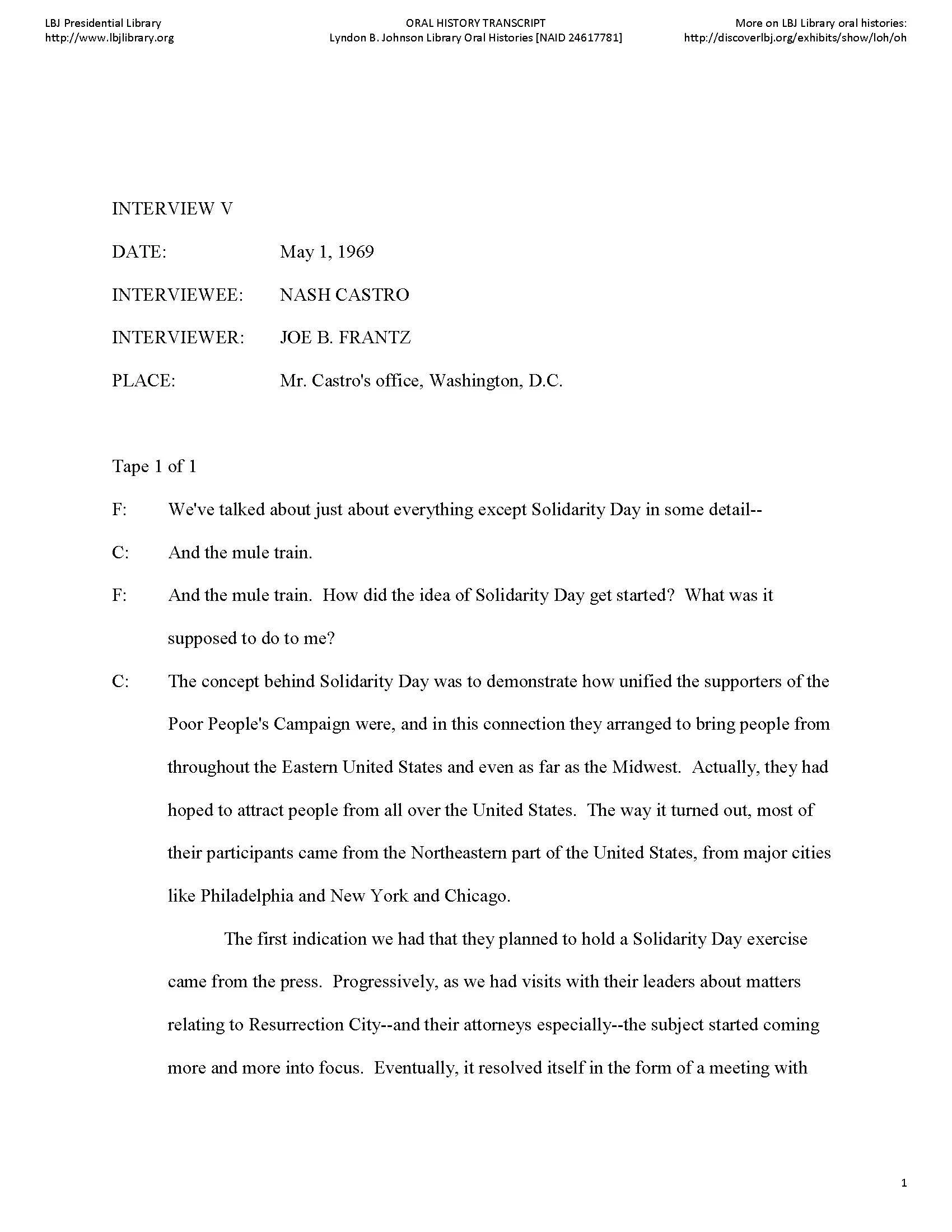
Download Full Transcript.
Castro, Nash. "Oral History Interview with Nash Castro." Interview by Joe B. Frantz. May 1, 1969. Lyndon B. Johnson Library Oral Histories.
