Description
In this expansive two-part oral history interview, Bayard Rustin provides a candid assessment of mid-century presidential leadership and the strategic internal maneuvers of the civil rights movement. Rustin offers an unapologetic critique of the Kennedy administration, which he viewed as "horribly overrated" and domestically ineffective, noting that the Kennedys actually bugged his strategy sessions with Dr. Martin Luther King Jr. In contrast, he identifies Lyndon B. Johnson as a president of deep feeling and technical mastery who understood how to "scratch backs" and "buy and sell" in Congress to achieve historic legislative gains. Rustin details the "utility of politics" in his support for the 1964 Atlantic City compromise, arguing that the movement had to mature from moral protest to political maneuvering to secure federal funding for housing and education.
The interview captures a series of pivotal, behind-the-scenes moments, including the high-stakes planning of the 1963 March on Washington and Rustin’s eventually "ignominious" resignation as the coordinator for Solidarity Day in 1968. Rustin describes his partnership with A. Philip Randolph—whom he calls "Chief"—as a relationship where Randolph provided the radical vision while Rustin managed the "dotting of I’s and crossing of T’s". He also reflects on his complex relationship with Dr. King, admitting that he served in a tutorial capacity regarding Gandhian nonviolence, famously recalling the moment he had to warn a young King about a gun in his armchair during the Montgomery boycott.
Finally, Rustin uses this interview to address the "enduring disappointment" of movements that fail to transition into the political mainstream. He asserts that the disappearance of organizations like SNCC was a direct result of their inability to shift from the "morality" of the street to the "maneuvering" of the ballot box. By recounting his own history of 22 arrests and his time on a chain gang, Rustin frames his later pragmatism not as a surrender, but as the only viable "blueprint" for a minority to effectively challenge a majority without being destroyed by state violence.
Historical Context
Conducted in 1969, shortly after the conclusion of the Johnson presidency, this interview is part of the extensive collection at DiscoverLBJ, a digital repository of the LBJ Presidential Library that features a multitude of oral histories from the architects of the 1960s. It reflects a moment of profound transition for the movement, as organizations like SNCC and the SCLC struggled to shift from Southern moral crusades to Northern economic politics. Rustin explains that while nonviolent protest was effective for securing legal rights like public accommodations, it was "no substitute for the ballot box" when addressing systemic issues like full employment and national economic planning.
The dialogue provides critical context for the "professionalization" of activism that Rustin championed. He discusses the necessity of forming a "triple alliance" between the civil rights movement, labor unions, and religious groups to create an interracial majority. He frames his own "critical support" of the Johnson administration as a strategic necessity, arguing that one must be harshest on the leaders they admire to create the necessary "political stir" for progress. Ultimately, the interview serves as a defense of democratic institutions, with Rustin asserting that the civil rights struggle was the primary catalyst for the universal liberation of women, students, and anti-war activists throughout the nation.
Read Full Transcript.
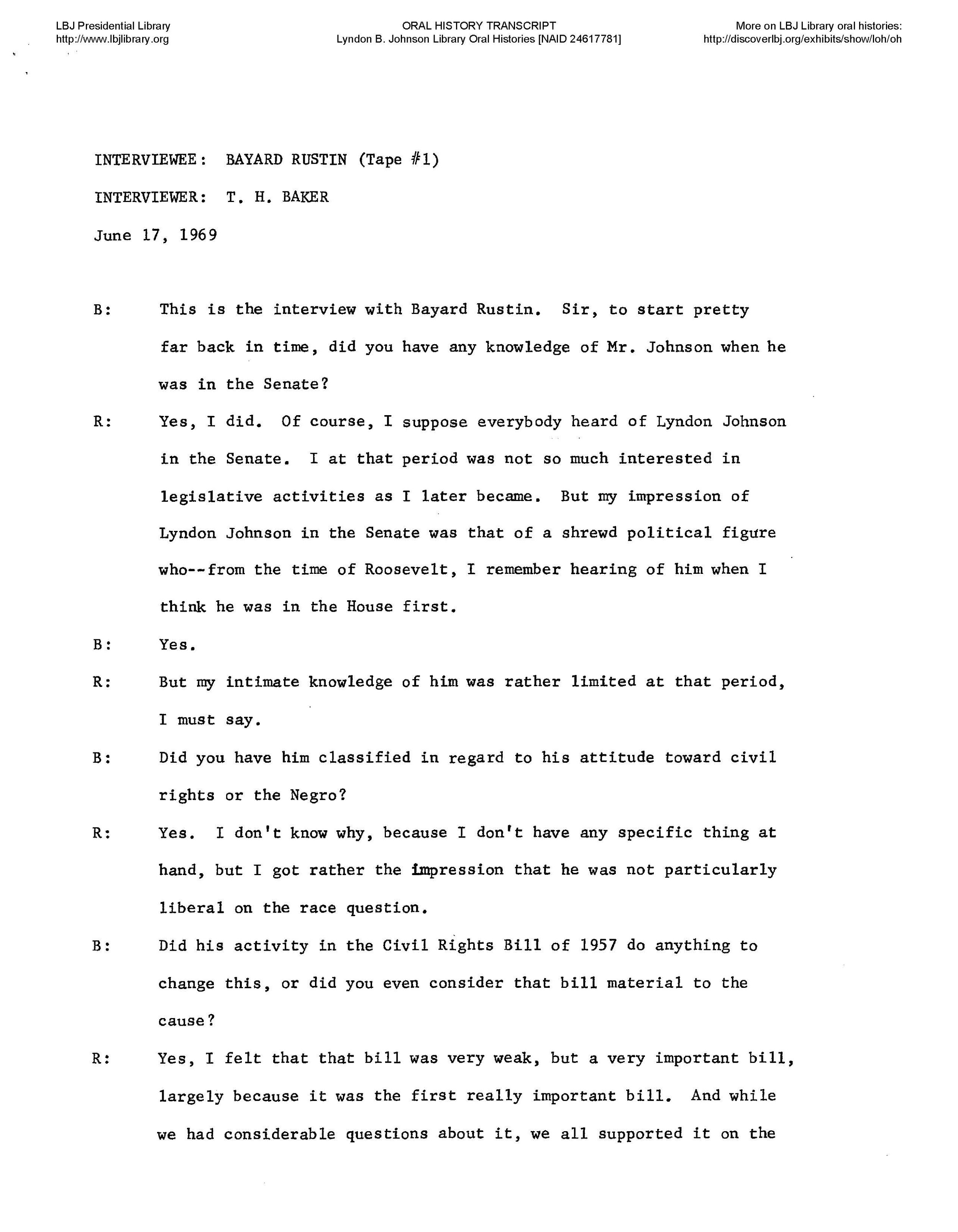
Rustin, Bayard. "Oral History Interview with Bayard Rustin." Interview by T. H. Baker. June 17 & 30, 1969. Lyndon B. Johnson Library Oral Histories, DiscoverLBJ. https://discoverlbj.org/item/oh-rustinb-19690617-1-74-65
