
In a deeply personal interview with Open Hands, Bayard Rustin reflects on the intersections of his identity as a Black, gay, socialist, and conscientious objector, describing an upbringing in West Chester, Pennsylvania that quietly affirmed his dignity. He argues that LGBTQ+ people have become a modern “barometer” of social progress, insisting that a society incapable of accepting difference in private life cannot truly advance in human rights.
Rustin on the First Federal King Holiday
Written just after the first national MLK Day, this letter finds Bayard Rustin cautioning against the canonization of Dr. King, arguing that portraying him as a flawless, superhuman figure makes his work seem unreachable and obscures the collective nature of the movement. Rustin urges a more honest history that recognizes King as part of a disciplined team—and honors the many unsung strategists whose collaboration made social change possible.
Ella Baker on the Foundations of the SCLC and SNCC
In this interview, Ella Baker reflects on building the Southern Christian Leadership Conference and emphasizes the shift from legal strategy to mass grassroots action. She highlights the behind-the-scenes leadership of Bayard Rustin and others, while stressing that the movement’s true strength came from ordinary people organizing from the ground up.
"The Long Game of Democracy": Bayard Rustin’s Reflections on the Johnson and Kennedy Eras
In this two-part oral history, Bayard Rustin reflects on the inner workings of the civil rights movement and offers candid assessments of leaders from John F. Kennedy to Lyndon B. Johnson. He argues that the movement’s long-term success depended on shifting from moral protest to strategic political maneuvering—using legislative power, coalition building, and negotiation to secure lasting change.
"As Goes Mississippi" Newspaper Column: Supporting the Mississippi Loyal Democrats Challenge
This column examines Bayard Rustin's support for the Mississippi Challenge, a coalition effort to replace Mississippi's all-white Democratic delegation with one that reflected the state's diverse electorate. Rustin presents the campaign as a vital step toward expanding democratic participation, arguing that inclusive political coalitions were essential to dismantling discriminatory power structures and strengthening democracy across the South.
Bayard Rustin's Vision for Economic Justice: "Firebombs or a Freedom Budget"
In 1967, Rustin called for a sweeping Freedom Budget to confront the economic roots of racial injustice, arguing that the civil rights movement had shifted from winning rights to demanding resources. Only large-scale federal investment, he insisted, could meet the needs of the poorest and restore hope to Black communities.
Bayard Rustin and A. Philip Randolph at the Alabama State Capitol, Montgomery, 1965
Rustin and Randolph are present at the culmination of the Selma to Montgomery Marches, joining fellow movement leaders and supporters on the steps of the Alabama State Capitol to bear witness to speeches demanding full voting rights for African Americans. Their participation at this moment signified solidarity, strategic leadership, and the unwavering commitment required to challenge entrenched oppression in the Deep South.
The March on Washington: A Landmark in Nonviolent Struggle
In this Gandhi Marg analysis, Charles C. Walker chronicles the March on Washington as a historic mass demonstration, emphasizing both its festive spirit and its extraordinary logistical coordination. Highlighting Bayard Rustin as the march’s chief architect, Walker underscores how disciplined nonviolence and meticulous planning helped shape a defining moment in the struggle for “Freedom Now.”
LIFE Magazine Cover: Bayard Rustin and A. Philip Randolph at the Lincoln Memorial, March on Washington 1963
A. Philip Randolph’s Statement in Defense of Bayard Rustin
A. Philip Randolph issues a public statement affirming his “complete confidence” in Bayard Rustin’s “character, integrity, and extraordinary ability,” highlighting Rustin’s role organizing three Marches on Washington and the 1947 Journey of Reconciliation, and condemning attacks—such as those by Senator Strom Thurmond—that sought to remove Rustin from leadership.
In the tense summer of 1963, pro-segregation opponents, led by Senator Thurmond, launched a smear campaign against Rustin—citing a past arrest—to undermine his pivotal role in planning the upcoming March on Washington. Randolph’s blunt refusal to cower to “undemocratic elements” underscored the Movement’s determination to defend its organizers against moralistic political attacks and maintain unity ahead of the historic demonstration
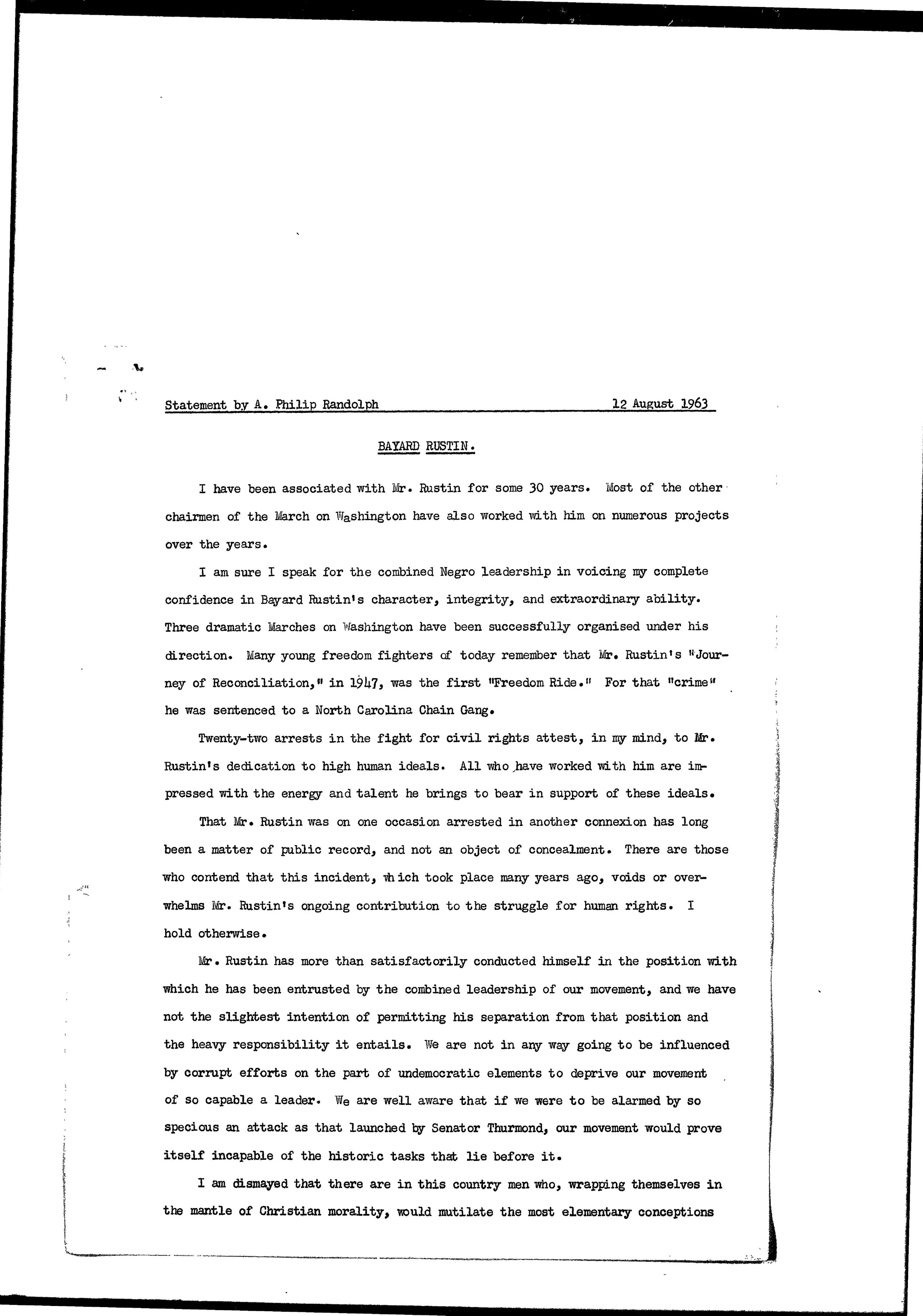
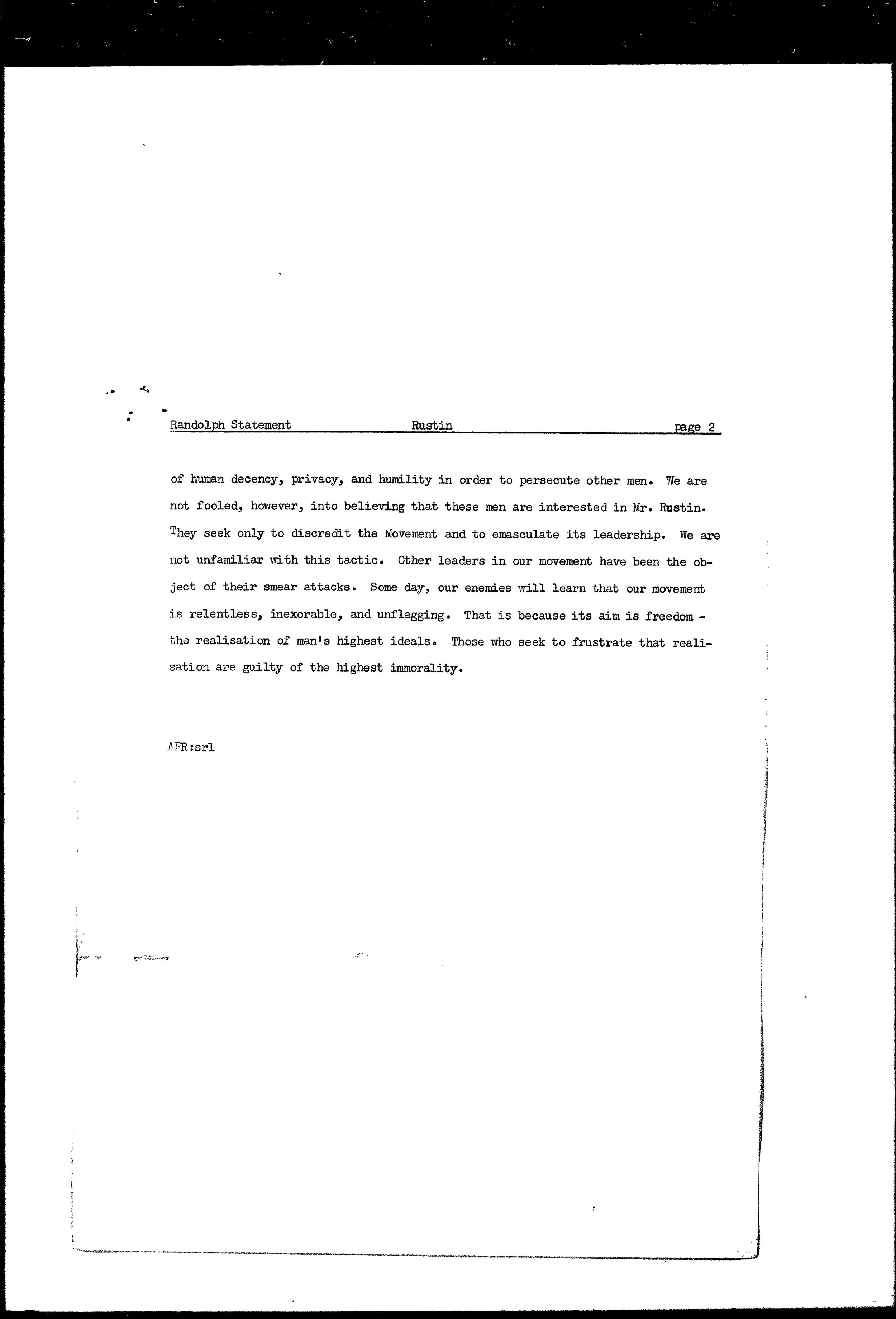
Randolph, A. Philip. “Statement by A. Philip Randolph on Bayard Rustin.” August 12, 1963. Bayard Rustin.
Bayard Rustin’s "Military Precision": Organizing the March on Washington Amidst Personal Attacks
This Associated Press feature profiles Bayard Rustin as the chief organizer of the March on Washington, tasked with orchestrating a massive, military-scale logistical operation just weeks before the event. It also confronts the personal attacks used to discredit him, highlighting Rustin’s transparency, commitment to nonviolence, and central behind-the-scenes role alongside A. Philip Randolph.
‘Mr. March’ Emphasizes Peaceful Demonstration: Bayard Rustin’s Direct Confrontation of Personal and Political Attacks
This Associated Press interview, published weeks before the March on Washington, portrays Bayard Rustin as the movement’s indispensable strategist, openly managing the massive logistics of a demonstration that had to unfold with flawless discipline. It also shows Rustin confronting efforts to discredit him head-on, grounding his leadership in his Quaker faith, commitment to nonviolence, and refusal to be silenced or blackmailed about his past.
Organizing Manuals No. 1 and No. 2: The Blueprint for the March on Washington
Issued by Bayard Rustin and Cleveland Robinson, these manuals provided the strategic and logistical blueprint for the 1963 March on Washington, transforming a sweeping moral vision into a meticulously disciplined mass action. Outlining nonviolent commitments, economic demands, and precise operational details—from participant quotas to internal security—the guides ensured the march’s message of jobs and freedom was matched by flawless execution.
