
This 1986 public statement finds Bayard Rustin urging Mayor Koch to veto amendments that would weaken New York City’s human rights protections for gay and lesbian people. Drawing on decades of civil rights activism, Rustin argues that laws should provide equal protection for all groups and warns against creating discriminatory loopholes. The statement reflects his enduring belief that the rights and security of every community are interconnected.
Bayard Rustin's Address to the National Association of Black and White Men Together
This 1985 newspaper article documents Bayard Rustin’s keynote address to the National Association of Black and White Men Together, where he spoke candidly about the challenges facing the gay rights movement. Rustin emphasizes the importance of coalition-building across communities, arguing that lasting progress depends on mutual support among all groups confronting discrimination. The article highlights his efforts to connect the legacy of the civil rights movement to the growing struggle for LGBTQ+ equality.
Regulate Runaway Shops and Congressional Endorsement
In this column published by the A. Philip Randolph Institute, Bayard Rustin critiques “runaway shops,” warning that corporate plant closures can devastate communities and disproportionately harm Black workers. He supports federal legislation to require advance notice of closures and provide displaced workers with protections including retraining, severance, and pension benefits.
A Sneak Attack on Black Construction Workers
In this column published by the A. Philip Randolph Institute, Bayard Rustin warns that the growth of nonunion “merit shops” threatens hard-won gains for Black workers in the construction industry. He calls for Black leaders and labor allies to unite in defending union jobs, fair wages, and economic opportunity.
A. Philip Randolph’s Statement in Defense of Bayard Rustin
A. Philip Randolph issues a public statement affirming his “complete confidence” in Bayard Rustin’s “character, integrity, and extraordinary ability,” highlighting Rustin’s role organizing three Marches on Washington and the 1947 Journey of Reconciliation, and condemning attacks—such as those by Senator Strom Thurmond—that sought to remove Rustin from leadership.
In the tense summer of 1963, pro-segregation opponents, led by Senator Thurmond, launched a smear campaign against Rustin—citing a past arrest—to undermine his pivotal role in planning the upcoming March on Washington. Randolph’s blunt refusal to cower to “undemocratic elements” underscored the Movement’s determination to defend its organizers against moralistic political attacks and maintain unity ahead of the historic demonstration
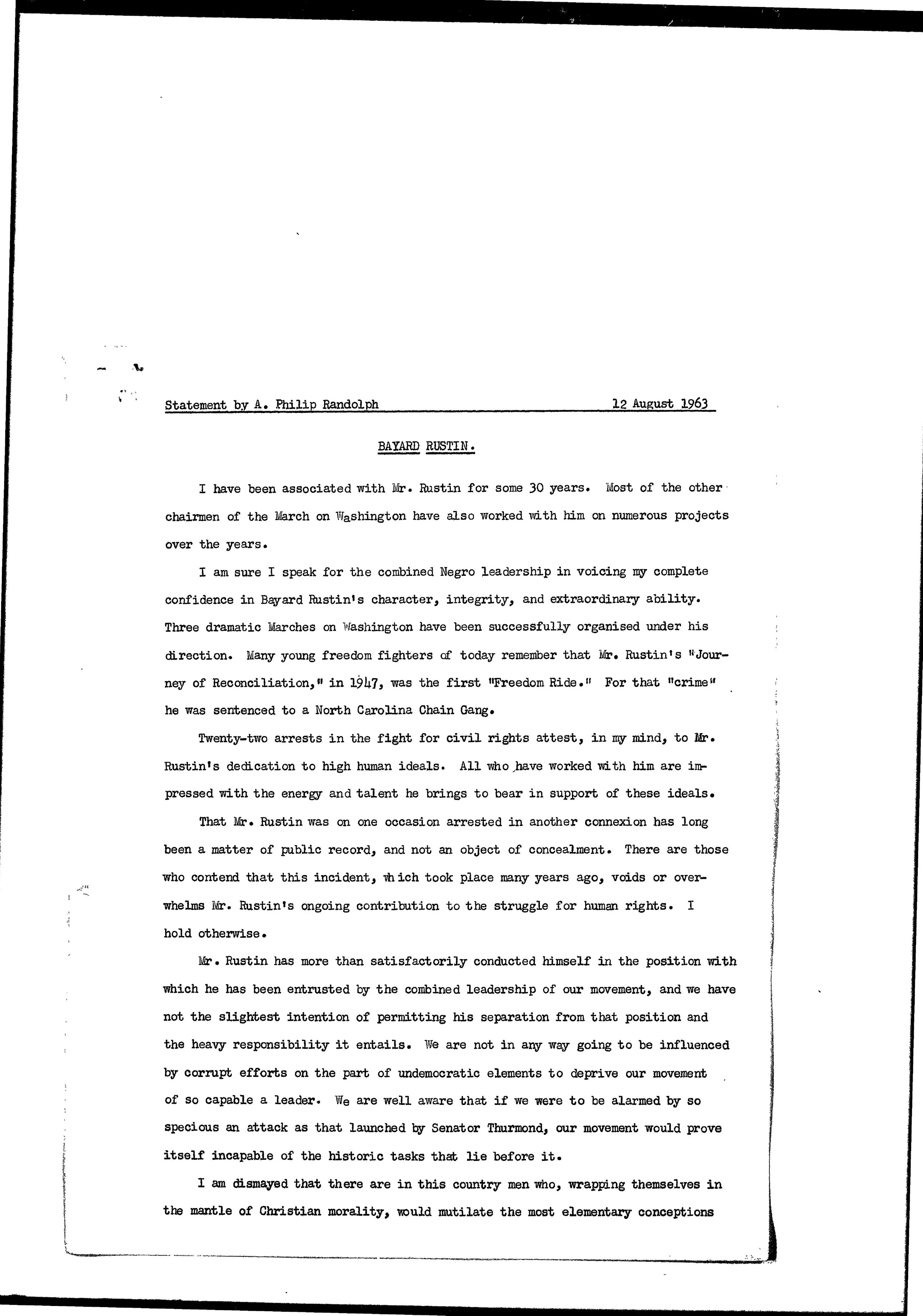
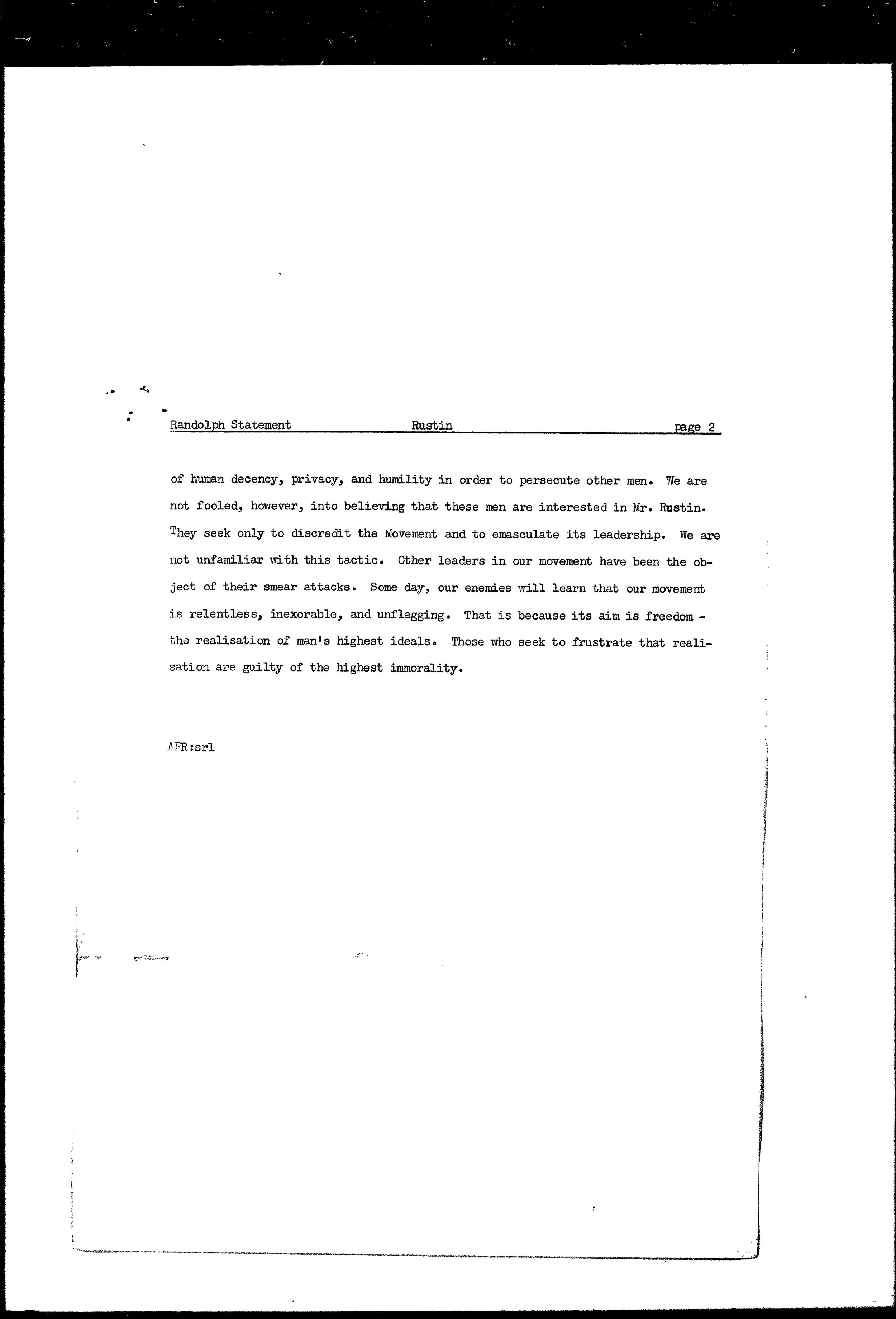
Randolph, A. Philip. “Statement by A. Philip Randolph on Bayard Rustin.” August 12, 1963. Bayard Rustin.
Bayard Rustin's Forced Resignation from the Fellowship of Reconciliation
This 1953 magazine article announces Bayard Rustin’s departure from the Fellowship of Reconciliation, publicly attributing it to personal reasons while praising his contributions to nonviolent activism and civil rights. Viewed alongside later historical accounts, the document reveals the challenges Rustin faced as a gay activist and exposes the tensions between the movement’s public ideals and its treatment of LGBTQ individuals. The entry offers a powerful window into the personal and institutional obstacles Rustin navigated throughout his career.
