Description
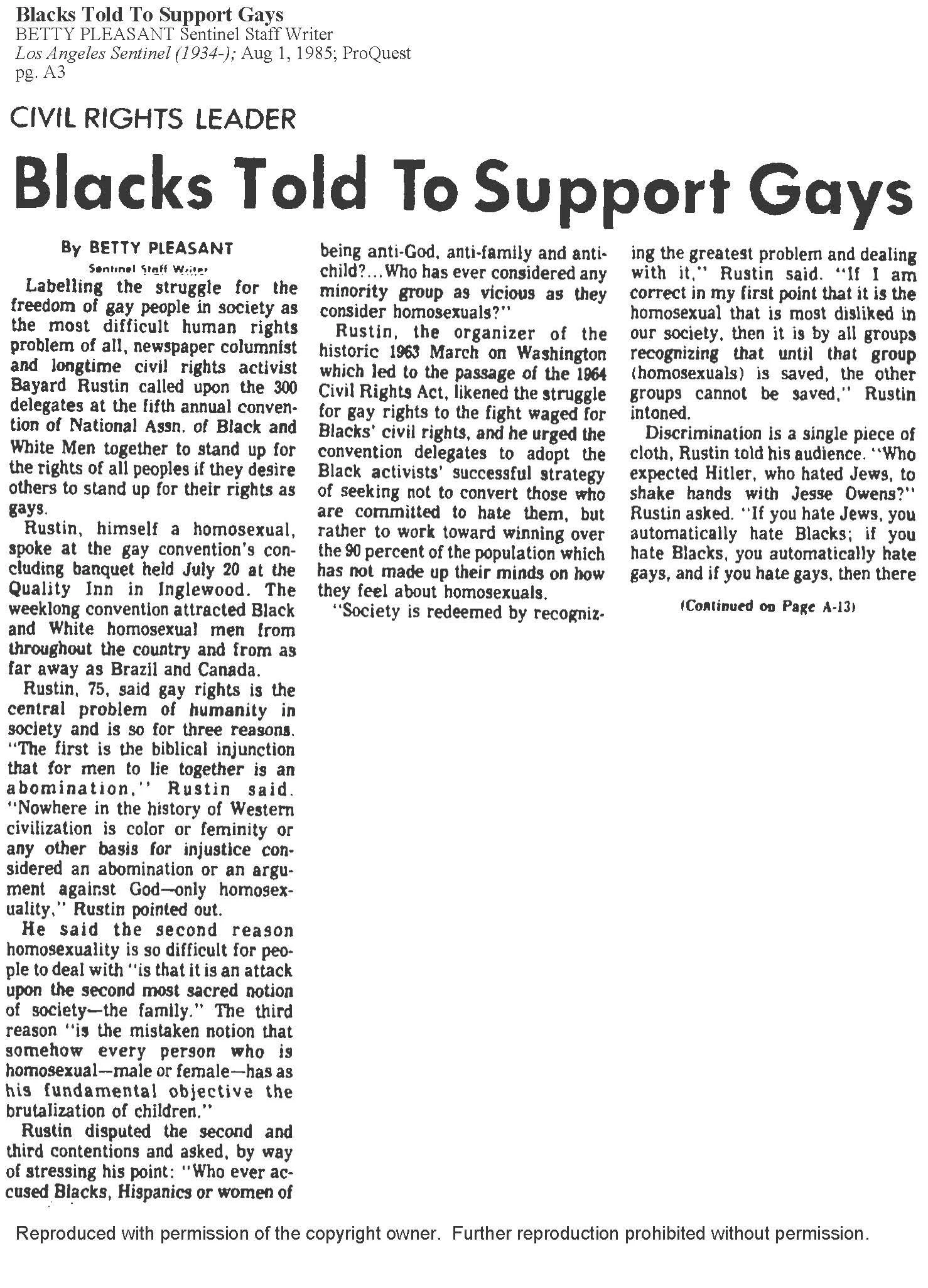
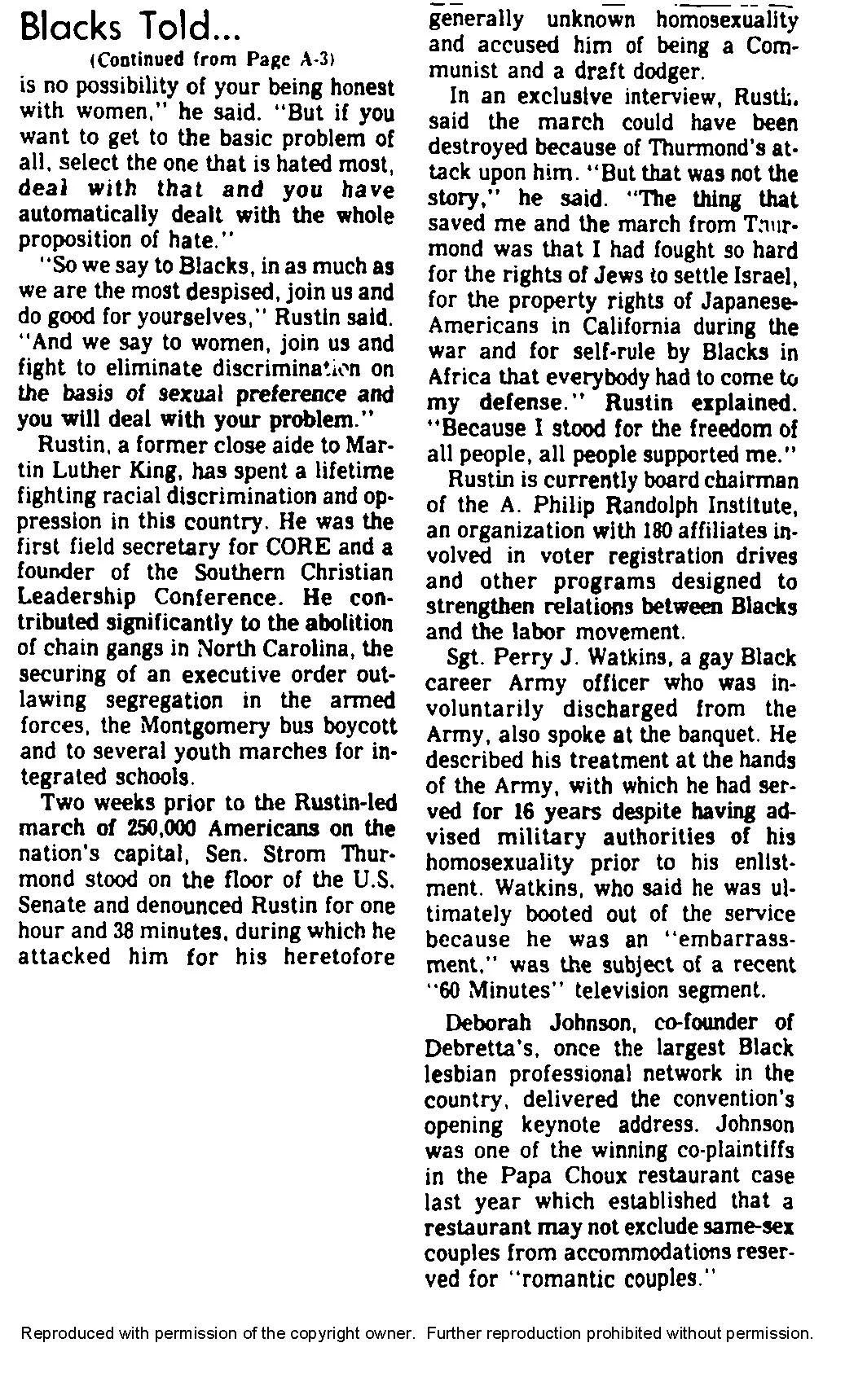
This 1985 newspaper article, written by staff writer Betty Pleasant for the Los Angeles Sentinel, provides a direct analysis of Bayard Rustin's closing banquet speech at the fifth annual convention of the National Association of Black and White Men Together (NABWMT) in Inglewood, California. Rustin, speaking openly as a 75-year-old gay Black man, labels the struggle for gay liberation as the most difficult human rights problem in Western society. He break downs his specific philosophical blueprint, explaining that homophobia is uniquely difficult to dismantle because it faces a dual cultural obstacle: a literal interpretation of biblical passages calling it an abomination, and an incorrect social perception that homosexuality is a direct attack on the traditional family structure. For Rustin, the utility of politics requires marginalized communities to move past narrow self-interest and build deep, mutual coalitions, challenging the 300 delegates to aggressively stand up for the civil liberties of all oppressed groups if they expect others to defend gay rights.
This piece outlines how Rustin connects his extensive historical platform as an architect of the 1963 March on Washington to professionalize queer advocacy within minority communities. To prove his point about the power of interracial solidarity, he details how his own lifetime of universal human rights work—including defending the property rights of interned Japanese-Americans during World War II, advocating for African self-rule, and supporting the State of Israel—forced diverse groups to rally to his own defense whenever he faced state persecution. The article also captures the broader institutional landscape of the conference by documenting concurrent civil rights struggles, highlighting speeches by Sgt. Perry J. Watkins, a gay Black career Army officer fighting an involuntary military discharge, and Deborah Johnson, a legal activist who successfully sued Papa Choux restaurant after it refused to serve same-sex couples. By preserving this news record, the entry demonstrates how Rustin sought to bind the moral authority of the traditional civil rights vanguard directly to the legal foundations of the modern gay liberation movement.
Historical Context
In the summer of 1985, the civil rights movement was undergoing a deep ideological polarization as minority communities struggled to respond to the devastating devastation of the AIDS crisis (Acquired Immunodeficiency Syndrome). Within the Black community and traditional civil rights organizations like the NAACP, there was immense friction and cultural resistance toward embracing gay rights, driven largely by conservative theological doctrines and a desire to shield the Black family structure from outside political scrutiny. This specific news coverage captures a critical turning point where veteran activists sought to shatter this division, using historically Black newspapers like the Los Angeles Sentinel to carry the message of gay liberation directly into the mainstream African American public.
At the exact same time, the broader national landscape was shaped by a massive escalation of state-sanctioned discrimination, as the federal government and the United States military aggressively purged homosexuals from their ranks under strict anti-gay personnel regulations. The presence of legal trailblazers like Sgt. Perry J. Watkins and Deborah Johnson at the convention highlights a defensive window where activists had to move past symbolic protests and launch high-stakes court battles to challenge the legal and financial foundations of systemic bias. By analyzing these real-time crises, we can see exactly why Rustin chose this specific window to address the NABWMT convention. He recognized that the traditional civil rights strategy was breaking down into isolated identity factions, and he was trying to pivot the movement back toward a universalist framework where the security of any single minority group was understood to be completely dependent on the liberation of all groups.
BETTY PLEASANT Sentinel, S. W. (1985, Aug 01). Blacks told to support gays. Los Angeles Sentinel (1934-) Retrieved from https://login.ezproxy.princeton.edu/login?url=https://www.proquest.com/newspapers/blacks-told-support-gays/docview/565453752/se-2
