Please note: The exact date of publication of this article is unknown.
Description
This March 1953 magazine article, published in the national journal Fellowship, provides a direct analysis of Bayard Rustin’s sudden departure from the national staff of the Fellowship of Reconciliation (FOR) after twelve years of groundbreaking nonviolent activism. The text operates as a highly sanitized public relations notice, stating that Rustin resigned strictly for "urgent personal reasons" while praising his monumental contributions to the 1947 Journey of Reconciliation and his early campaigns against racial segregation. However, the true history behind this text reveals a calculated cover-up by FOR leadership to hide an anti-gay firing. As detailed by the modern Fellowship of Reconciliation's historical retrospective, Before It Embraced LGBTQ Rights, the FOR Forced Bayard Rustin to Resign, Rustin's departure was actually a forced expulsion triggered by his January 1953 arrest on a "morals charge" for having sex with two men in a parked car in Pasadena, California. This arrest caused immediate panic among anti-war planners who feared political attacks from conservative groups, prompting executive director A.J. Muste to pressure Rustin into signing a pre-drafted resignation letter to shield the peace movement from public scandal.
The document contains a striking and bitter layer of institutional irony on its second page, which details a concurrent administrative battle where the FOR actively defends the Rev. Charles Jones, a white Presbyterian minister from North Carolina being dismissed by his church overseers over his "liberalism" and bold civil rights work. The text notes that former Senator Frank P. Graham testified on Jones's behalf, praising him as "a Christ-like man" who literally lived out his religious convictions. This stark juxtaposition exposes a profound moral double standard, as the FOR deployed its full resources to champion a heterosexual ally fighting racial oppression while simultaneously discarding its own premier Black strategist for his sexual orientation. This calculated abandonment left deep psychological scars on Rustin, who later noted in a 1987 interview with Open Hands that "when I lost my job [with the FOR], some of these nonviolent Christians despite their love and affection for humanity were not really able to express very much affection to me." By pairing the sanitized 1953 press clipping with modern institutional admissions, this entry uncovers how early pacifist bureaucracies enforced rigid conformity and abandoned their queer architects of color under pressure.
Historical Context
In the early 1950s, the American progressive landscape was paralyzed by the Cold War and the anti-gay purges of the Lavender Scare. Government campaigns actively fired gay and lesbian citizens under the false premise that they were unstable security risks. This environment of intense social panic forced peace groups like the FOR into a defensive posture. Anti-war planners worried that any public connection to homosexuality would allow conservative critics to ruin their movement by labeling it an un-American conspiracy. To protect their public reputation, leaders chose to demand strict sexual conformity, treating Rustin's identity as a liability and pushing for his absolute removal instead of standing up for his universal human rights.
Despite these early limitations, the organization underwent a massive positive transformation over the following decades. In the late 1980s, the FOR completely shifted its position on LGBTQ rights and began actively working to mend its past mistakes. By 2001, the FOR launched an official Lesbian, Gay, Bisexual, Transgender & Queer Task Force to support the fight for equal rights, eventually creating the Bayard Rustin Fellowship in 2015 and issuing a formal public apology in Fellowship magazine. Today, the organization's executive leadership includes openly gay individuals who use the group's platform to advocate for LGBTQ protections, showing a complete evolution from the rigid social conformity of the 1950s into a progressive force for universal human rights.
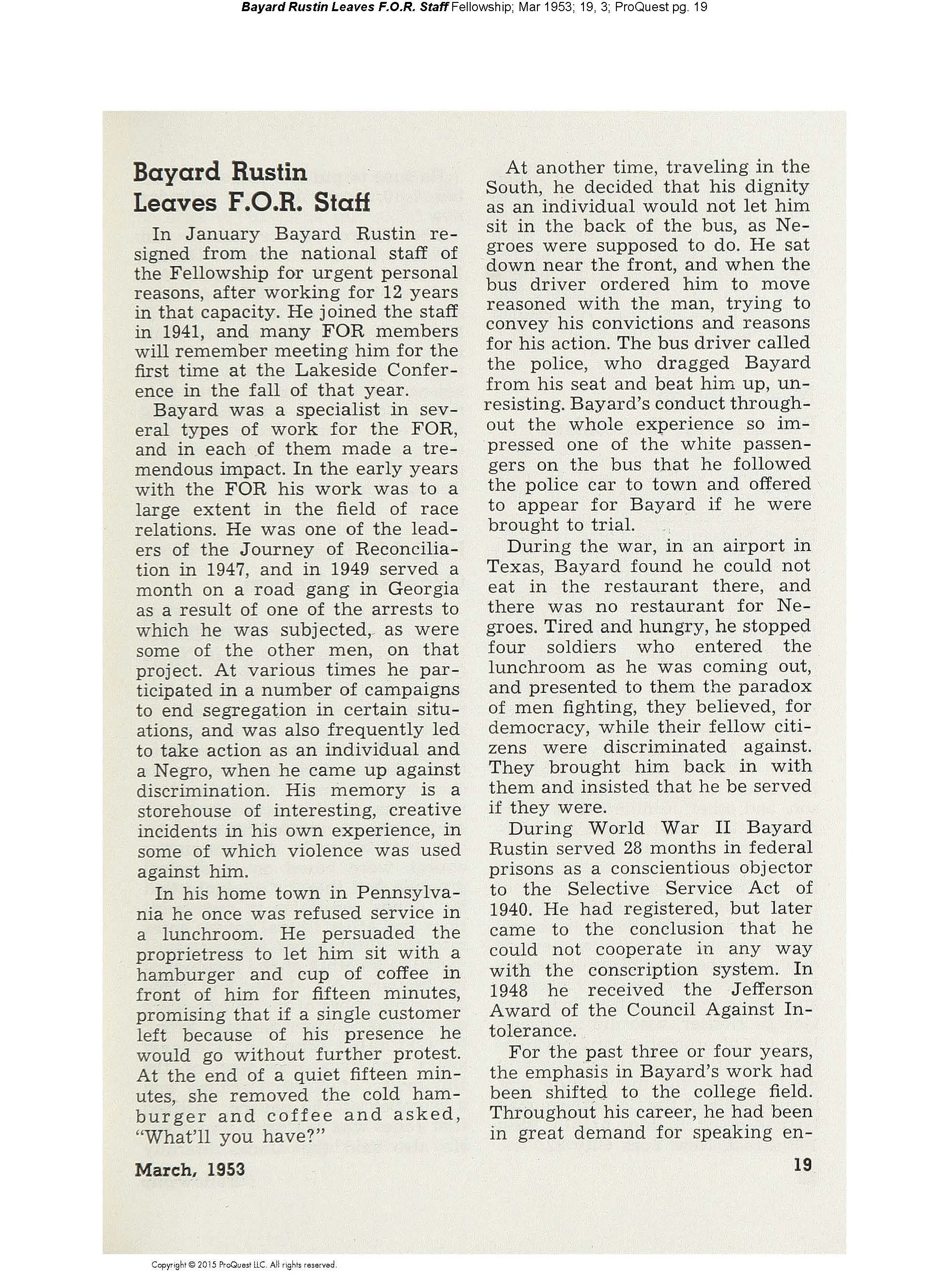
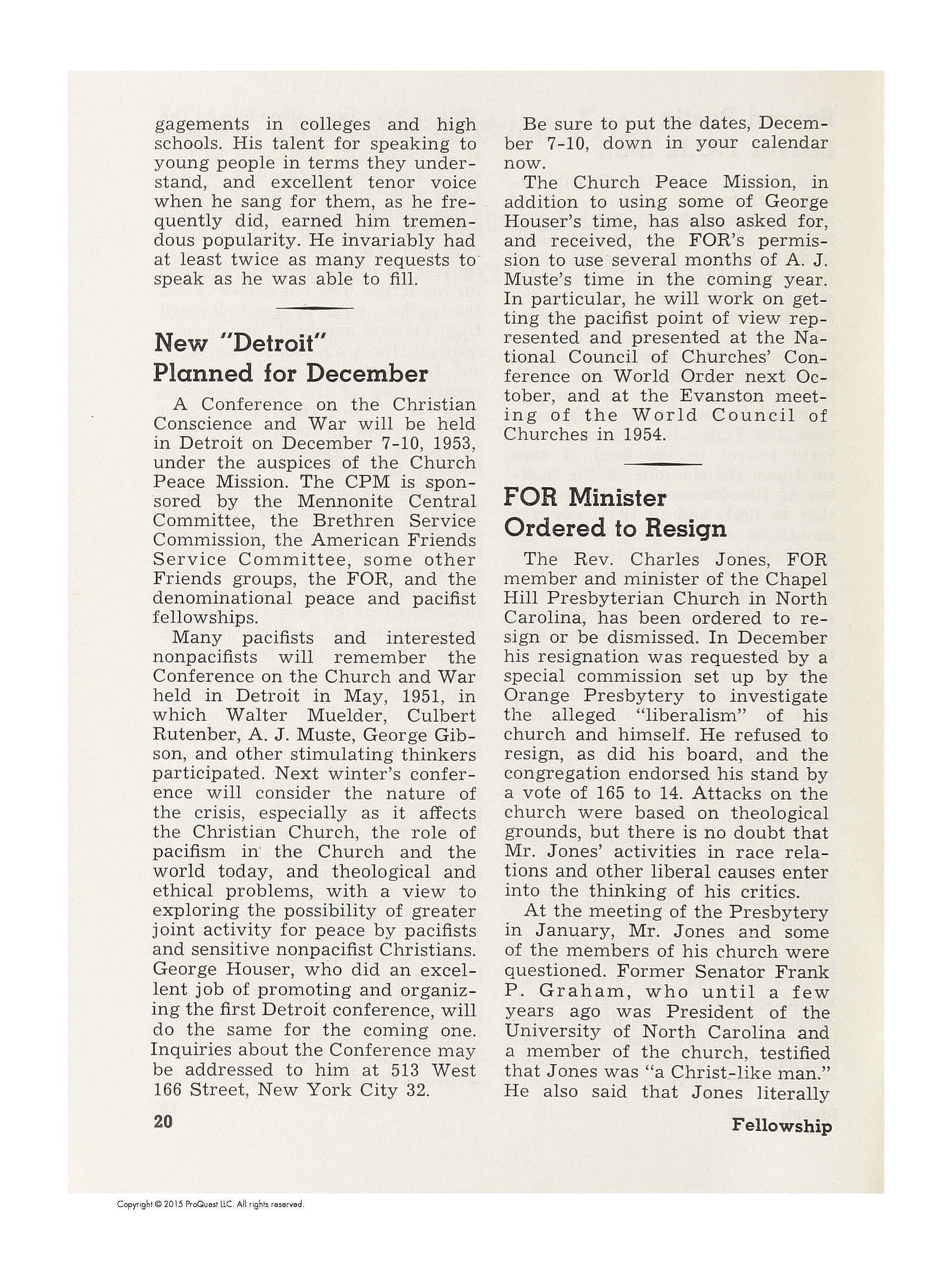
Bayard rustin leaves F.O.R. staff. (1953). Fellowship, 19(3), 19-20. Retrieved from https://login.ezproxy.princeton.edu/login?url=https://www.proquest.com/scholarly-journals/bayard-rustin-leaves-f-o-r-staff/docview/1958601327/se-2
Fellowship of Reconciliation. "Before It Embraced LGBTQ Rights, the FOR Forced Bayard Rustin to Resign." FORUSA Digital Archive, June 25, 2021. https://forusa.org/before-it-embraced-lgbtq-rights-the-for-forced-bayard-rustin-to-resign-2/.
