Description
On May 23, 1986, Bayard Rustin released an official public statement titled "Bayard Rustin Urges Mayor Koch to Veto Amendments to Human Rights Laws," delivering a naked critique of the City Council's latest legislative actions. Writing as Chairman of the A. Philip Randolph Institute and leader of the Leadership Conference on Civil Rights—a massive national coalition of over 150 organizations dedicated to human rights—Rustin declares his absolute opposition to the amendments recently passed by the city government. He maintains that these changes apply a dangerous double standard to the gay community, treating them differently than other protected groups in society. For Rustin, the nature of politics requires the highest executive of the city to step in and protect vulnerable minorities by using his veto power to kill the weakening amendments completely.
Rustin grounds his public authority in his lifetime of personal sacrifice, reminding the community that he has been arrested twenty-four times while fighting for democracy. He breaks down his historical record, explaining that his very first arrest occurred in 1928 for distributing leaflets on behalf of presidential candidate Al Smith during a wave of national anti-Catholic hysteria. He explains that whether he was fighting against untouchability in India or tribalism in Africa, history has proven that laws with discriminatory loopholes create an immediate threat to every citizen, including those who think they are immune to the consequences. By releasing this direct text, Rustin sought to build an interracial majority, insisting that the only final security for any group is to provide total equal protection for every group under the law.
Historical Context
This final statement was issued at a volatile breaking point for the New York gay rights struggle, occurring on the exact day the City Council successfully voted to pass the restrictive amendments to the human rights code. These amendments, pushed heavily by conservative councilmembers, were intentionally designed to restrict the civil rights of lesbians and gay men by granting private landlords of buildings under six units and religious educational institutions the legal right to discriminate based on orientation.
This specific moment marked a massive generational split on the political left, as mainstream liberal groups clashed with conservative religious coalitions over the fundamental definition of civil liberties. Rustin compiled this public ultimatum to directly pressure Mayor Koch to hold true to his promises of integration. By using his national platform to condemn the Council's behavior as a violation of basic human rights, Rustin sought to show that the fight against anti-gay bigotry was directly linked to the same moral lineage that had dismantled racial segregation in the South.
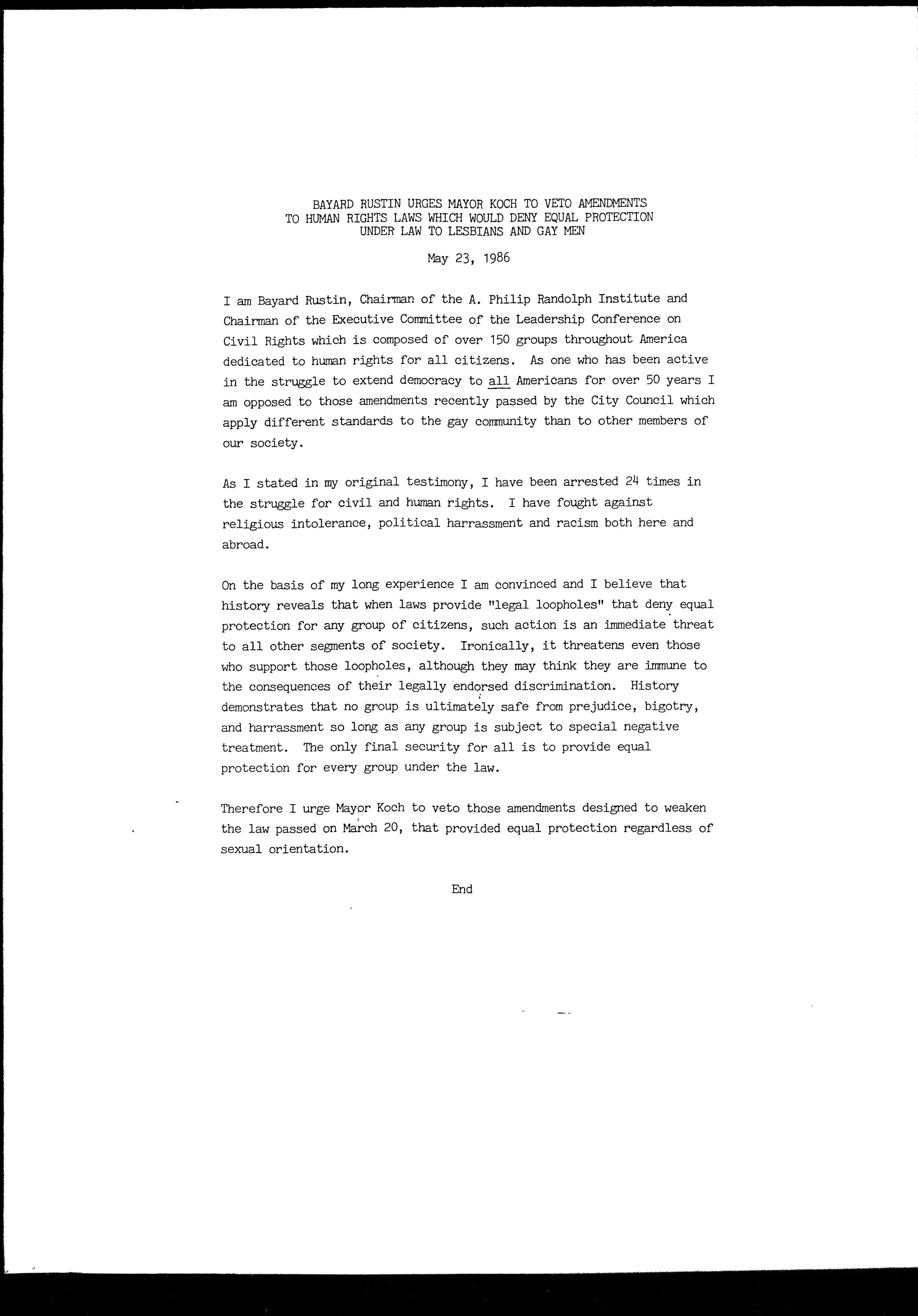
Rustin, Bayard. "Public Policy Statement: Bayard Rustin Urges Mayor Koch to Veto Amendments to Human Rights Laws." May 23, 1986.
