Description
In this 1986 interview, Harold Fleming, a veteran of the Potomac Institute, details the undertakings of the 1965 White House Conference, "To Fulfill These Rights," centering the intellectual framework established by Bayard Rustin. Fleming explores the friction surrounding the Moynihan Report, noting that while Daniel Patrick Moynihan was an influential shaper of policy, it was Rustin who most effectively challenged the reduction of racial injustice to purely moral or psychological frameworks. Fleming details how Rustin’s strategic vision for a "Freedom Budget"—a ten-year plan to abolish poverty through full employment and guaranteed income—informed the heated policy debates of the mid-1960s.
The dialogue captures Rustin’s role as a "resourceful and influential spokesman" who moved the movement from "protest to politics" by engaging directly with federal bureaucracy. Fleming explains that Rustin’s advocacy for a policy of "abundance" served as the critical counter-narrative to programs focusing on "attitudinal training" for Black youth, which Rustin criticized for treating poverty as a psychological defect rather than an economic result. By documenting Rustin’s influence, Fleming portrays him as the master strategist who forced the Johnson administration to confront the institutional racism embedded in the North’s "de facto" segregation patterns.
Historical Context
Written in mid-1986, this interview reflects on 1965, when the civil rights movement was at a crossroads just months after the passage of the Voting Rights Act. It captures the "enduring disappointment" following the 1965 Watts uprisings, which Rustin analyzed as a manifesto against systemic deprivation rather than simple rage. Fleming’s account illustrates how the White House Conference was part of a "revolutionary" attempt to graft economic justice onto political democracy, a project that was eventually stymied by the escalating costs and political drain of the Vietnam War.
The interview also provides context for the "professionalization" of the movement that Rustin championed through the A. Philip Randolph Institute. Fleming notes that while figures like Moynihan influenced presidential thinking, it was the "interracial majority" of labor, liberal, and religious groups organized under Rustin’s tactical guidance that provided the only viable mechanism for actualizing a "Great Society". Ultimately, this document serves as a record of the "long game" Rustin played, shifting the national focus from moral witness to structural reform.
See Full Transcript
See Full Transcript
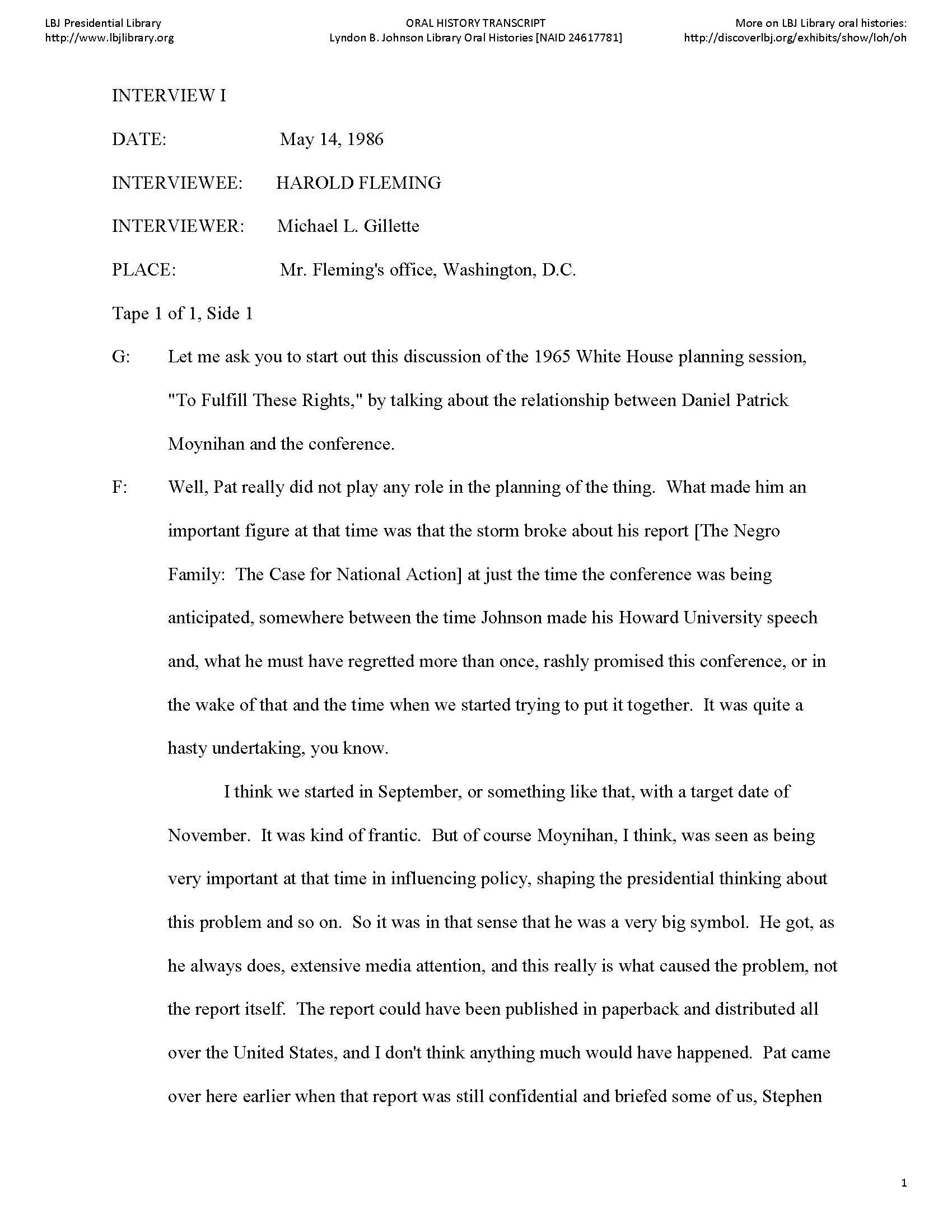
Fleming, Harold. "Oral History Interview with Harold Fleming." Interview by Michael L. Gillette. May 14, 1986. Lyndon B. Johnson Library Oral Histories.
