Description
In this firm letter to Mayor Edward I. Koch, Bayard Rustin urges the Mayor to "hold the line" against amendments that threatened to weaken New York’s "Gay Rights Bill". Rustin draws on his 50-year career in the civil rights movement to argue that legal protections for the LGBTQ+ community are a universal necessity, stating that no group is safe from prejudice as long as any one group is subject to special negative treatment. He insists that the bill must be protected in its strongest form to ensure the basic human rights of all New Yorkers are upheld.
This letter is illuminated by Rustin's 1986 interview with Joseph Beam, where he describes the "utility of politics" in the fight for equality. In that conversation, Rustin explains that he does not view his role as simply supporting politicians, but as a strategist who tells those in power, "if and when you get into office you must do these things". His appeal to Koch is a direct application of this philosophy—treating gay rights as a "barometer" for the health of American democracy and demanding that the political system fulfill its responsibility to protect marginalized citizens.
Historical Context
The 1986 New York City "Gay Rights Bill" had been a point of intense political contention for fifteen years before finally moving toward passage. Rustin’s involvement during this final push was strategic; he used his standing as a "senior" leader of the civil rights movement to frame gay rights not as a special interest, but as a continuation of the struggle for universal dignity. This letter captures the moment Rustin successfully lobbied Mayor Koch to veto weakening amendments, ensuring that the final legislation provided robust protections.
The interview with Joseph Beam, conducted during the same year, reveals Rustin's shift toward more public advocacy for the LGBTQ+ community. He tells Beam that "bigotry is indivisible" and that the same forces that opposed Black liberation were often the ones targeting the gay community. By connecting his private correspondence with Koch to these public statements, the entry shows how Rustin effectively used his "intersectional" identity to bridge the gap between the mid-century civil rights era and the modern struggle for queer liberation.
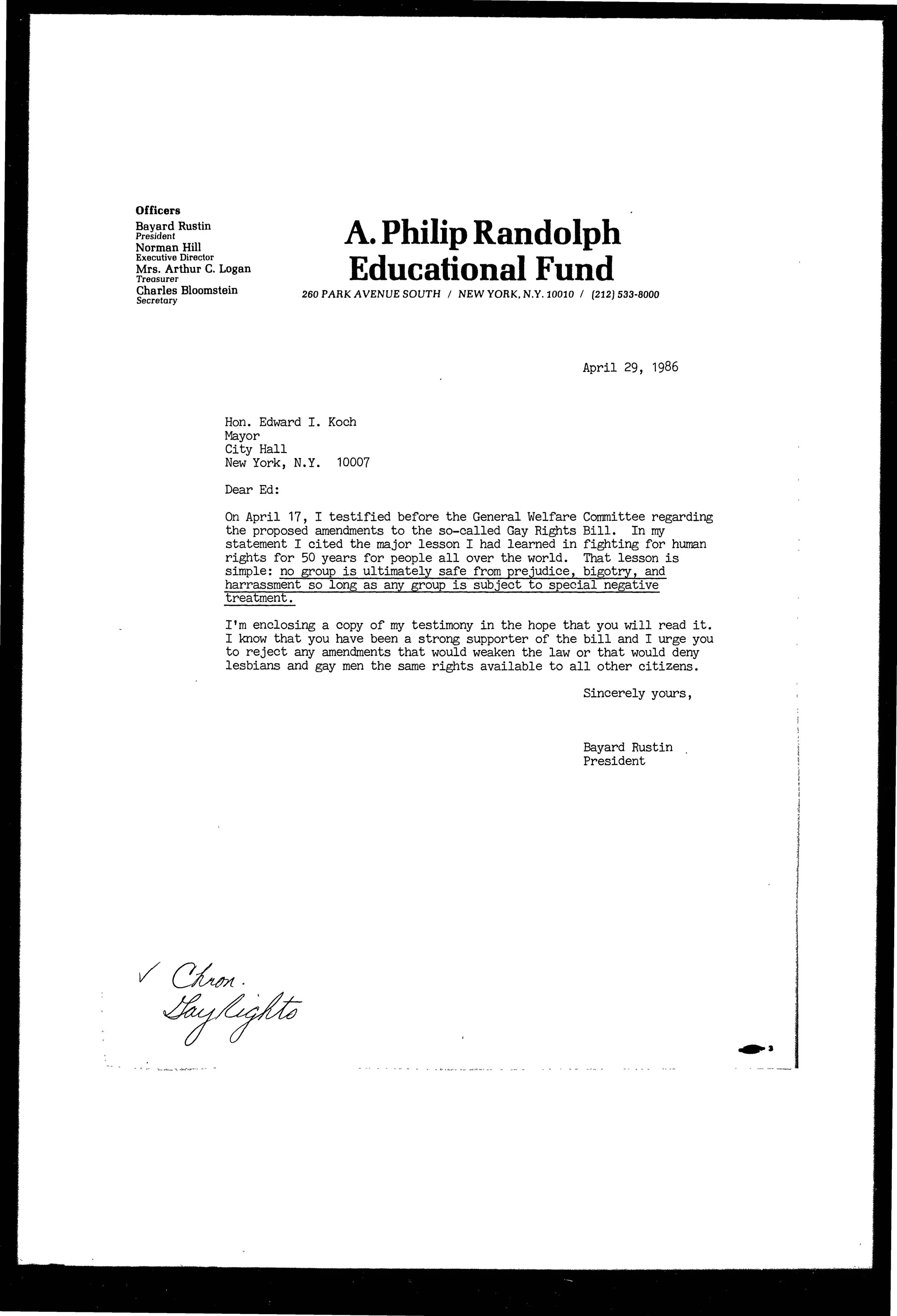
Rustin, Bayard. Letter to Mayor Edward I. Koch. April 29, 1986. Bayard Rustin Papers, General Correspondence.
Beam, Joseph. "Brother to Brother: An Interview Between Bayard Rustin and Joseph Beam." The Advocate, January 1, 2015 (originally conducted 1986).
