
In this oral history interview, Mandy Carter reflects on her decades of activism and the profound influence of Bayard Rustin on her commitment to nonviolent organizing. She connects Rustin’s legacy—from the Journey of Reconciliation to the March on Washington for Jobs and Freedom—to today’s movements for intersectional justice and Black queer leadership.
Standing in the Need of Prayer": Newton Garver’s Witness to Rustin at Swarthmore
In this reflective essay for Friends Journal, Newton Garver recounts a powerful 1949 talk by Bayard Rustin at Swarthmore College, where Rustin described his experience on a North Carolina chain gang after the 1947 Journey of Reconciliation. Garver highlights Rustin’s use of disciplined love and nonviolence—even toward a hostile guard—as a profound spiritual victory, ending with Rustin moving the audience by singing the spiritual “Standing in the Need of Prayer.”
Rustin on the Vietnam War and Dr. King
In this letter, Bayard Rustin corrects the record on his stance toward the Vietnam War and his advice to Dr. King, emphasizing that his disagreement was strategic, not ideological. Drawing on hard-earned movement experience, Rustin argues that keeping the civil rights and peace movements distinct was essential to protecting their political strength and effectiveness.
The First Freedom Ride: Rustin on the Journey of Reconciliation
In this 1985 recording, Bayard Rustin reflects on the Journey of Reconciliation as a strategic test of segregation laws, framing his arrest and chain gang sentence as calculated steps toward legal change. He presents the campaign as a blueprint for later civil rights victories, showing how disciplined nonviolent action could expose injustice and drive federal intervention.
Nonviolence as a Self-Disciplinary Tool: The Igal Roodenko Interview
In this oral history, Igal Roodenko reflects on his partnership with Bayard Rustin during the Journey of Reconciliation, describing it as a strategic test of segregation laws through disciplined nonviolence. He highlights Rustin’s leadership and the effort to move the movement from moral protest to legal and political change.
A. Philip Randolph’s Statement in Defense of Bayard Rustin
A. Philip Randolph issues a public statement affirming his “complete confidence” in Bayard Rustin’s “character, integrity, and extraordinary ability,” highlighting Rustin’s role organizing three Marches on Washington and the 1947 Journey of Reconciliation, and condemning attacks—such as those by Senator Strom Thurmond—that sought to remove Rustin from leadership.
In the tense summer of 1963, pro-segregation opponents, led by Senator Thurmond, launched a smear campaign against Rustin—citing a past arrest—to undermine his pivotal role in planning the upcoming March on Washington. Randolph’s blunt refusal to cower to “undemocratic elements” underscored the Movement’s determination to defend its organizers against moralistic political attacks and maintain unity ahead of the historic demonstration
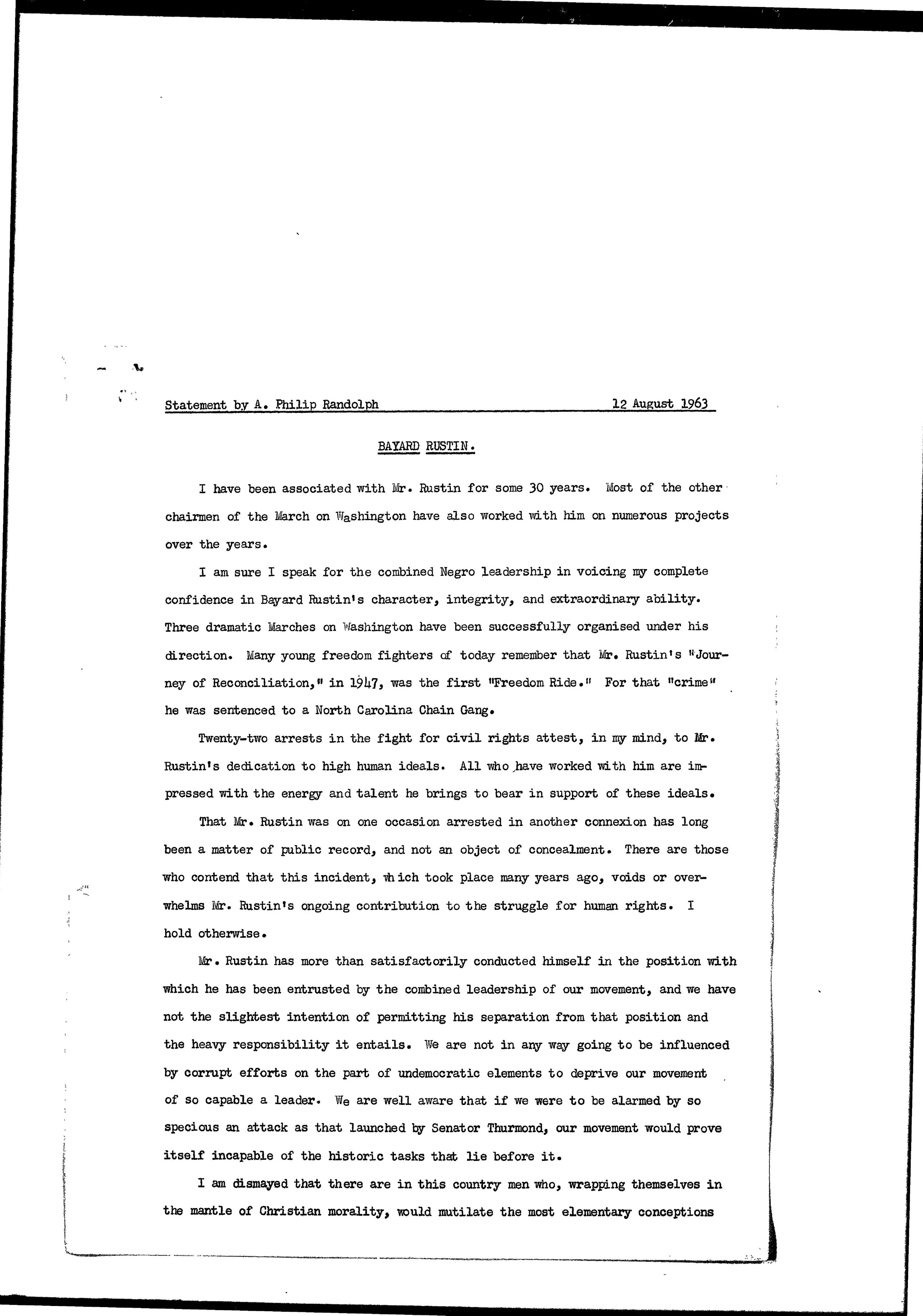
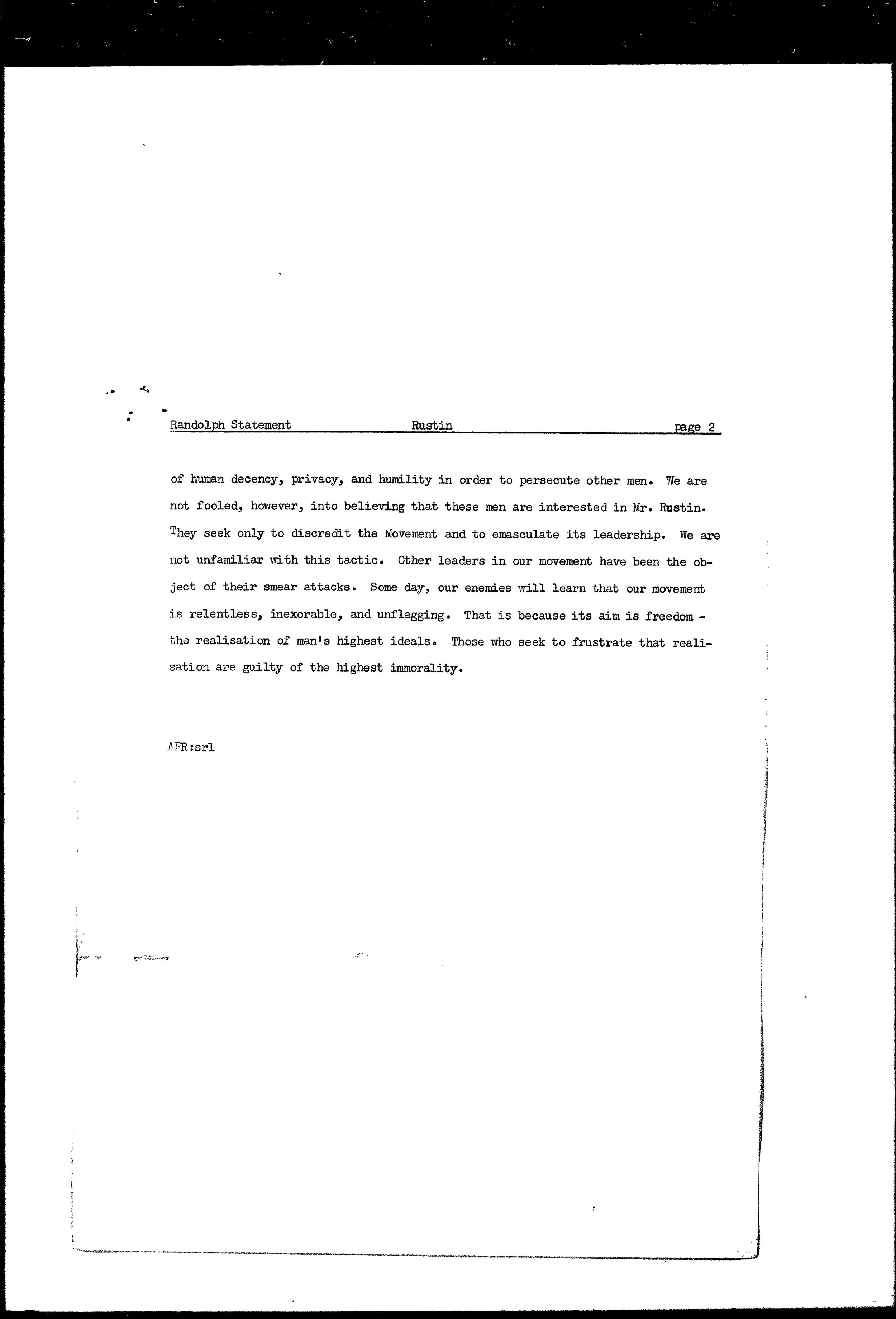
Randolph, A. Philip. “Statement by A. Philip Randolph on Bayard Rustin.” August 12, 1963. Bayard Rustin.
1947 Newspaper Report on Bayard Rustin’s Arrest During the Journey of Reconciliation
This article reports on Bayard Rustin’s 1947 arrest in Chapel Hill while participating in the Journey of Reconciliation, an early civil rights action challenging segregation on interstate buses. The coverage highlights Rustin’s unwavering commitment to nonviolent direct action and the personal sacrifices he endured for racial equality.
Witness to the Journey: Louise Jones and the 1947 Safe Haven
In this powerful interview, 97-year-old educator Louise Jones recalls offering sanctuary to Bayard Rustin and fellow activists at Black Mountain College after they were brutally beaten during the 1947 Journey of Reconciliation. Her firsthand testimony brings human depth to the historical record, tracing how witnessing Rustin’s courage transformed her from a witness of violence into a lifelong advocate for justice and community service.
Twenty-Two Days on the Chain Gang: A Report on Systemic Barbarism
After his arrest during the Journey of Reconciliation, Bayard Rustin wrote a confidential report exposing the brutal conditions of North Carolina’s chain gang system, documenting forced labor, dehumanization, and systemic abuse. Transforming personal suffering into a strategic call for reform, Rustin used detailed evidence and coalition-building to demand the abolition of the state’s penal barbarism.
Imprisonment From the Inside: Rustin’s Analysis of the Carceral State
This 1947 treatise finds Bayard Rustin offering a sweeping critique of the American prison system, arguing that punishment and authoritarian control only deepen violence and criminality. He condemns prisons as “schools for crime” that fail to rehabilitate and instead perpetuate cycles of harm. Rustin ultimately calls for a transformative approach rooted in treatment, human dignity, and the rejection of vengeance as the basis of justice.
