
Description
Writing to Professor William S. McFeely, Bayard Rustin clarifies a long-standing historical misunderstanding regarding his position on the Vietnam War and his advice to Dr. Martin Luther King Jr.. Rustin explicitly states that he never urged Dr. King to abandon the peace movement. Instead, he argues that his disagreement was purely tactical, believing that King's "notion that he could combine the civil rights and peace struggle was an error".
Rustin explains that his caution was rooted in his 1942 experience with the Congress of Racial Equality (CORE), which was "gravely weakened" when it struggled to establish its own identity separate from its pacifist founding organization. He maintains that both the peace and civil rights movements would have been stronger if they had remained strategically distinct. By "setting the record straight," Rustin highlights the "utility of politics" over emotional appeals, insisting that his primary concern was the protection and political power of the civil rights struggle.
Historical Context
By the late 1980s, the narrative of the 1960s was being cemented in academic reviews and biographies, such as David Garrow's Bearing the Cross. Rustin used this correspondence to challenge the simplified "pro-war" versus "anti-war" labels that historians often applied to him. This letter illustrates the "enduring disappointment" Rustin often felt toward those who confused his strategic discipline for a lack of moral conviction.
His reference to the 1947 "Journey of Reconciliation" serves as a reminder that his expertise in nonviolent direct action spanned decades, giving him a unique authority to judge the tactical risks of the movement. This exchange demonstrates Rustin’s role as a guardian of his own history, ensuring that the complexity of his relationship with King and his commitment to the "long game" of coalition politics was accurately recorded for future generations.
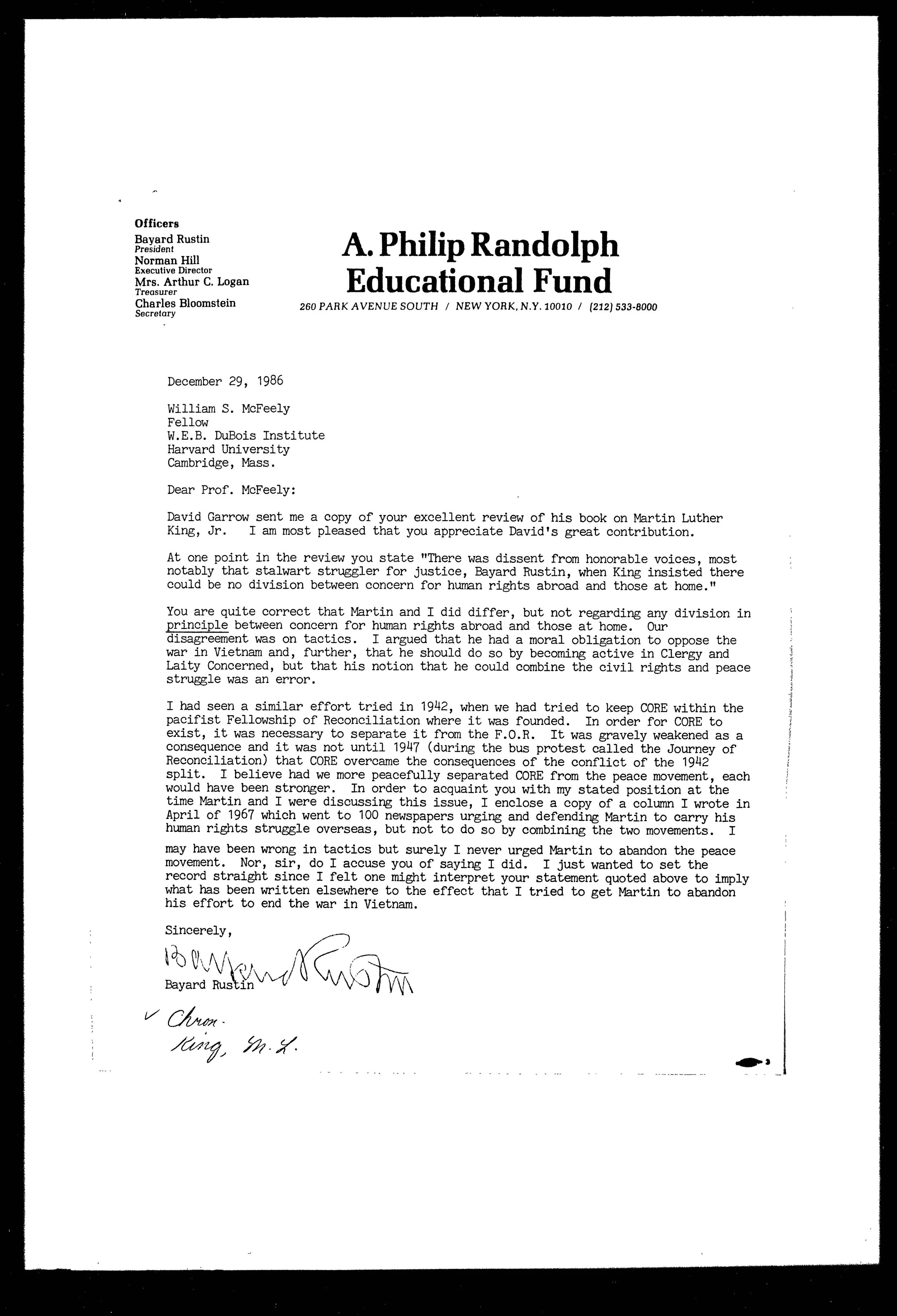
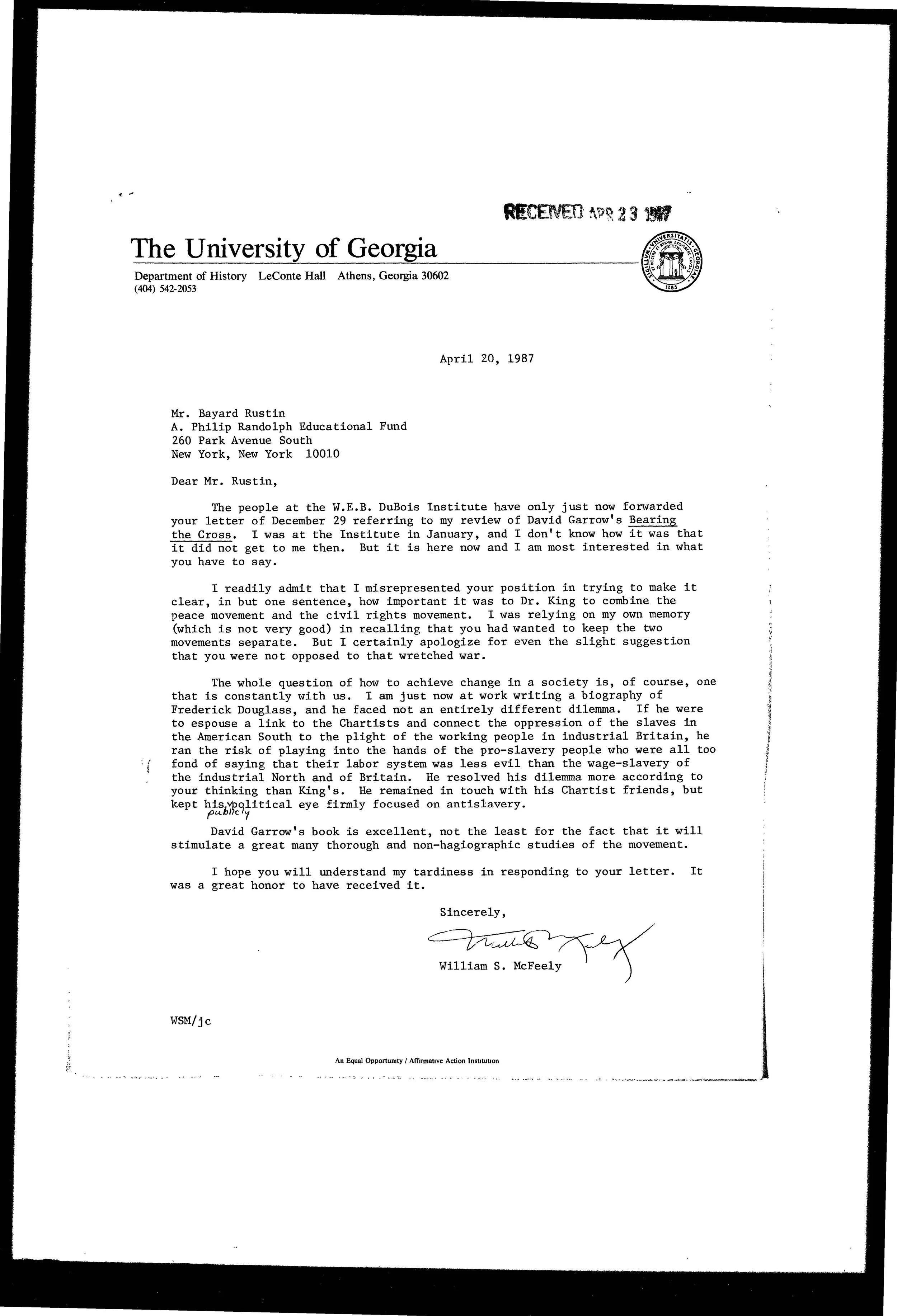
Rustin, Bayard. Letter to Professor William S. McFeely. December 29, 1986. Bayard Rustin Papers, General Correspondence.
