
Description
In this 1967 article, Bayard Rustin analyzes the shifting tactical landscape of the civil rights movement, warning that "every young Negro is being taught to be a rioter" by current history. Rustin observes that youngsters have concluded that "what Negro established-leaders could not do by arbitration, they could accomplish in a short time by violence." He notes that in cities like New York, Watts, and Chicago, serious attention to Negro demands only followed riots, creating a dangerous lesson that violence is "the only way to get what he needs." Rustin characterizes this transition as the ushering in of a "new era far more difficult and much less dramatic" than the period defined by the March on Washington, as the struggle moves from the visible drama of bombings to the quiet, underlying work of addressing "jobs, housing, schools."
Rustin offers a sharp assessment of the federal government’s responsibility, stating that if the majority of people are not prepared to ask Congress for help for the "Negro poor," the result will be a choice between two outcomes: the Negro will "either tear the fabric of this country to pieces or he will tear away from the leadership of those who seem to stand with the whites." He emphasizes that while "labor and the Church" previously acted as a "national conscience" through lobbying, the movement now requires "consistent and visible results fast" to maintain order. For Rustin, the utility of politics is at a breaking point; he suggests that the "presence of priests and rabbis and ministers" is still required to move beyond spectacular demonstrations toward the less dramatic but more difficult labor of structural social change.
Historical Context
Published in early 1967, this piece captures a pivotal moment where the focus of the struggle shifted from the Southern theater of legal segregation to the systemic economic inequalities of Northern and Western cities. This period is unique for the emerging realization that legislative victories like the Civil Rights Act had failed to improve the daily material conditions of the urban poor, leading to a profound sense of abandonment. Rustin identifies a dangerous pedagogical shift where the slow pace of democratic arbitration was being discredited by the immediate, albeit destructive, responsiveness of the state to civil disorder.
The document highlights the specific transition from the spectacular moral protests of the early 1960s to the grueling, less dramatic labor of institutional lobbying and economic reconstruction. Rustin’s analysis focuses on the breakdown of the traditional coalition of labor and religious groups, which he believed was the only force capable of moving Congress toward a meaningful redistribution of wealth. By characterizing current history as a teacher of violence, Rustin was warning of a total fracture in leadership, where the youth would abandon established nonviolent architects in favor of those promising immediate disruption.
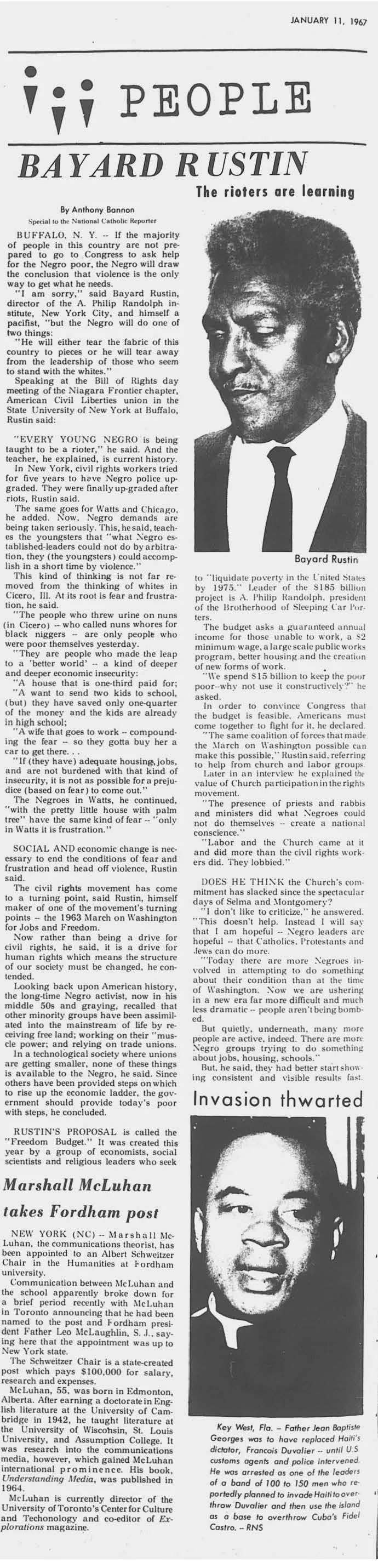
Bannon, A. (1967, Jan 11). BAYARD RUSTIN: THE RIOTERS ARE LEARNING. National Catholic Reporter, 3, 2. Retrieved from https://login.ezproxy.princeton.edu/login?url=https://www.proquest.com/magazines/bayard-rustin/docview/2169686340/se-2
