
Description
In this 1968 column for the Philadelphia Tribune, Bayard Rustin provides a naked assessment of the Kerner Commission Report, asserting that the "fundamental problem lies in the racist behavior of American institutions." Rustin maintains that the "private views" of individuals are ultimately irrelevant compared to the "overt racist actions" of the state and its organizations. He draws a direct parallel to his earlier work with the NAACP to integrate the University of Texas, noting that progress was not achieved by "psychoanalyzing white students" but by a Supreme Court ruling that "destroyed the institution of segregated education." For Rustin, the utility of politics lies in the "ultimate democratization" of these institutions rather than the revision of private beliefs.
Rustin emphasizes that placing a premium on "social justice and human rights" is the only way to reduce intolerance to an "irreducible minimum." He argues that once institutions are "altered to work for black people," the private whispers of white people in their "drawing rooms" become a matter of "supreme indifference." He characterizes the focus on individual attitudes as a "traditional reluctance" to confront the real nature of racism, which is rooted in behavior and policy. By shifting the "onus" to institutional change, Rustin sought to professionalize the movement’s demands, ensuring that the "blueprint" for the future was built on the solid ground of law and economic reform rather than the shifting sands of public sentiment.
Historical Context
The year 1968 was defined by the release of the Kerner Commission Report, which famously concluded that the nation was moving toward two separate and unequal societies—one black, one white—due to systemic "white racism." The report provided concrete data showing that 2 million people were living in "squalid and overcrowded" conditions, specifically identifying the lack of economic opportunity and police brutality as the primary triggers for urban unrest. This period was unique for the intense "ideological friction" between those who sought cultural "separatism" and those, like Rustin, who insisted on the "socialization of the economy" through integration. There was a prevailing sense that the "nature of politics" had reached a breaking point, requiring a shift toward the grueling labor of institutional reconstruction.
This era marked a "revolutionary transition" catalyzed by the passage of the Civil Rights Act of 1968, often called the Fair Housing Act, which prohibited discrimination in the sale, rental, and financing of housing. This specific legislation represented the exact "institutional change" Rustin advocated for, shifting the focus from personal prejudice to the legal foundations of the American property market. Critics of the time were often an "irritant" to the mass media, which preferred to frame racism as a matter of personal prejudice rather than a structural defect. Rustin’s analysis reflects his commitment to a "long game" where the utility of politics is measured by the capacity to achieve consistent and visible results through policy rather than psychoanalysis.
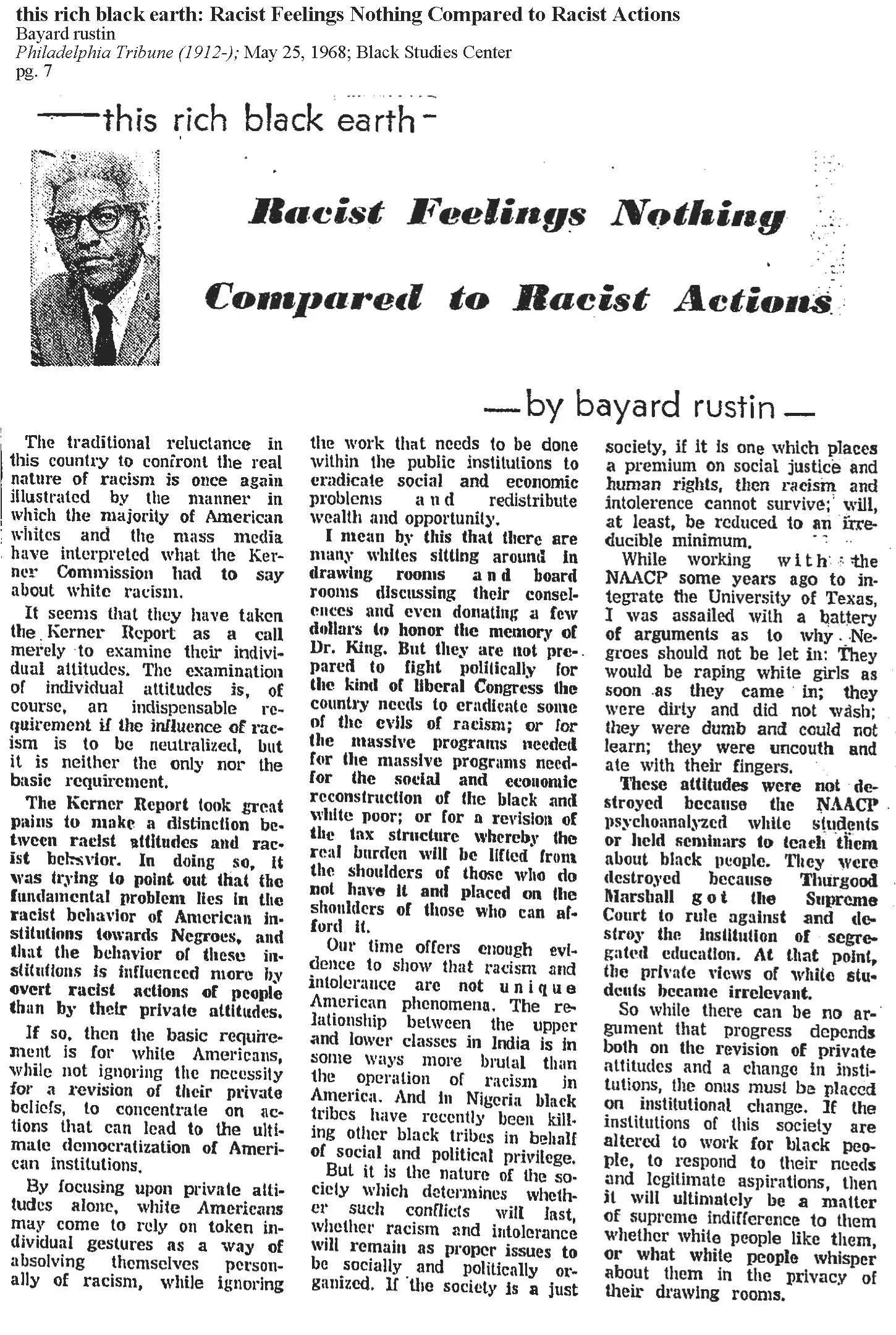
Rustin, Bayard. "This Rich Black Earth: Racist Feelings Nothing Compared to Racist Actions." Philadelphia Tribune, May 25, 1968.
