Please note: The exact date of this document is unknown.
Description
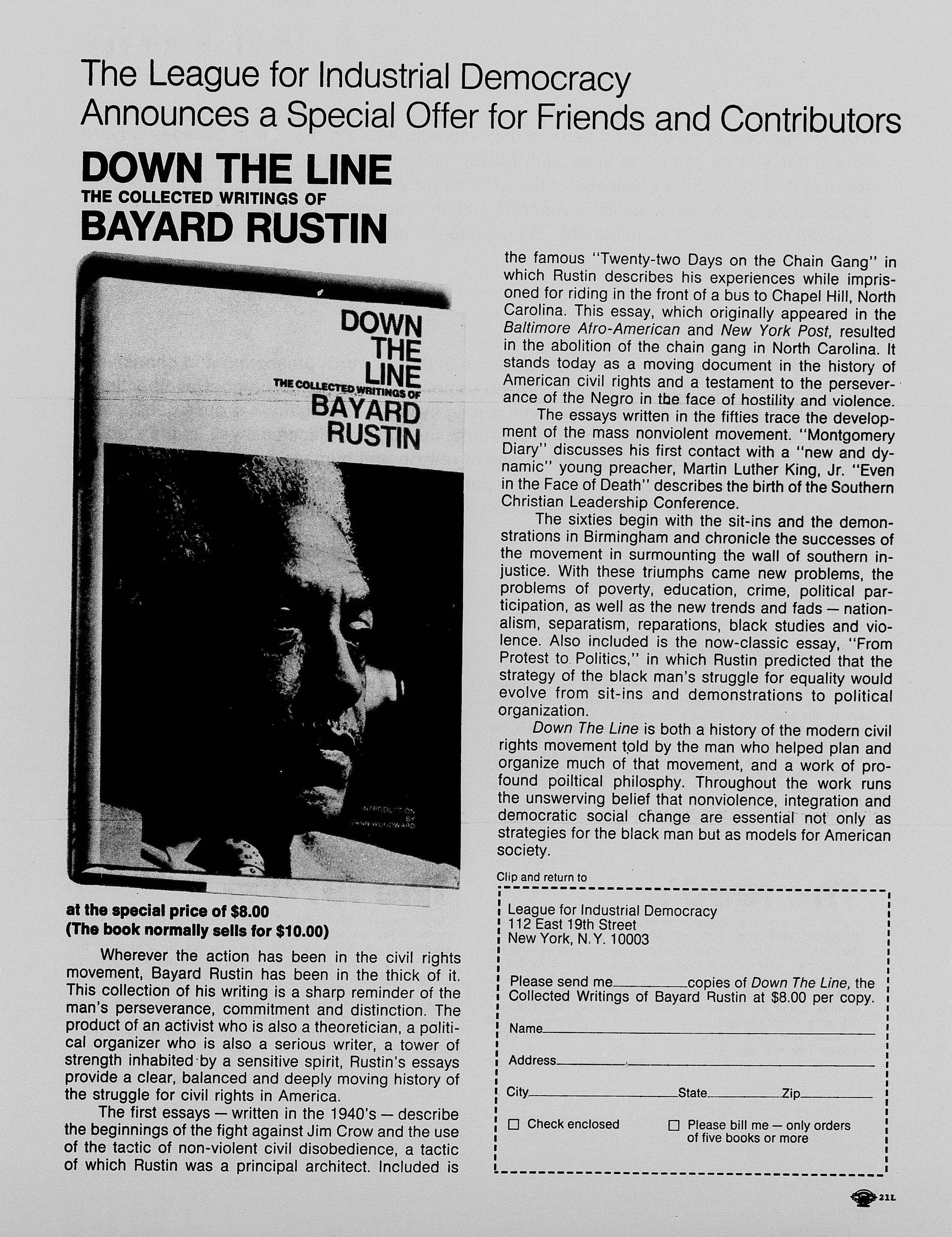
This document is a promotional order form for Down The Line, the definitive collection of Bayard Rustin’s writings published by Quadrangle Books. The collection spans nearly three decades, beginning with his 1942 reflections on the "interracial majority" and concluding with his sophisticated 1970s analyses of urban displacement and economic policy. The volume includes his now-classic 1965 essay, "From Protest to Politics," which predicted that the movement must evolve from spectacular demonstrations to disciplined political organization. Rustin uses these collected works to offer a naked defense of integration and democratic socialism, maintaining that nonviolence is not merely a tactic but a necessary model for American society. He dismisses contemporary fads—such as separatism and nationalism—as sterile retreats from the hard labor of structural social change.
The publication marks Rustin’s arrival as the movement's "Socrates," a thinker who prioritized the socialization of the economy over the mythology of cultural aesthetics. By compiling these essays, Rustin sought to professionalize the civil rights struggle, providing a technical manual for how a minority group can move from the margins to the center of political power. He argues that the utility of politics lies in surmounting the wall of Southern injustice to confront the deeper, more complex problems of poverty and education. For Rustin, this collection was not a retrospective of past glories but a blueprint for a long game that required an interracial coalition to secure a redistribution of national wealth.
Historical Context
The release of Down The Line in 1971 occurred during a period of revolutionary transition and deep ideological friction. Rustin’s history of writing had always served as the movement’s intellectual vanguard; as early as the 1940s, his reports on the Journey of Reconciliation provided the legal and tactical foundations for the sit-ins that would follow twenty years later. By the early 1970s, however, his uncompromising commitment to integration and class-based politics made him an irritant to a new generation of radical intellectuals. While others were writing manifestos on Black Power, Rustin was documenting the socialization of wealth as the only viable path to liberation.
This document captures the specific moment when Rustin attempted to codify his life’s work to combat the rising tide of identity politics. His writings reflect an enduring disappointment with those who substituted clever words for rigorous analysis, a theme that remained consistent from his earliest pacifist tracts to his late-career columns. By institutionalizing his thoughts through the League for Industrial Democracy and the A. Philip Randolph Institute, Rustin ensured that his social-democratic blueprint remained available to those willing to engage in the less dramatic, more difficult work of institutional reconstruction. This entry serves as a record of Rustin’s intellectual stamina and his refusal to abandon the traditionalist values of the liberal-labor alliance.
League for Industrial Democracy. "Down The Line: The Collected Writings of Bayard Rustin Order Form." Socialist Party of America Papers, 1971 (reprinted 1974). Retrieved from https://login.ezproxy.princeton.edu/login?url=https://www.proquest.com/archival-materials/league-industrial-democracy-papers/docview/3059242659/se-2
