Description
In this influential 1971 column, Bayard Rustin addresses the escalating debate over whether the American descendant of slaves should be called "Negro," "Black," or "Afro-American." Rustin offers a naked critique of the "Black" consciousness movement, asserting that the preoccupation with a new name is often a substitute for the hard labor of political and economic analysis. He maintains that while a name change might provide a temporary psychological lift, it does nothing to alter the irreducible minimum of poverty, poor housing, or inadequate medical care facing the masses. For Rustin, the utility of politics lies in the socialization of the economy, and he warns that symbolic reconciliations are easily conceded by white society precisely because they carry no financial or structural cost.
Rustin defends the term "Negro" not out of a lack of pride, but out of a respect for the "long game" of history. He argues that the great victories of the 1950s and 60s—the Montgomery Bus Boycott, the sit-ins, and the March on Washington—were won under the banner of the "Negro," and to abandon the term is to risk a sterile isolation from one’s own revolutionary heritage. He characterizes the rush toward new slogans as a flight from the reality of the struggle, suggesting that a name is a "blueprint" for how a group perceives its place in the world. By prioritizing the "mythology" of a new title over the material redistribution of wealth, Rustin contends that activists are effectively "masturbating" intellectually rather than engaging in the professionalization of power needed to reconstruct the ghetto.
Furthermore, Rustin views the linguistic shift as an internal class problem. He notes that the educated elite can afford the luxury of debating nomenclature, while the unemployed worker remains trapped in the same economic morass regardless of what they are called. He asserts that the nature of politics in a democratic nation requires an interracial majority, and he fears that the move toward more nationalist-leaning terms like "Afro-American" serves only to fracture the liberal-labor-civil rights coalition. Ultimately, Rustin’s column serves as a professional warning: the movement must not let the "psychological wave" of cultural identity drown out the urgent demand for full employment and the total elimination of poverty.
Historical Context
Published during a period of revolutionary transition in American life, this column captures the growing rift between the integrationist old guard and the burgeoning Black Power movement. The early 1970s was a time of competitive scarcity and enduring disappointment with the pace of economic change following the legislative victories of the mid-60s. Rustin, acting as the movement’s primary architect, sought to ground the struggle in the social-democratic principles of the Freedom Budget rather than the aesthetic shifts favored by the New Left.
The column’s republication in the New York Times underscores Rustin’s status as a key interpreter of Black political thought for a national audience. It documents the moment when the "Socrates of Civil Rights" became an irritant to a new generation of activists who viewed his traditionalism as a barrier to self-determination. This entry preserves a vital record of the intellectual stamina required to resist popular slogans in favor of a class-based strategy, illustrating Rustin’s belief that the socialization of society was the only path to a dignity that a mere name change could never provide.
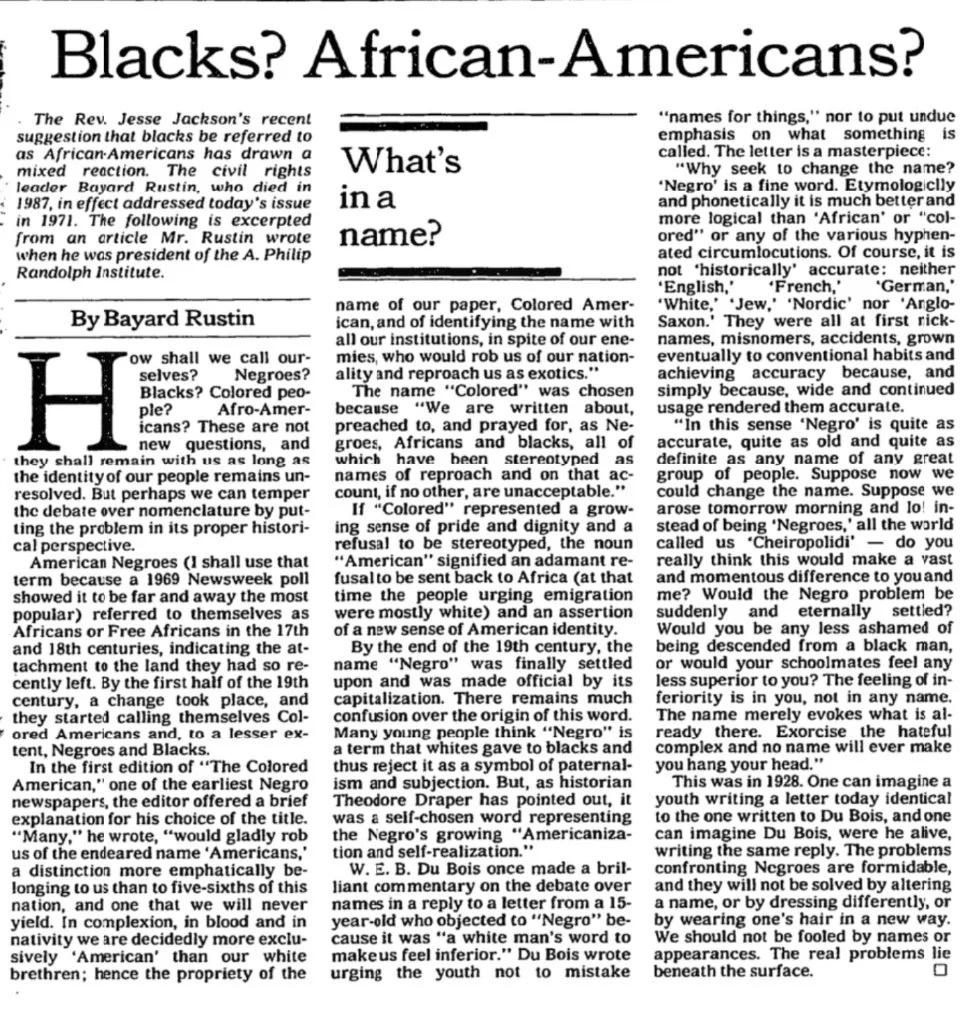
Rustin, Bayard. "What's In A Name?" New York Amsterdam News, January 1971. (Republished in the New York Times).
