
Description
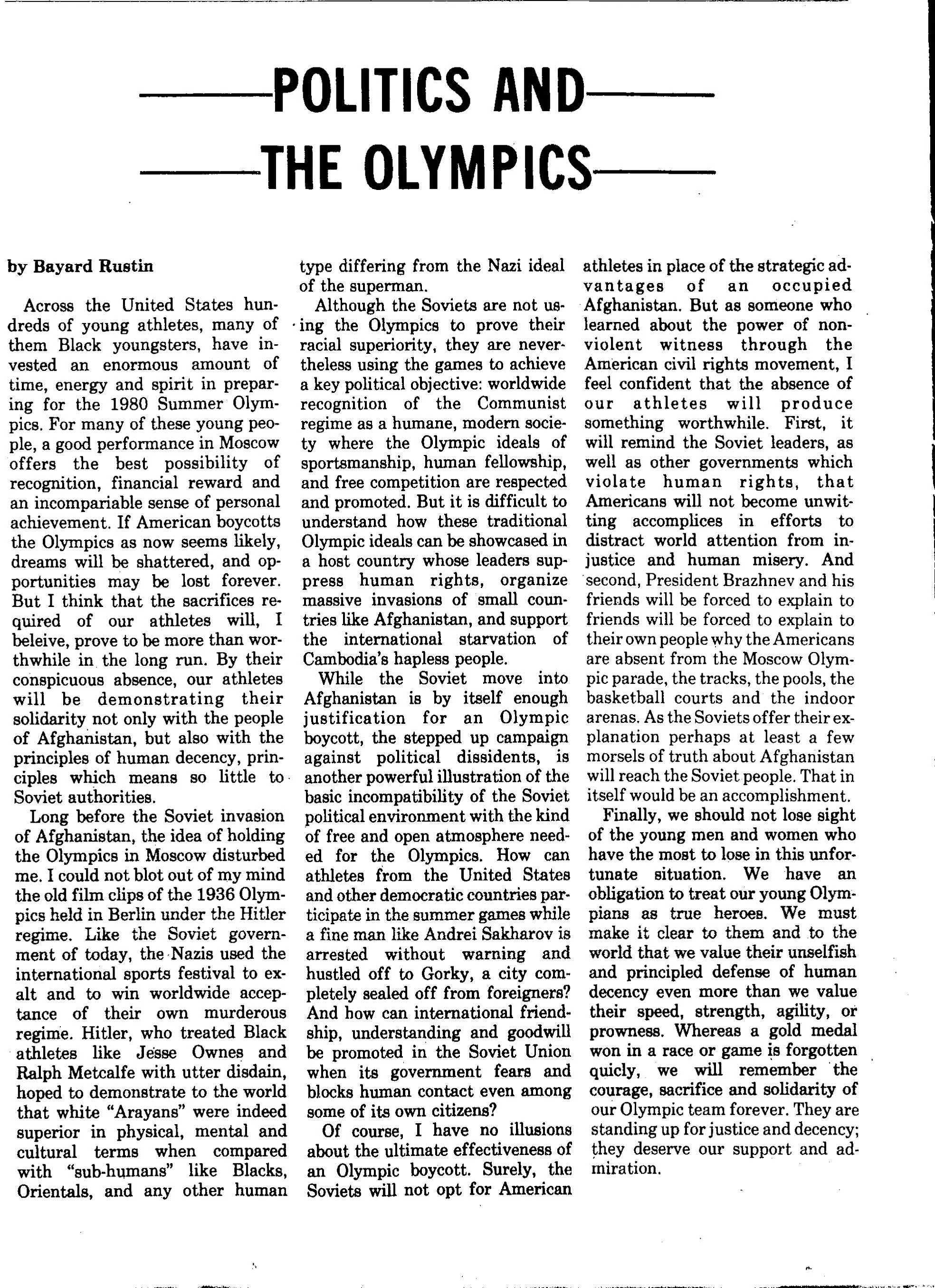
In this 1980 column for The Louisville Defender, Bayard Rustin analyzes the proposed American boycott of the Summer Olympics in Moscow following the Soviet invasion of Afghanistan. Rustin acknowledges the heavy personal and financial toll on athletes—particularly Black youngsters for whom the games represent a singular path to recognition—but he maintains that the sacrifice is a necessary demonstration of solidarity with the principles of human decency. He draws a direct parallel to the 1936 Berlin Olympics, arguing that just as the Nazi regime used sports to exalt a murderous ideology, the Soviet government seeks to use the games to distract the world from injustice and human misery. For Rustin, the utility of politics must extend to the international stage to ensure that democratic nations do not become unwitting accomplices to totalitarianism.
Rustin emphasizes that the absence of American athletes serves a dual purpose: it acts as a silent protest against the violation of human rights and forces the Soviet leadership to explain the vacancy to their own people, potentially delivering "morsels of truth" about the conflict in Afghanistan. He argues that the true measure of a hero is not found in speed or strength, but in the "unselfish and principled defense" of justice. Rustin asserts that while gold medals are quickly forgotten, the courage required to stand up for human decency creates a lasting legacy of solidarity. By prioritizing the "socialization" of international ethics over the personal dreams of athletes, Rustin frames the boycott as a vital tool in the long game of global human rights advocacy.
Historical Context
Published in February 1980, this column captures a moment of intense Cold War friction and the expansion of the civil rights struggle into the realm of global geopolitics. The Soviet-Afghan War created a climate of competitive scarcity in international diplomacy, leading Rustin to advocate for a blueprint of moral consistency that transcended domestic concerns. While many athletes and sports commentators viewed the boycott as an unfair politicization of amateur athletics, Rustin’s perspective reflects his evolution into a professional human rights strategist who viewed the "nature of politics" as inherently tied to the protection of vulnerable populations worldwide.
The year 1980 was also a period of enduring disappointment for those hoping for a cooling of international tensions, as the invasion of Afghanistan signaled a move toward renewed global conflict. Rustin’s stance illustrates his willingness to act as an irritant even to those within his own community who might have preferred to see Black athletes compete on the world stage. This document serves as a record of his conviction that the "logistics" of freedom require a total commitment to human rights, asserting that the socialization of these values is the only way to effectively challenge the power of authoritarian regimes.
Rustin, B. (1980, Feb 21). POLITICS AND THE OLYMPICS. The Louisville Defender (1933-) Retrieved from https://login.ezproxy.princeton.edu/login?url=https://www.proquest.com/newspapers/politics-olympics/docview/2726012860/se-2
