
Description
In this 1980 column for the Michigan Chronicle, Bayard Rustin provides a naked assessment of how racial stereotypes evolved from the blatant caricatures of the past into more refined, subtle forms of exclusion. Rustin focuses his analysis on the NBC program Skag, a drama starring Karl Malden that purported to depict the daily life of an East Pittsburgh steelworker. He maintains that while the "coarse and crude" racism of the Amos and Andy era had become socially unacceptable, Skag practiced a new form of erasure by presenting a white-dominated workforce that ignored the increasingly important role of Black laborers in the steel industry. For Rustin, this was not a simple oversight but a distortion of reality that rendered Black workers as an insignificant force in production.
Rustin further critiques the program for its condescending depiction of working-class life. He argues that the show’s producers, viewing ordinary labor as dull, felt the need to "spice up" the narrative with sordid events like prostitution and alcoholism. He characterizes this approach as an act of condescension from a "better class" of writers who lecture the masses rather than offering a balanced depiction of their vitality. Rustin asserts that the utility of politics must include holding the television industry accountable, as workers support these networks through their purchases. He concludes that NBC would be doing a favor to both Black people and the labor movement by "junking" a program that insults the very people whose sweat keeps the industry alive.
Historical Context
Published in May 1980, this piece documents a pivotal shift in the "nature of politics" regarding cultural representation. By this time, the legal foundations of segregation had been dismantled, but the movement faced a new era of ideological friction centered on the "invisible" racism of institutions and media. Rustin’s focus on the steel industry reflects his long-term commitment to the labor-civil rights alliance and his understanding of the socialization of the economy; he recognized that if Black workers were erased from the cultural narrative of labor, they would be more vulnerable to the economic shifts then devastating the industrial North.
This period was marked by an enduring disappointment with how mass media managed the transition from the spectacular protests of the 1960s to the integrated reality of the 1980s. Rustin’s role as an irritant to the television industry illustrates his professionalized approach to advocacy, where he viewed the "barometer of social change" as the accuracy with which a society depicts its working class. By calling out the subtle racism of a major network, Rustin sought to protect the dignity of the interracial majority and ensure that the blueprint for social justice included the right to an honest and unvarnished representation in the national consciousness.
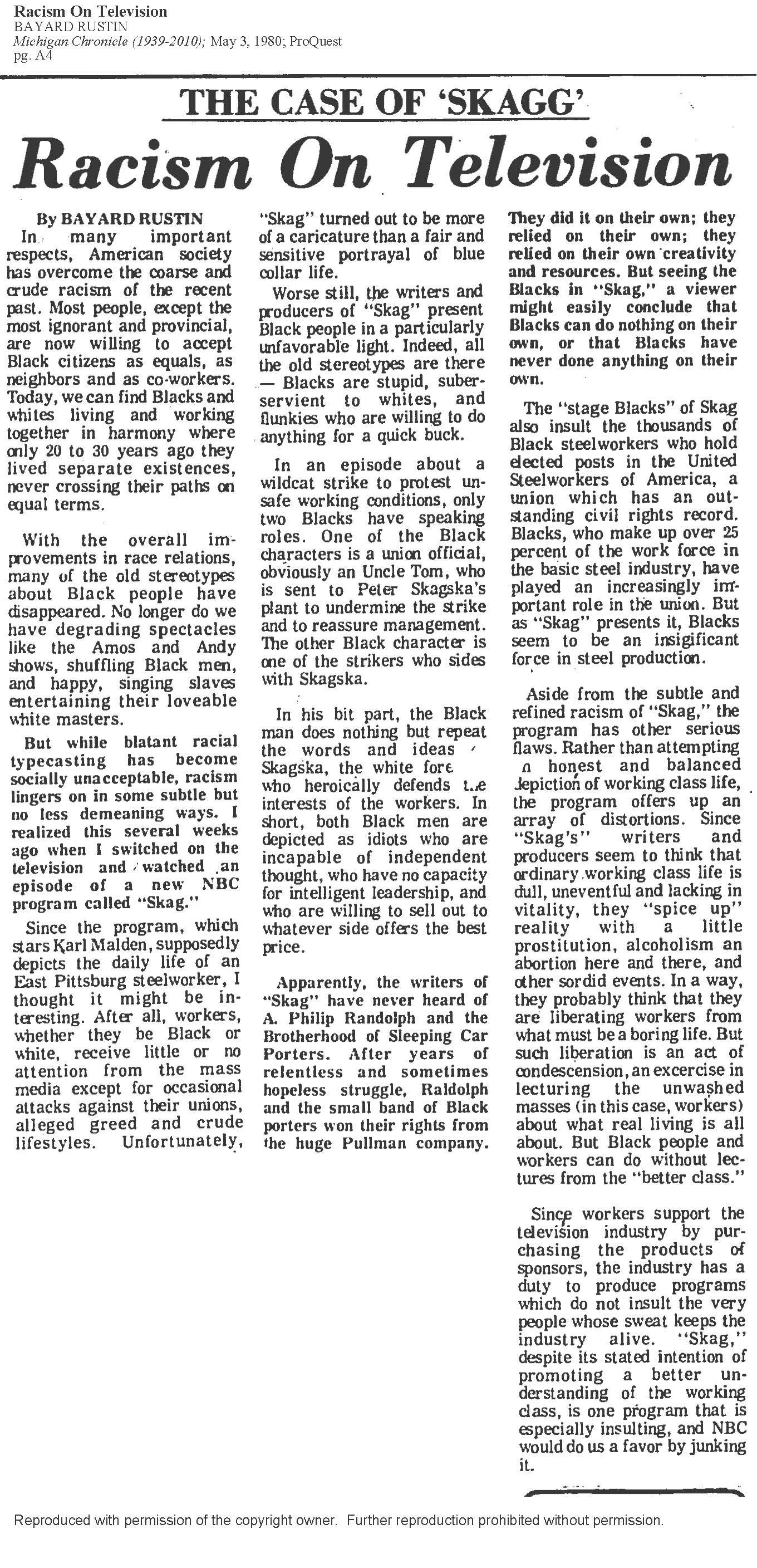
RUSTIN, B. (1980, May 03). Racism on television. Michigan Chronicle (1939-2010) Retrieved from https://login.ezproxy.princeton.edu/login?url=https://www.proquest.com/newspapers/racism-on-television/docview/2404982217/se-2
