Please note: The exact date of this brief is unknown.
Description
In this late 1985 educational brief, Bayard Rustin utilizes a precise question-and-answer layout titled "Questions and Answers About Intro 1" to provide a direct analysis of proposed civil rights legislation in New York City. Rustin outlines a clear blueprint explaining that the city's existing human rights law already bans discrimination based on race, creed, color, national origin, ancestry, sex, marital status, and physical handicap. He argues that adding "sexual orientation" to this law simply grants gay and lesbian citizens the exact same legal protections in employment, housing, and public accommodations that other groups have enjoyed for years, a conceptual framework detailed further in his Educational Brief on the Strategic Framework for Equal Protection. For Rustin, the utility of politics requires dismantling systemic bias through clear communication, forcing lawmakers to look past popular myths and base public policy on objective legal facts.
The brief features highly detailed explanations designed to dismantle the most common legal and social anxieties surrounding the bill. Rustin explicitly clarifies that the legislation has nothing whatsoever to do with legalizing, approving, or sanctioning illegal sex acts, emphasizing that the law protects an individual's status or identity rather than their conduct. To prove his point, he draws a direct legal parallel to freedom of religion, explaining that while a person's creed is protected, they are still subject to criminal prosecution if their religious beliefs lead them to commit illegal acts like bigamy. Furthermore, he explains that the bill does not require employers to implement affirmative action quotas, nor does it force religious institutions to accept or promote homosexuality within their own private facilities, completely protecting traditional separation of church and state.
Rustin also addresses deep theological questions regarding religious objections to the legislation, maintaining that no major denomination holds that the mere state of being homosexual is intrinsically evil. He explains that while certain religions proscribe specific sexual practices, gay citizens are not asking the government to regulate private behavior, but simply to protect their right to be known as who they are. Rustin uses a brilliant rhetorical argument to remind religious critics that while some people might find specific orthodox practices sinful or wrong, that personal belief never gives them the right to deny someone a job, a home, or a hotel room. By defining sexual orientation as a morally neutral trait and pointing out that the term was already functioning successfully in the State of Wisconsin and fifty other American cities, Rustin sought to professionalize queer advocacy and turn it into a standardized, universally understood civil rights measure.
Historical Context
In the mid-1980s, a deep wave of social panic spread across the country as the devastating escalation of the AIDS crisis (Acquired Immunodeficiency Syndrome) triggered a powerful political backlash against the gay community. In New York City, local gay and lesbian citizens faced widespread discrimination in the housing market, where landlords routinely evicted tenants or refused leases to same-sex couples without any legal consequences. This specific document reflects a critical turning point where veteran strategists like Rustin stepped in to counter this bias by framing gay rights as a universal human rights issue.
Activists during this window realized that standard protests were not enough to overcome the deep-seated fears of conservative lawmakers, who were stalling local anti-discrimination bills like Intro 1 by trapping them in committees for years. Rustin built this educational manual to give local coalitions a clear, rational blueprint to push the legislation out of the backrooms and force an open vote in the City Council.
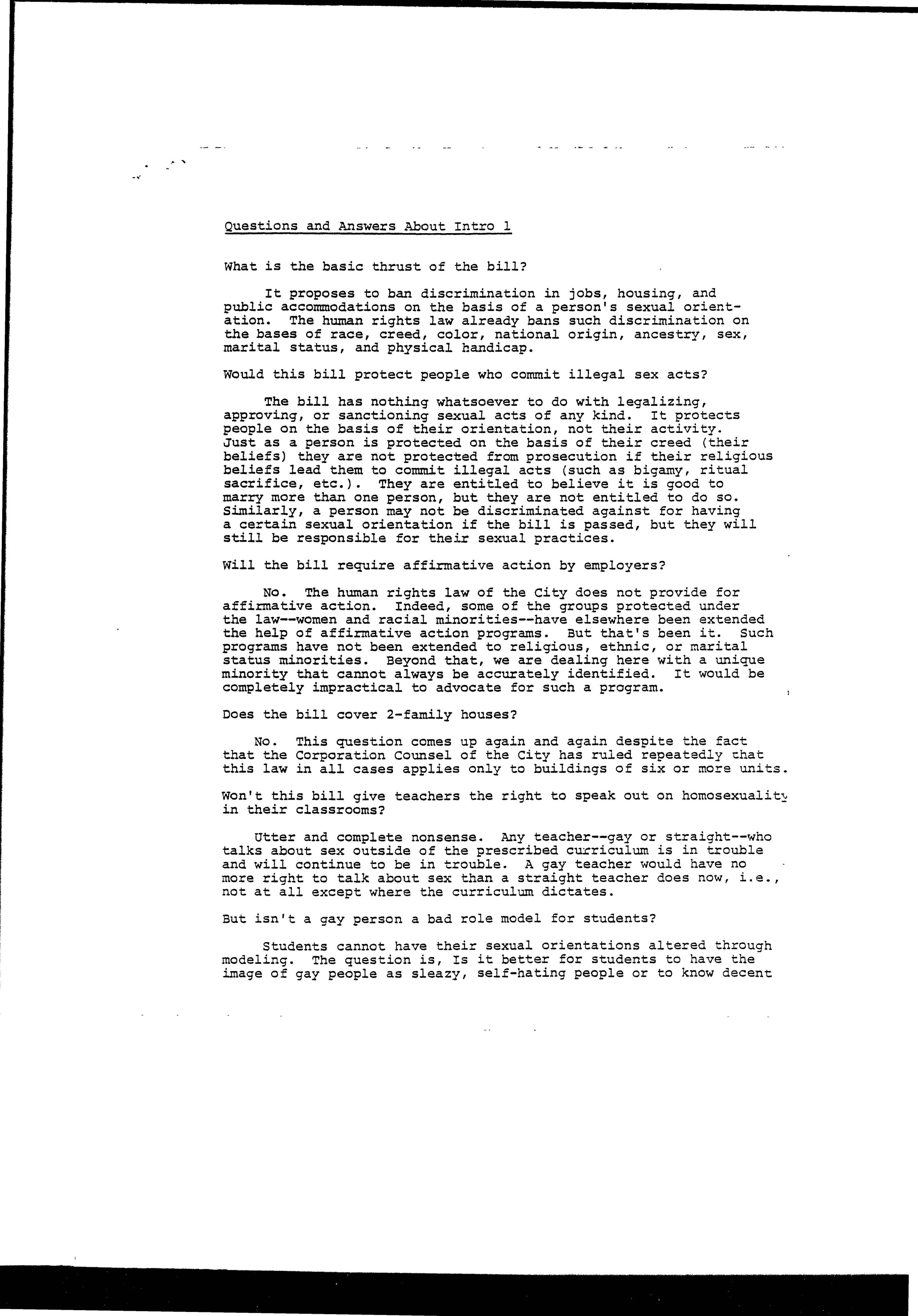
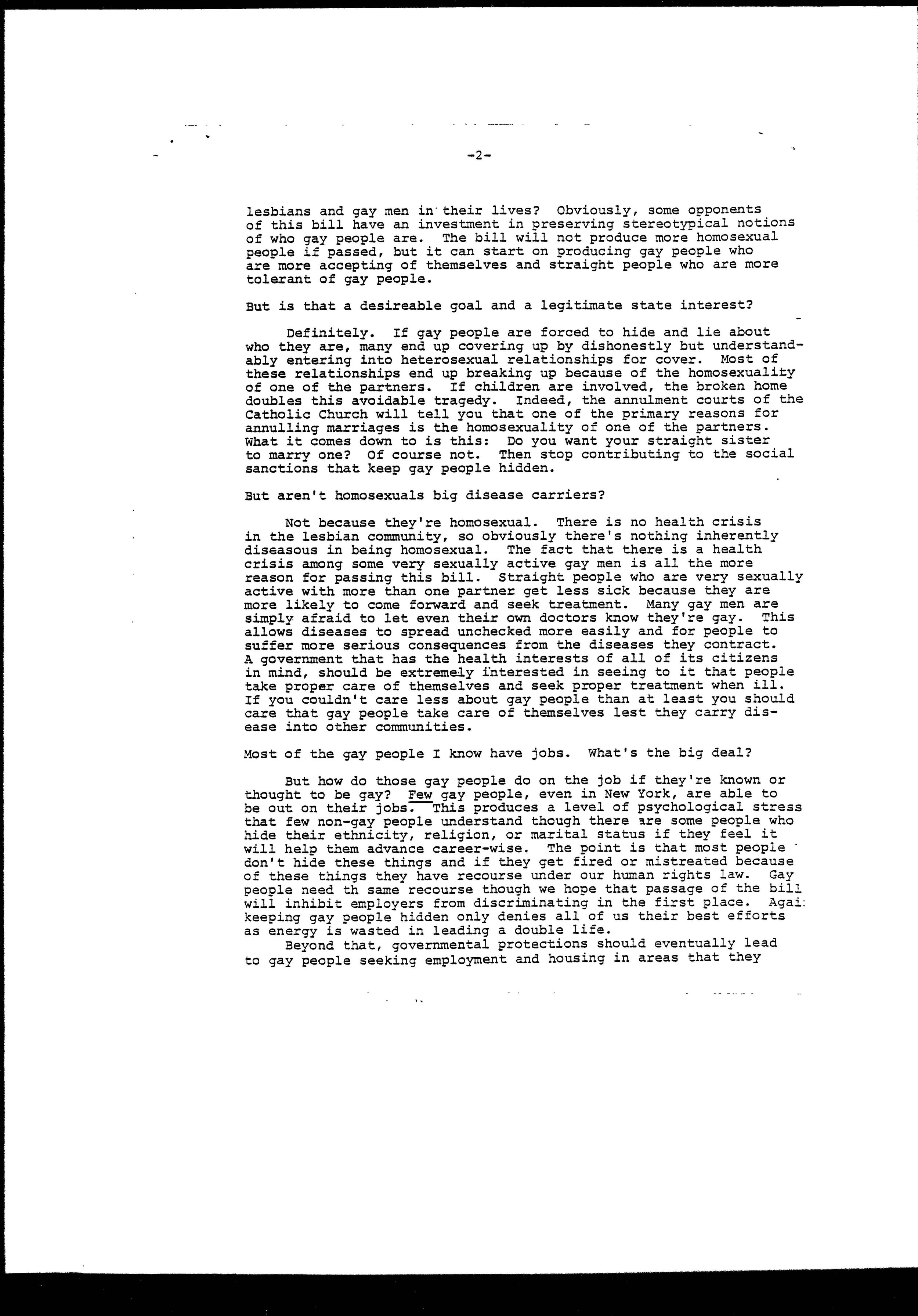
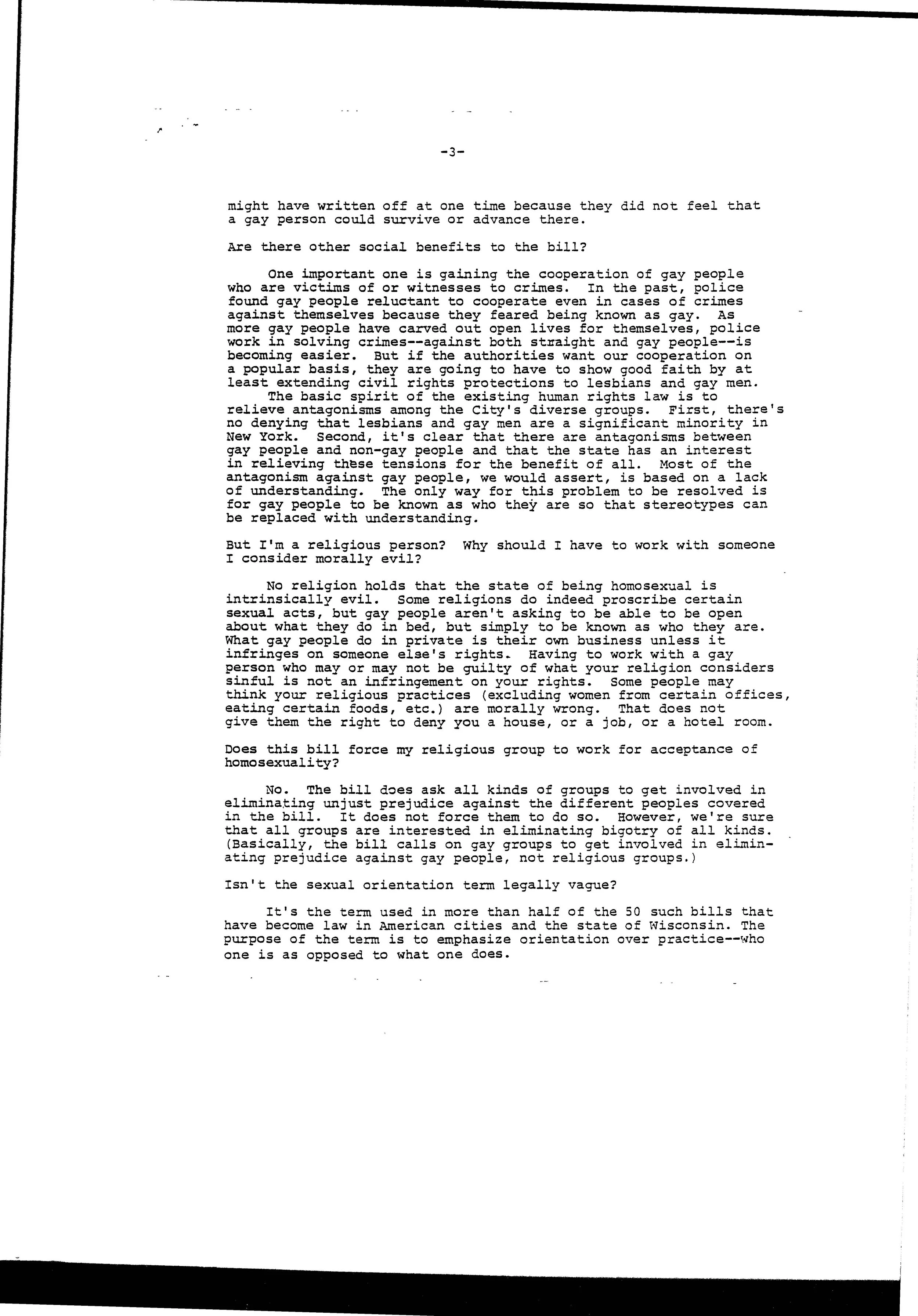
A. Philip Randolph Educational Fund. "Educational Monograph: Questions and Answers About Intro 1." Late 1985. Questions and Answers About Intro.
As part of this folder
Gay rights, 1961-1986. (1961). Bayard rustin papers; alphabetical subject file () Retrieved from https://login.ezproxy.princeton.edu/login?url=https://www.proquest.com/archival-materials/gay-rights-1961-1986/docview/2595021229/se-2
