
Description
In this May 5, 1980, letter, activist and writer Stuart Elliott communicates directly with Bayard Rustin to voice deep disappointment over an article Rustin co-wrote about the recent Zimbabwe elections. Elliott challenges the assertion made by Rustin and his co-author that Robert Mugabe's political triumph was merely the result of voter intimidation and traditional tribal magic. He argues that this view completely downplays the massive, undeniable public support behind Mugabe's party. To strengthen his point, Elliott contrasts these findings with earlier municipal elections, noting that the historic voter turnout was dramatically higher than during previous internal settlements managed under white minority rule. This staggering level of black political engagement had already been documented during the preliminary voting rounds, as reported in the contemporary article, Rhodesia Says Vote Turnout Reaches 57 Percent.
The letter details how international observers often ignored structural coercion applied by the existing white power structure and British authorities against Mugabe's coalition. Elliott outlines how thousands of government-backed soldiers and right-wing groups were deployed across the country, creating an atmosphere of fear and sparking open threats of a military coup if black nationalists won the election. He stresses that the overwhelming victory was a direct push for structural change, as black citizens sought to overturn extreme economic inequality where a tiny white minority-controlled half of the nation's best agricultural land. By preserving this critical exchange, the entry reveals the immense friction within the American left over foreign policy, capturing the tension between mainstream anti-communist observers and grassroots advocates who demanded complete democratic majority rule and direct economic aid for the new African republic.
Historical Context
The political backdrop of May 1980 marked a major milestone for the global anti-colonial movement as the newly independent nation of Zimbabwe officially emerged from the collapse of Rhodesia's white minority government. Following nearly two decades of bitter guerrilla warfare between liberation forces and Ian Smith's regime, the transition to legal majority rule was finalized through the late 1979 Lancaster House Agreements mediated by the British government. The subsequent February 1980 multi-racial elections resulted in a landslide victory for Robert Mugabe and his Zimbabwe African National Union (ZANU), stunning Western observers who were deeply anxious about the rise of a Marxist-leaning government in sub-Saharan Africa. This geopolitical shift split the civil rights vanguard in the United States; traditional anti-communist activists worried that Mugabe's alignment with socialist states would destabilize African democracy, while anti-colonial advocates countered that true liberation was impossible without immediate, radical land redistribution and substantial Western financial aid to correct decades of racial inequality.
This debate exposed a sharp ideological divide among black American leaders regarding their international monitoring roles and the criteria used to judge foreign elections. Rustin had traveled to the region as an election observer for Freedom House, a nonpartisan organization focused on global democratic health, where he co-wrote a Wall Street Journal editorial highlighting the heavy voter intimidation practiced by Mugabe’s guerrilla factions. Domestic critics on the American left argued that by singling out ZANU's tactics, Rustin's reporting inadvertently protected the interests of the old white power structure and ignored the systemic coercion deployed by 23,000 state-backed auxiliary forces pushing for rival candidates. Examining this real-time dispute reveals how the domestic fight for racial solidarity became deeply entangled with global Cold War politics, forcing American civil rights organizations to rethink how they balanced a commitment to institutional democratic procedures against the urgent, revolutionary demands to dismantle entrenched colonial wealth.
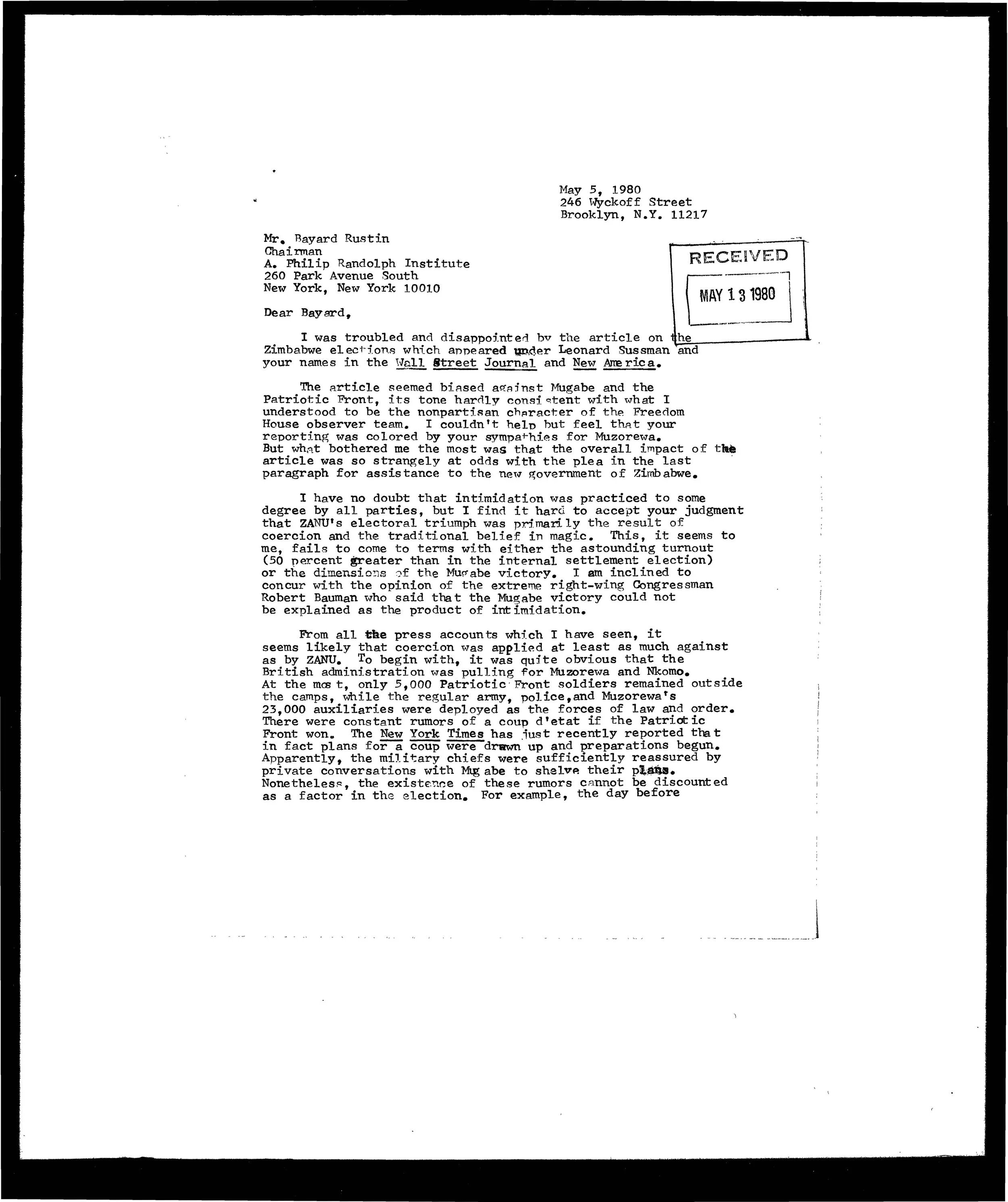
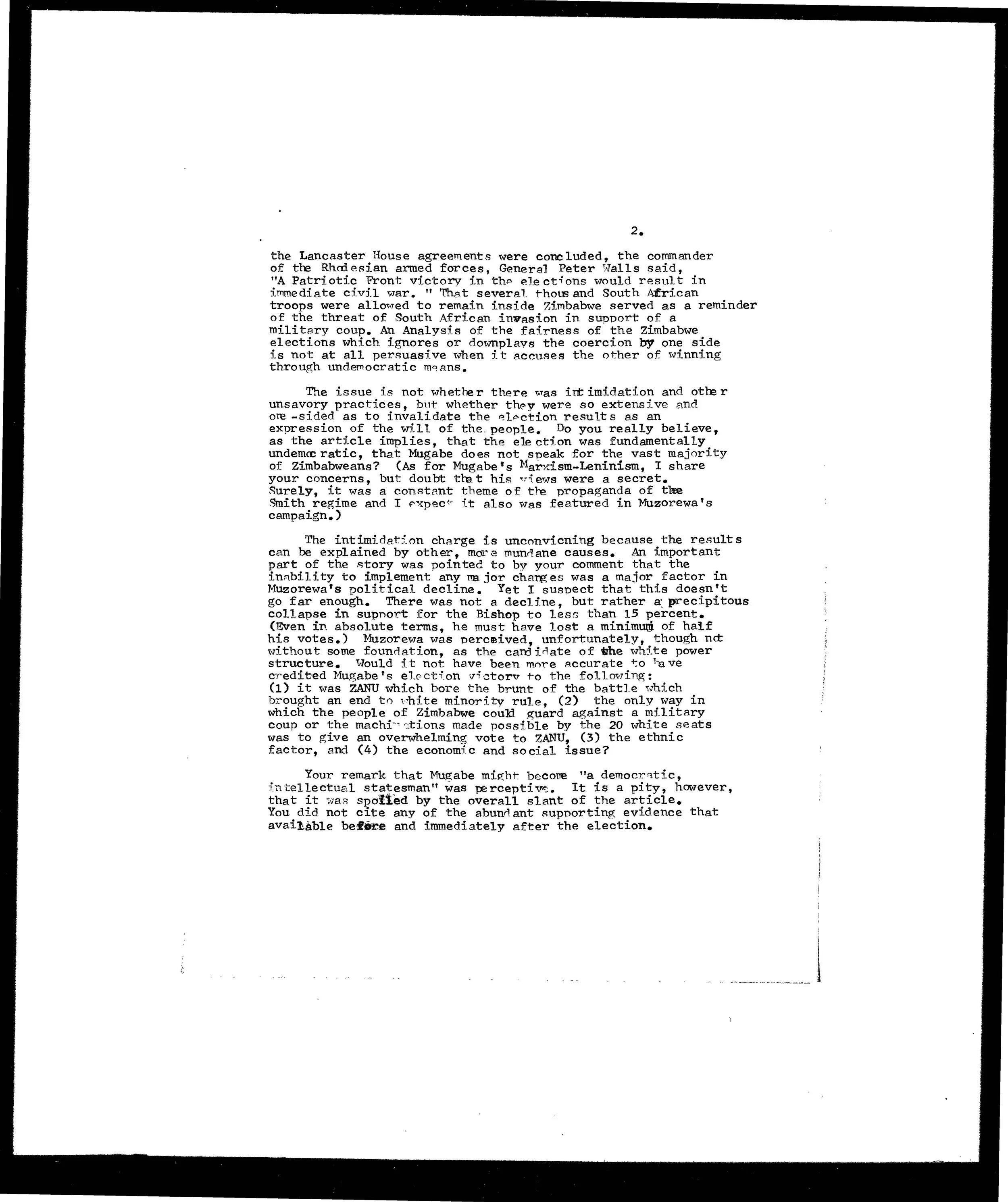
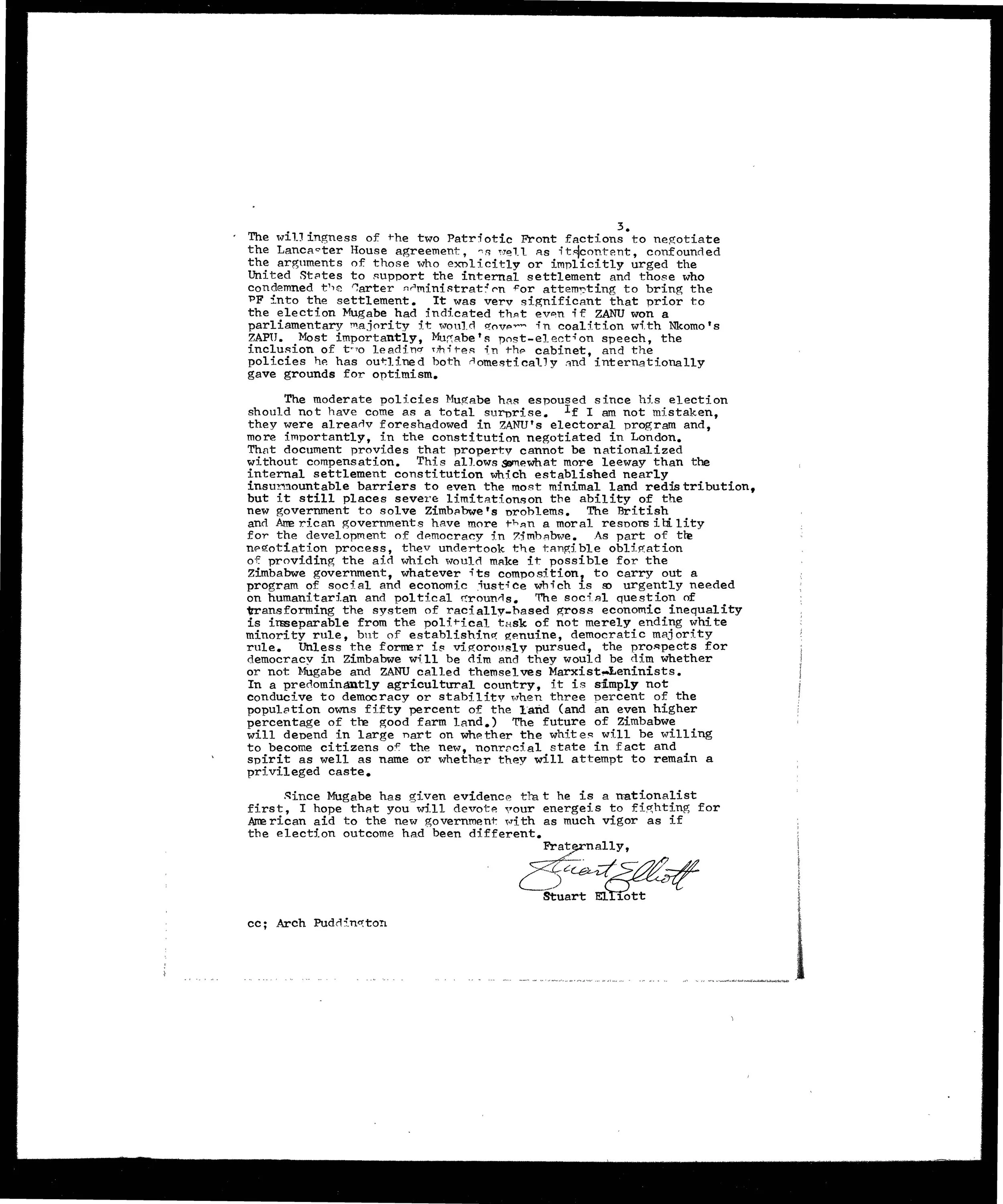
Elliott, Stuart. "Letter to Bayard Rustin regarding the Zimbabwe Democratic Transition and Freedom House Observer Reporting." May 5, 1980. Bayard_Rustin,_General_Corresp.
"Rhodesia Says Vote Turnout Reaches 57 Percent." The Washington Post, April 21, 1979. https://www.washingtonpost.com/archive/politics/1979/04/21/rhodesia-says-vote-turnout-reaches-57-percent/4024ee15-b0a8-453b-8512-22c78ee74577/.
