Description
In this column from The St. Louis American, Bayard Rustin calls residential segregation one of the most socially destructive patterns of racial bias in American culture. He breaks down how neighborhoods split along race and class lines, leaving lower-income Black Americans trapped inside underfunded enclaves of despair. Rustin specifically focuses on the fierce community resistance to a low-income public housing project under construction in the middle-class neighborhood of Forest Hills, Queens. He questions the local white residents who claim their protests are strictly about municipal services and project size, arguing that they would not be picketing in freezing weather if the building were meant for high-income families.
The column details Rustin's strong critique of a Black economic self-help organization named NEGRO, which also opposed the Forest Hills development. NEGRO argued that scattering public housing in middle-class neighborhoods was a form of "genocide" that dismantled the Black community, suggesting instead that the city spend the funds to fix up abandoned apartments in Harlem and Bedford-Stuyvesant. Rustin exposes the contradiction in this idea, explaining that those apartments were abandoned precisely because families wanted to escape the pitiless oppression, drug addiction, and high infant mortality of the slums. Echoing NAACP leader Roy Wilkins, Rustin insists that the challenge is to eliminate the ghetto rather than rebuild it, stating that integrated neighborhoods are the only way to prevent America from permanently becoming two separate and unequal nations.
Historical Context
The intense local battle over the Forest Hills public housing project in Queens, New York, reached a boiling point in the winter of late 1971 and early 1972. Led by local resident Mario Cuomo, who acted as a mediator, the neighborhood erupted in angry street protests against a city plan to build three 24-story low-income residential towers in a predominantly white, Jewish middle-class community. This fight became the nation's biggest test case for "scatter-site" housing—a progressive policy that deliberately placed public housing inside wealthy areas to break up poor inner-city slums. The massive backlash in Forest Hills showed that white northern homeowners would fiercely resist integration in their own backyards, creating a deep political crisis for the Democratic Party as working-class white voters began defecting to the conservative "law and order" movement.
This local standoff directly exposed the limits of the Civil Rights Act of 1968, famously known as the Fair Housing Act. As Rustin points out in his column, federal open housing laws originally faced huge resistance from northern politicians and only passed because Congress felt deep shame after the assassination of Dr. Martin Luther King Jr. in April 1968. The Forest Hills crisis proved that passing a federal law on paper did not stop local communities from using zoning rules, neighborhood pickets, and building size complaints to block Black and Hispanic families from moving in. By analyzing this document, we can see exactly how the front lines of the civil rights movement shifted away from basic legal access in the South and moved into a much harder economic battle over northern property values, local tax dollars, and real estate borders.
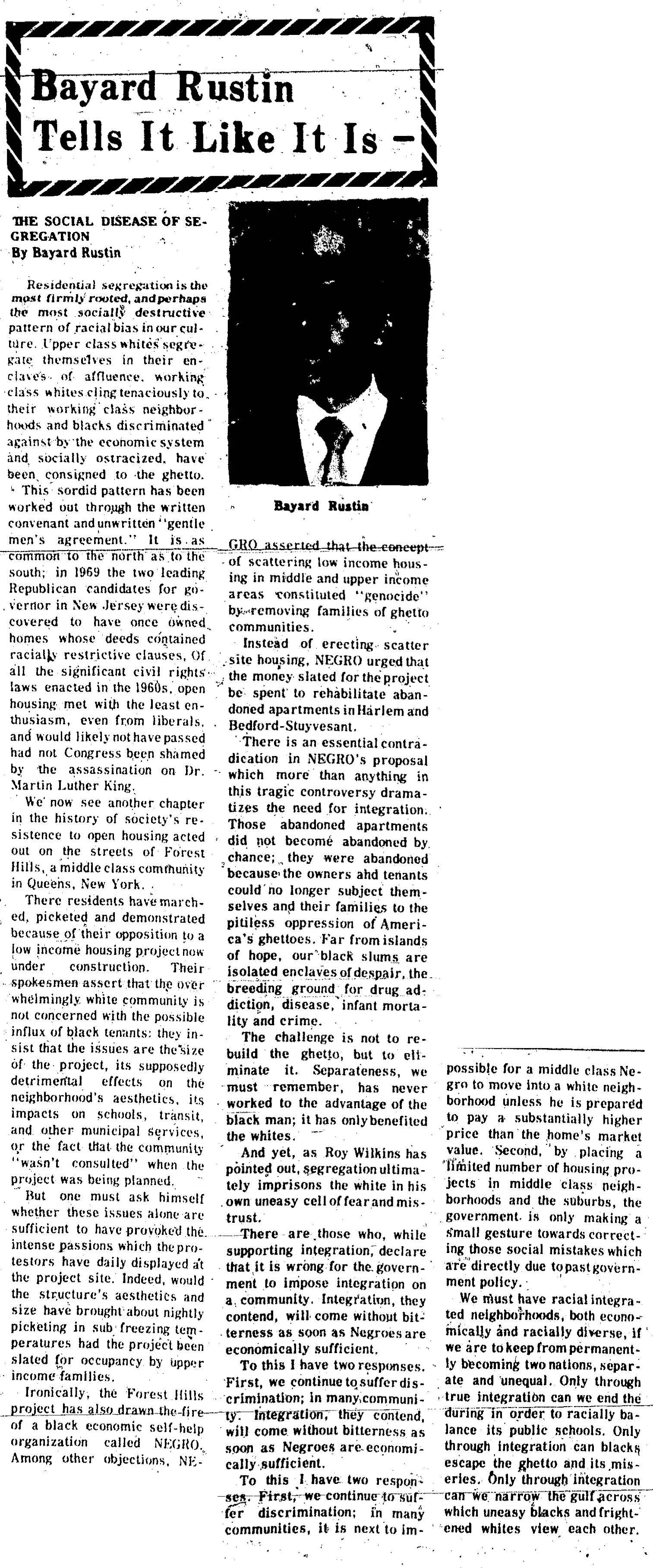
Rustin, Bayard. "Bayard Rustin Tells It Like It Is: The Social Disease of Segregation." The St. Louis American, undated [c. 1971/1972], p. 5.
