
Description
In this column written for The Louisville Defender, Bayard Rustin challenges progressive leaders and Black communities to stop avoiding the topic of crime. He argues that top conservative officials—including President Richard Nixon, Vice President Spiro Agnew, and Attorney General John Mitchell—regularly use "law and order" as a cheap slogan to exploit white fear and prejudice. However, Rustin insists that progressives must not abandon the issue, because Black citizens are the primary victims of both violent crime and organized illegal syndicates. He highlights a government study proving that the overwhelming number of crimes against whites are committed by other whites, dismantling the racist myth that crime consists mostly of Black-on-white violence.
The column details Rustin's specific requirements for a fair and effective anti-crime program, which he notes will cost billions of dollars. He strongly rejects Nixon's D.C. crime bill because it relies on cheap, repressive measures like "no-knock" police raids and holding suspects without bail. Instead, Rustin demands a massive federal funding package to construct modern correctional facilities to eliminate prison overcrowding and root out internal police corruption. Backing a proposal by Supreme Court Chief Justice Warren Burger, Rustin also calls for an entire overhaul of the court system to ensure a strict 60-day limit between arrest and trial. He concludes that the absolute bedrock of any anti-crime program must be full employment, pointing out that high crime rates are an inevitable result of a 34.9% unemployment rate among Black youth.
Historical Context
The late autumn of 1970 represented a conservative turning point in American politics, driven by the Nixon administration's highly successful execution of its "Southern Strategy." This was a political plan to win over white Southern voters and working-class Northerners by slowing down federal enforcement of civil rights laws and openly opposing court-ordered school integration.
To win over these white conservative voters, the White House launched an aggressive public relations campaign focused heavily on "law and order" and anti-protest rhetoric, which resulted in the passage of the D.C. Crime Bill that gave police dangerous "no-knock" raid powers and allowed the government to hold suspects without bail. This political environment put civil rights organizations on the defensive, as legitimate community safety concerns were routinely weaponized by the state to justify harsh police crackdowns and roll back progressive social programs.
This domestic crisis was further highlighted by a wave of violent prison rebellions across the country, fueled by terrible overcrowding, systemic racism, and the lack of basic legal rights for inmates. Traditional civil rights leaders found themselves caught in a difficult bind; they wanted to protect citizens from police brutality, but they also had to address the real economic drain of crime inside segregated urban neighborhoods. Rustin’s column captures the exact historical moment where social democracy strategists tried to reclaim the narrative from political reactionaries. By linking local crime rates directly to the absence of work and the systemic failure of the prison system, Rustin sought to turn a repressive conversation into a structural demand for jobs and institutional accountability.
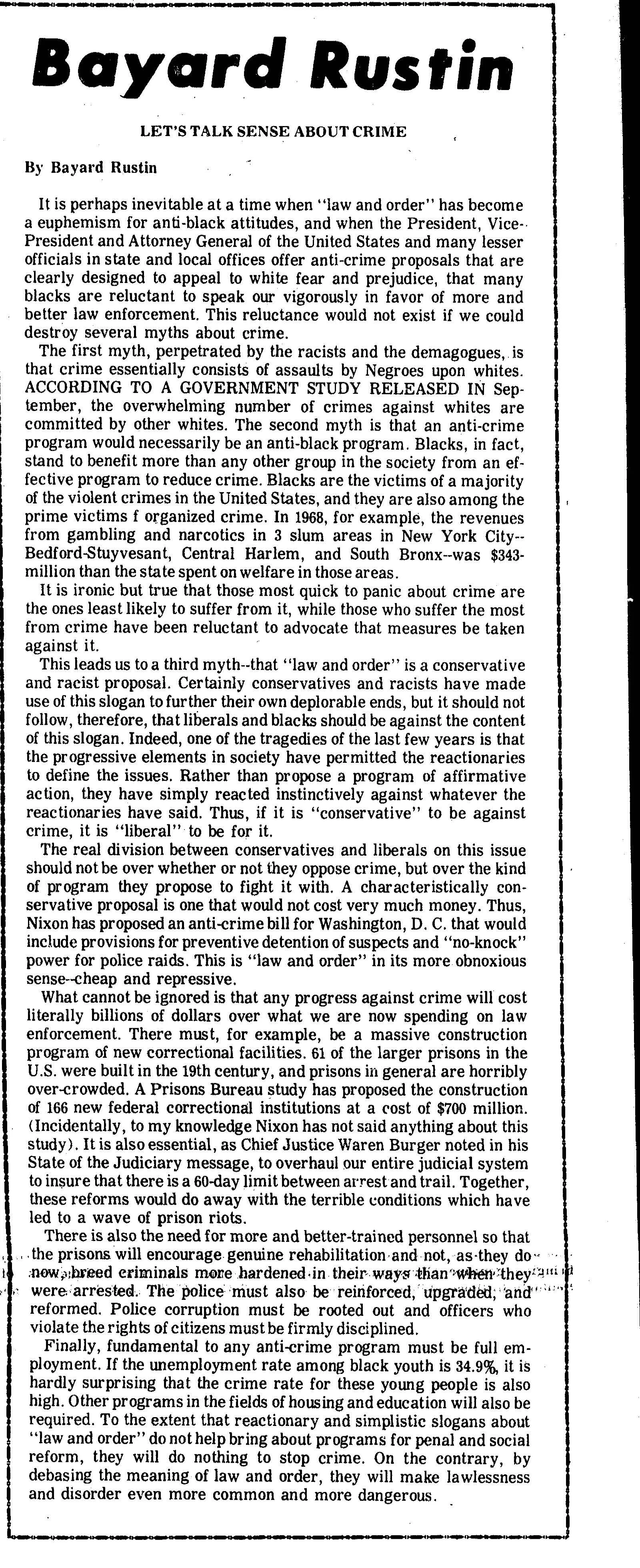
Rustin, Bayard. "Bayard Rustin Tells It Like It Is: Let's Talk Sense About Crime." The Louisville Defender, December 3, 1970, p. 4.
