
Description
In this column written for The St. Louis American, Bayard Rustin strongly condemns President Richard Nixon's recent veto of a federal minimum wage increase. Rustin calls the veto a tragic blow to the working poor, especially since Nixon's economic policies caused grocery prices to spike by 38% since 1969. He explains that under the current low minimum wage of $1.60 an hour, a family of four must spend half of their entire budget just on food, forcing many working families to eat macaroni instead of meat at dinner. He points out that this economic struggle affects nearly 15 million underpaid Americans, including domestic maids, farm laborers, garment factory workers, and low-level government employees.
The column details Rustin's political strategy for turning this legislative defeat into a victory for the civil rights movement. He points out a major irony: welfare payments in nearly half of the states are actually higher than the federal minimum wage, meaning that raising the wage to the proposed $2.20 an hour would actually trim welfare rolls. Rustin warns Black Americans that they cannot rely on public moral outrage over the unfolding Watergate scandal to fix poverty or create jobs. Instead, he presents a clear blueprint to replace the conservative politicians who blocked the bill, urging Black voters to register in large numbers and partner with labor unions to elect 23 new liberal congressmen who will fight for working people.
Historical Context
The autumn of 1973 was a time of intense political drama and severe economic hardship across the United States. The nation was gripped by a massive wave of inflation and a global energy crisis that caused the cost of living to skyrocket, hitting low-wage workers and minority communities the hardest. At the exact same time, the Nixon administration was completely paralyzed by the Watergate scandal, which exposed deep political corruption and wiretapping inside the White House, leading to a massive loss of public confidence in federal leadership.
This economic crisis became a major battleground between Congress and the White House over the direction of domestic policy. President Nixon aggressively used his executive veto power as a weapon to dismantle Great Society social programs and block liberal spending bills, arguing that capping wages was necessary to fight inflation. Rustin used this column to highlight a major change in Southern politics, noting that several Southern congressmen actually voted to override the President's veto because they were now afraid of the growing political power of newly registered Black voters in their home districts. By preserving this document, researchers can see how civil rights architects tried to channel public anger over Watergate away from simple political gossip and transform it into a disciplined, organized vote for macroeconomic justice.
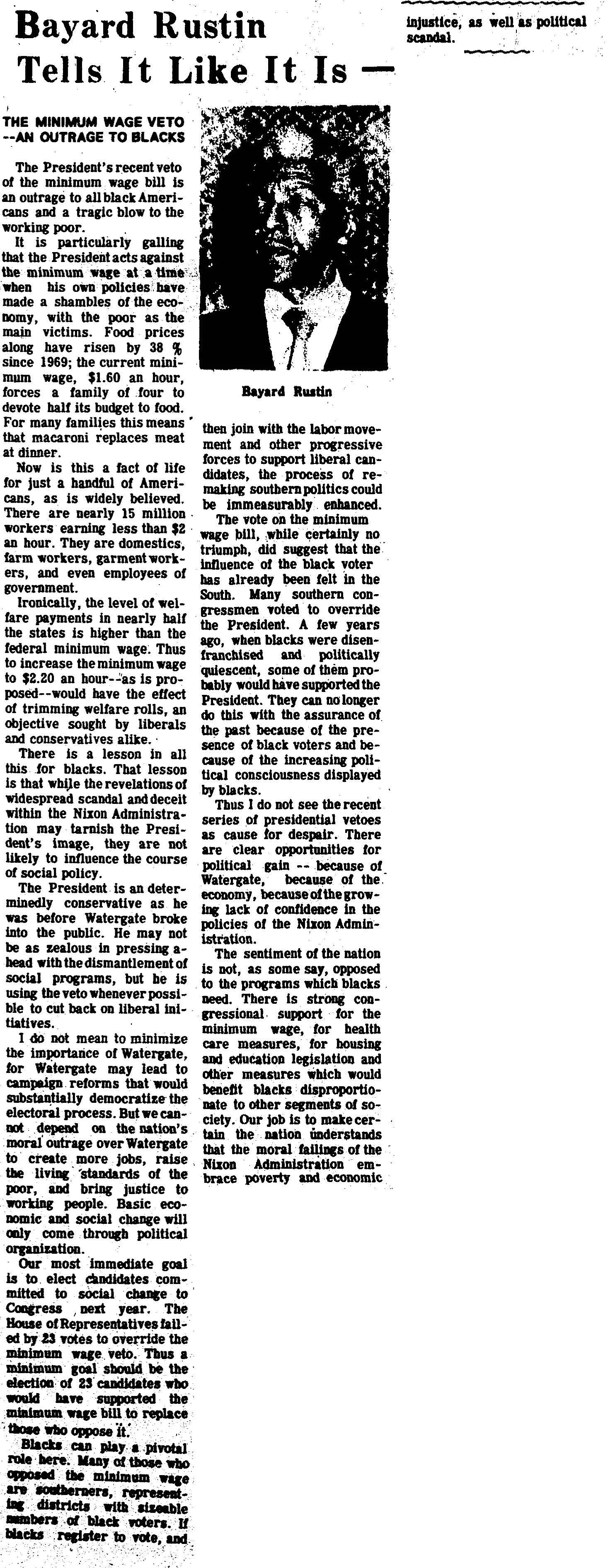
Rustin, Bayard. "Bayard Rustin Tells It Like It Is: The Minimum Wage Veto—An Outrage to Blacks." The St. Louis American, October 11, 1973, p. 5.
