
Description
In this column published in The Informer and Texas Freeman, Bayard Rustin reviews data from universities like Howard and George Washington to show that student enrollment in Black Studies courses is rapidly dropping. He argues that while many observers blame this trend on general student apathy, the deeper reality is that Black students are voluntarily rejecting these separate departments for traditional, rigorous curricula. Rustin maintains that autonomous Black Studies programs, which were originally demanded as a revolutionary gesture for racial solidarity, actually laid the groundwork for educational vehicles that perpetuate the harmful myth of minority inferiority.
The column details Rustin's agreement with Black economics professor Thomas Sowell, who argued that university quotas and separate tracks send a psychological message that Black people lack the ability to succeed without permanent charity. Rustin explains that students who genuinely wish to serve the cause of racial advancement are moving toward practical fields like medicine, law, and science rather than separate cultural courses. He acknowledges that the original demand for Black Studies was a legitimate reaction to a racist system that ignored Black history, but he accuses elite college administrators of using these separate tracks as a cheap political trick to look progressive. Rustin concludes that instead of taking the easy way out with instant solutions, universities must invest the millions of dollars necessary for compensatory programs that help students overcome real educational deficiencies caused by ghetto poverty.
Historical Context
By the winter of 1973, the intense wave of militant campus takeovers and student strikes that defined the late 1960s had largely cooled down. In response to those earlier armed protests, major universities had quickly established independent Black Studies departments and implemented early affirmative action quotas. However, by the mid-1970s, both students and civil rights intellectuals began to re-evaluate the long-term career value of these non-traditional, isolated academic tracks within a highly competitive job market.
This period of reassessment was deeply influenced by a growing intellectual conflict within the American left over the future of integration. Conservative and moderate Black scholars, most notably Thomas Sowell with his groundbreaking 1972 book Black Education: Myths and Tragedies, began publicly arguing that paternalistic university policies actively undermined competent Black professionals. Sowell's book argued that lowering academic standards, relying on racial quotas, and creating separate, un-academic Black Studies departments treated Black students as charity cases, which ultimately ruined their credibility by matching Black identity with educational incompetence. Rustin used his platform to amplify this critique, operating as an advocate for class-based social democracy. He recognized that wealthy universities were using separate cultural tracks to satisfy federal quotas on paper while completely avoiding the difficult, expensive work of fixing segregated public primary schools.
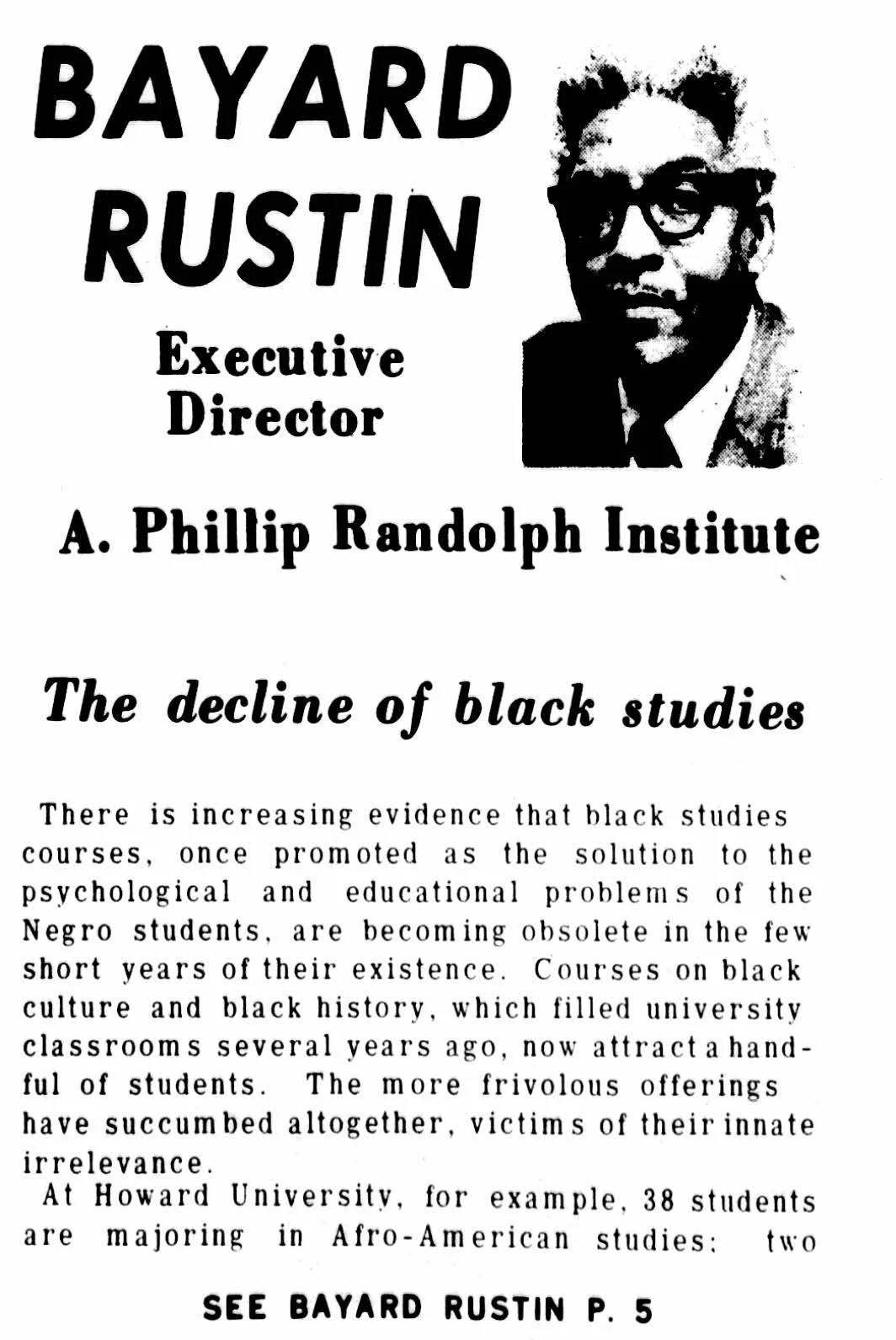
Rustin, Bayard. "Bayard Rustin Tells It Like It Is: The Decline of Black Studies." The Informer and Texas Freeman, December 1, 1973, p. 5.
