
Description
In this column published in the National Catholic Reporter, writer Anthony Bannon interviews Bayard Rustin about the shifting tactics of the civil rights movement. Rustin warns that if the federal government refuses to help the Negro poor, young people will conclude that violence is the only way to get what they need. He explains that for five years, civil rights workers in New York peacefully petitioned and negotiated to get Black workers promoted to better positions on subways and buses, but city officials completely ignored them until a massive riot broke out in Harlem. Rustin notes that the same exact pattern happened during the violent uprisings in Watts and Chicago, teaching a dangerous lesson to youth that destruction works faster than calm arbitration.
The column details Rustin's strategic desire to steer the public conversation away from emotional debates and toward structural solutions. He introduces his newly created "Freedom Budget for All Americans," an economic blueprint backed by civil rights and religious leaders to wipe out poverty over a ten-year period. The plan calls for guaranteed public works jobs, a higher minimum wage, and federal investments in integrated housing to cure the root conditions of fear and frustration. Rustin emphasizes that while spectacular street protests were useful in the past, the movement has entered a much more difficult era that requires the steady, sophisticated labor of institutional lobbying and economic reform.
Historical Context
The early days of 1967 marked a highly volatile transition point as the center of gravity for the civil rights movement shifted from the rural South to the urban North. While landmark legislation like the Civil Rights Act of 1964 dismantled legal segregation, it failed to improve the daily material conditions of the northern urban poor. Frustration over substandard housing, police brutality, and severe joblessness boiled over into massive, multi-day explosions of unrest in northern cities, catching the traditional white liberal establishment off guard.
This shifting tactical landscape became even more complex due to the heavy financial drain of the escalating Vietnam War. As the United States poured billions of dollars into military operations overseas, President Lyndon B. Johnson was forced to cut funding for his domestic anti-poverty programs, creating an environment of competitive scarcity at home. Rustin's analysis captures the precise historical window where the breakdown of the traditional civil rights coalition became visible. By publicizing his economic blueprint in a prominent religious journal, Rustin sought to convince church leaders and labor unions to unite and pressure a hostile Congress for wealth redistribution before the movement completely dissolved into separate, violent factions.
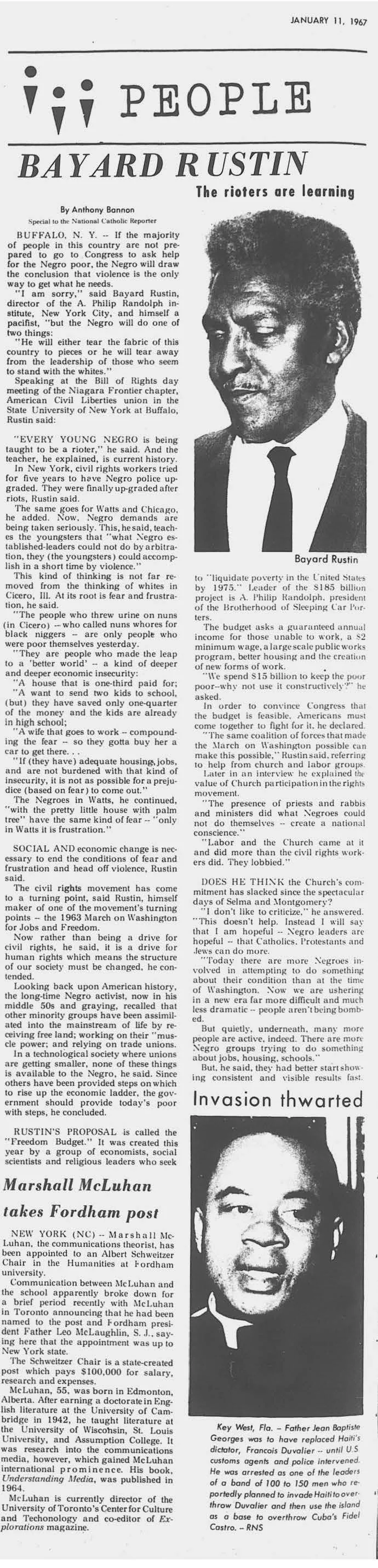
Bannon, Anthony. "Bayard Rustin: The Rioters Are Learning." National Catholic Reporter, January 11, 1967, p. 2.
