Description
In this column published in The St. Louis American, Bayard Rustin delivers a fierce critique of the 1968 Republican presidential ticket of Richard Nixon and Spiro Agnew, arguing that their primary campaign pledge of "law and order" is nothing more than a coded political promise to keep Black Americans in a subjugated place. Rustin contends that by prioritizing police repression, guns, and billy clubs over the real domestic crises of poverty, urban decay, and structural racism, Nixon and Agnew entered into an unholy political pact with the segregationist third-party candidate George Wallace. He dismisses Nixon's token promotion of "black capitalism" as a fraud, arguing that true ghetto transformation requires the federal government to act as an employer of last resort and provide massive public investments in housing, schools, healthcare, and mass transit.
The column details Rustin's urgent call for political self-defense among Black voters in the face of this conservative axis. He praises baseball legend Jackie Robinson for his courageous decision to break away from the Republican Party that year, warning all voters that casting a ballot for Nixon is functionally identical to voting for Wallace and racism. Rustin warns that the 1968 election represents a dangerous crossroads reminiscent of the post-Civil War betrayal of Reconstruction, urging every eligible Black American to register and vote in November to block the Nixon-Agnew-Wallace machine from turning back the clock on civil rights.
Historical Context
Published in late August 1968, this column captured the peak of national political tension immediately following the 1968 Republican National Convention in Miami Beach and running concurrently with the chaotic Democratic National Convention in Chicago. The 1968 presidential election was heavily shaped by a severe white racial backlash against the urban uprisings, anti-war protests, and civil rights demonstrations of the mid-to-late 1960s.
Sensing this profound social anxiety, Richard Nixon crafted a calculated "law and order" platform designed to peel away white working-class voters in the North and conservative segregationists in the South—competing directly with George Wallace’s populist third-party campaign. Civil rights leaders like Rustin recognized this conservative convergence as an existential threat to the legislative and social gains of the civil rights movement. Rustin's column serves as a powerful mobilization plea, urging the Black electorate to consolidate their voting power and reject candidates who pandered to racial animosity.
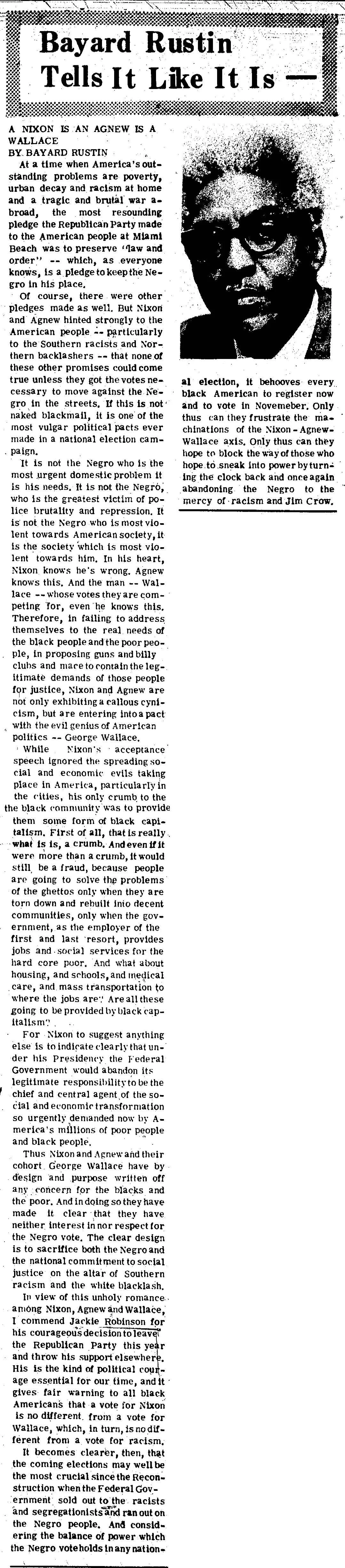
Rustin, Bayard. "Bayard Rustin Tells It Like It Is: A Nixon Is An Agnew Is A Wallace." The St. Louis American, August 29, 1968, p. 7.
